Tag: Physics

  • Newton’s Esoteric Texts About the Bible

    Newton’s Esoteric Texts About the Bible

    Advertisements

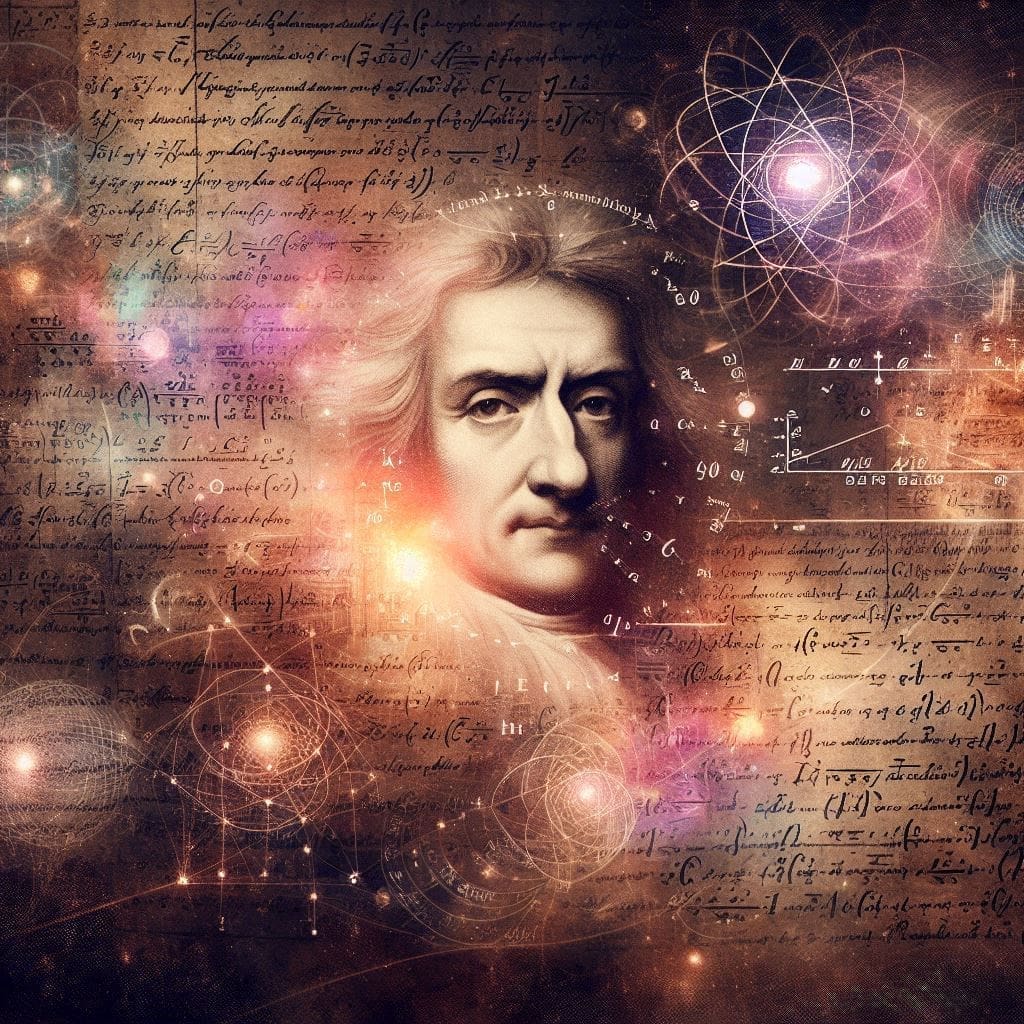
    One of the most famous of Newton’s theological works is his “Observations on the Prophecies of Daniel and the Apocalypse of St. John.” In this work, Newton attempts to decipher the complex symbolism and imagery found in the biblical books of Daniel and Revelation. He believed that these texts contained hidden meanings that could be unlocked through careful study and interpretation. Newton spent years poring over these texts, using his keen intellect and mastery of mathematics to unravel their mysteries .

    Newton’s writings on the Bible were not confined to prophecy alone. He also wrote extensively on the nature of God, the Trinity, and the relationship between science and religion. In his work “The Chronology of Ancient Kingdoms Amended,” Newton argues that the Bible contains a chronology of ancient civilisations that aligns with his own scientific calculations. He believed that by studying the Bible, one could gain insights into the history of the world and the nature of God’s plan for humanity.

    Newton’s religious beliefs were deeply intertwined with his scientific pursuits. He saw his work in physics and mathematics as a way to better understand the mysteries of the universe and the divine order that governs it. In his view, science and religion were not mutually exclusive, but rather complementary ways of seeking truth and understanding the world around us.

    While Newton’s esoteric texts about the Bible may not be as well-known as his scientific achievements, they provide valuable insight into the mind of one of history’s greatest thinkers. His writings on prophecy, theology, and the nature of God continue to fascinate and inspire scholars to this day. By delving into Newton’s spiritual explorations, we can gain a deeper appreciation for the complexity and depth of his intellectual pursuits.

  • The Observer Effect: The Role of Consciousness

    The Observer Effect: The Role of Consciousness

    Advertisements

    But what does this mean for our understanding of consciousness and the nature of reality?

    The Observer Effect has sparked much debate and speculation within the scientific community. Some argue that it points to the power of consciousness to shape our physical reality. In other words, our thoughts and intentions can influence the world around us. This idea is not new – ancient philosophical and spiritual traditions have long maintained that our consciousness plays a vital role in shaping our reality.

    One popular interpretation of the Observer Effect is the idea that consciousness is a fundamental part of the universe, rather than a byproduct of physical processes. This theory suggests that consciousness is not limited to the human brain, but is instead a universal force that permeates all of existence. In this view, our consciousness interacts with the world around us in ways that we are only beginning to understand.

    The implications of the Observer Effect are profound. If our consciousness can influence physical reality, then perhaps we have more power over our lives and our environment than we realise. Our thoughts, emotions, and intentions may have a tangible impact on the world around us. This idea is both empowering and daunting – it suggests that we are not passive observers of our reality, but active participants in its creation.

    Of course, the concept of consciousness as a fundamental force in the universe is still highly speculative. The nature of consciousness remains one of the greatest mysteries of science, and many questions remain unanswered. But the Observer Effect reminds us that our understanding of reality is limited by our perspective – by the very act of observing, we shape the world we see.

    In the end, the Observer Effect challenges us to reconsider our assumptions about the nature of consciousness and its role in the universe. Perhaps the power of our minds is greater than we ever imagined, and our thoughts have the ability to shape the very fabric of reality. It is a concept that invites us to explore the mysteries of our own consciousness, and to consider the profound implications of our place in the universe.

  • How Does the Mind Affect Matter?

    How Does the Mind Affect Matter?

    Advertisements

    One of the most well-known ideas about the mind-matter connection is the concept of consciousness creating reality. This idea suggests that our thoughts and beliefs have the power to shape the physical world around us. In other words, our perception of reality is directly influenced by our thoughts and feelings. This theory is often associated with the law of attraction, which states that like attracts like. According to this perspective, if you focus on positive thoughts and emotions, you will attract positive experiences and outcomes in your life.

    Quantum physics has also provided some intriguing insights into the mind-matter relationship. The famous double-slit experiment, for example, showed that particles can behave as both waves and particles depending on the observer’s conscious presence. This suggests that our consciousness has a direct impact on the behaviour of subatomic particles. Some scientists have even proposed that consciousness is a fundamental aspect of the universe, existing alongside space, time, and matter.

    Another theory about the mind-matter connection is the idea of mind over body. This theory suggests that our thoughts and beliefs can influence our physical health and well-being. Numerous studies have shown that practices like meditation, visualisation, and positive thinking can have a significant impact on our physical health. For example, research has shown that mindfulness meditation can reduce stress, lower blood pressure, and improve overall health.

    While the exact mechanisms of how the mind affects matter are still not fully understood, there is mounting evidence to suggest that our consciousness plays a crucial role in shaping our reality. Whether through the power of intention, quantum entanglement, or mind-body connections, it is becoming increasingly clear that our thoughts and beliefs have a profound impact on the physical world around us.

    In conclusion, the mind-matter relationship is a complex and fascinating topic that continues to intrigue scientists and philosophers alike. While there is still much to learn about how our consciousness influences the physical world, the evidence suggests that our thoughts and beliefs can have a powerful impact on our reality. By cultivating a positive mindset, practising mindfulness, and embracing the interconnectedness of mind and matter, we can harness the power of our consciousness to create the reality we desire.

  • The Psychology of Entanglement Theory

    The Psychology of Entanglement Theory

    Advertisements

    One of the key aspects of entanglement theory is that it challenges the conventional idea of separateness and individuality. In the classical Newtonian view of the world, we are all seen as distinct and separate beings, with our own individual thoughts, feelings, and experiences. However, entanglement theory suggests that at a fundamental level, we are all interconnected and interdependent, much like the entangled particles in quantum physics.

    This idea of interconnectedness has profound implications for our understanding of human psychology. It suggests that our thoughts and emotions are not solely our own, but are influenced by the interconnected web of relationships and interactions that we have with others. This can help explain phenomena such as empathy, intuition, and synchronicity, where we seem to pick up on the thoughts and feelings of others even when they are not explicitly communicated.

    Entanglement theory also raises questions about the nature of consciousness and identity. If our thoughts and emotions are influenced by the entanglement of particles, then what does that mean for our sense of self? Are we truly separate individuals, or are we just nodes in a larger network of interconnected consciousness?

    Another interesting aspect of entanglement theory is the idea of non-locality, where entangled particles can affect each other instantaneously, regardless of the distance between them. This challenges our conventional understanding of cause and effect, suggesting that there may be mechanisms at work in the universe that transcend time and space.

    Overall, the psychology of entanglement theory raises fascinating questions about the nature of reality, consciousness, and human experience. It challenges us to rethink our assumptions about separateness and individuality, and consider the possibility that we are all interconnected in ways that we are only beginning to understand. By exploring these ideas, we may gain a deeper understanding of ourselves and our place in the universe.

  • Albert Einstein’s Ideas About God

    Albert Einstein’s Ideas About God

    Advertisements

    Einstein was often asked about his beliefs in God, and his answers were always thought-provoking. While he did not adhere to a specific religious tradition, Einstein did believe in a higher power or cosmic intelligence that governed the universe. He once famously said, “I believe in Spinoza’s God who reveals himself in the orderly harmony of what exists, not in a God who concerns himself with the fates and actions of human beings.”

    Einstein’s conception of God was not the traditional personal deity that many people believe in. Instead, he saw God as a unifying force that underlay all of physical existence. He believed that the laws of nature and the order of the universe were evidence of a higher intelligence at work.

    Einstein’s ideas about God were deeply rooted in science and reason. He saw no conflict between his scientific pursuits and his belief in a higher power. In fact, he often argued that science and religion were not mutually exclusive, but rather two different ways of understanding the world.

    Einstein’s views on God were not easily defined or categorised. He believed in a God that transcended the limitations of human understanding and perception. His ideas were complex and nuanced, reflecting his own deep thinking and contemplation of the mysteries of the universe.

    In a world where science and religion are often seen as opposing forces, Einstein’s ideas about God offer a unique perspective. He reminds us that there is more to the universe than what we can see and measure, and that there may be a higher intelligence at work that we cannot fully comprehend.

    Whether or not one agrees with Einstein’s ideas about God, it is clear that his beliefs were deeply held and thoughtfully considered. His insights continue to challenge and inspire us to think more deeply about the nature of existence and the mysteries of the universe.

  • Crushing Forces: The Phenomenon of Gravitational Compression

    Crushing Forces: The Phenomenon of Gravitational Compression

    Advertisements

    One of the most well-known examples of gravitational compression is the formation of a neutron star. When a massive star reaches the end of its life and explodes in a supernova, the core of the star can collapse under its own gravity, forming a super dense ball of neutrons. This compression causes the star to shrink to a size of only a few kilometres across, while still retaining the mass of the original star. This incredibly dense object has a gravitational pull so strong that even light cannot escape from it, making it one of the most extreme objects in the universe.

    Another example of gravitational compression is the formation of a black hole. When a massive star collapses under its own gravity, it can create a singularity – a point of infinite density and zero volume. This singularity is surrounded by an event horizon, beyond which no light or matter can escape. The immense gravitational pull of a black hole is so strong that it distorts space and time around it, creating a gravitational field that can warp and bend light, making it appear to observers as if the black hole is “sucking in” everything around it.

    Gravitational compression is not limited to massive stars and black holes – it can also occur on a smaller scale with objects like asteroids and comets. When a small body with enough mass collides with another object, the force of the impact can cause it to compress under its own gravity, forming a denser and possibly fractured object. This process can also generate heat and create new materials through chemical reactions, leading to the formation of new minerals and compounds.

    Overall, gravitational compression is a powerful force that plays a crucial role in shaping the universe as we know it. From the formation of neutron stars and black holes to the evolution of smaller celestial bodies, this process has a profound impact on the structure and composition of the cosmos. By studying gravitational compression, scientists can gain a better understanding of the forces at work in the universe and the intricate processes that govern the evolution of celestial objects.

  • The Invisible Force: Understanding Gravitational Tension

    The Invisible Force: Understanding Gravitational Tension

    Advertisements

    One of the most famous examples of gravitational tension is the force that keeps planets in orbit around the sun. The sun’s massive gravitational pull keeps the planets in their respective orbits, preventing them from drifting off into space. This tension also keeps the moon in orbit around the Earth, causing the tides to rise and fall.

    Gravitational tension also plays a crucial role in the formation of galaxies and other large structures in the universe. The force of gravity causes matter to clump together, forming stars, planets, and other celestial bodies. Without this tension, the universe would be a barren wasteland, devoid of any structure or organisation.

    In everyday life, we can see the effects of gravitational tension all around us. When we drop a ball, it falls to the ground because of the force of gravity pulling it downward. When we jump, we feel the pull of gravity bringing us back to the ground. Even the tides in the ocean are caused by the gravitational tension between the Earth, the moon, and the sun.

    Understanding gravitational tension is essential for scientists and engineers to predict the motion of objects in space and on Earth. By studying the force of gravity, we can better understand how the universe works and how to navigate it safely.

    In conclusion, gravitational tension is a powerful force that shapes the universe and keeps everything in its place. Without it, the universe would be a vastly different place, and life as we know it would not exist. So next time you look up at the stars, remember the force of gravity that keeps them in their place, and marvel at the wonders of the universe.