Tag: Criminology

  • I Stand Against The Modern Romanticisation of Pederasty, and Other Sexual Vicissitudes

    I Stand Against The Modern Romanticisation of Pederasty, and Other Sexual Vicissitudes

    Advertisements

    I lay in bed staring at the ceiling. Too many thoughts rush through my mind. Too many memories of injustices which might never end. A repertoire of traumas that I can only wish I could shake off. But I cannot; the scar that sexual abuse left in my life cannot be erased. It cannot be healed. It cannot be forgotten. It haunts me every day…

    Subscribe to get access

    Read more of this content when you subscribe today.

  • Venezuela: Liberation or New Cage?

    Venezuela: Liberation or New Cage?

    Advertisements

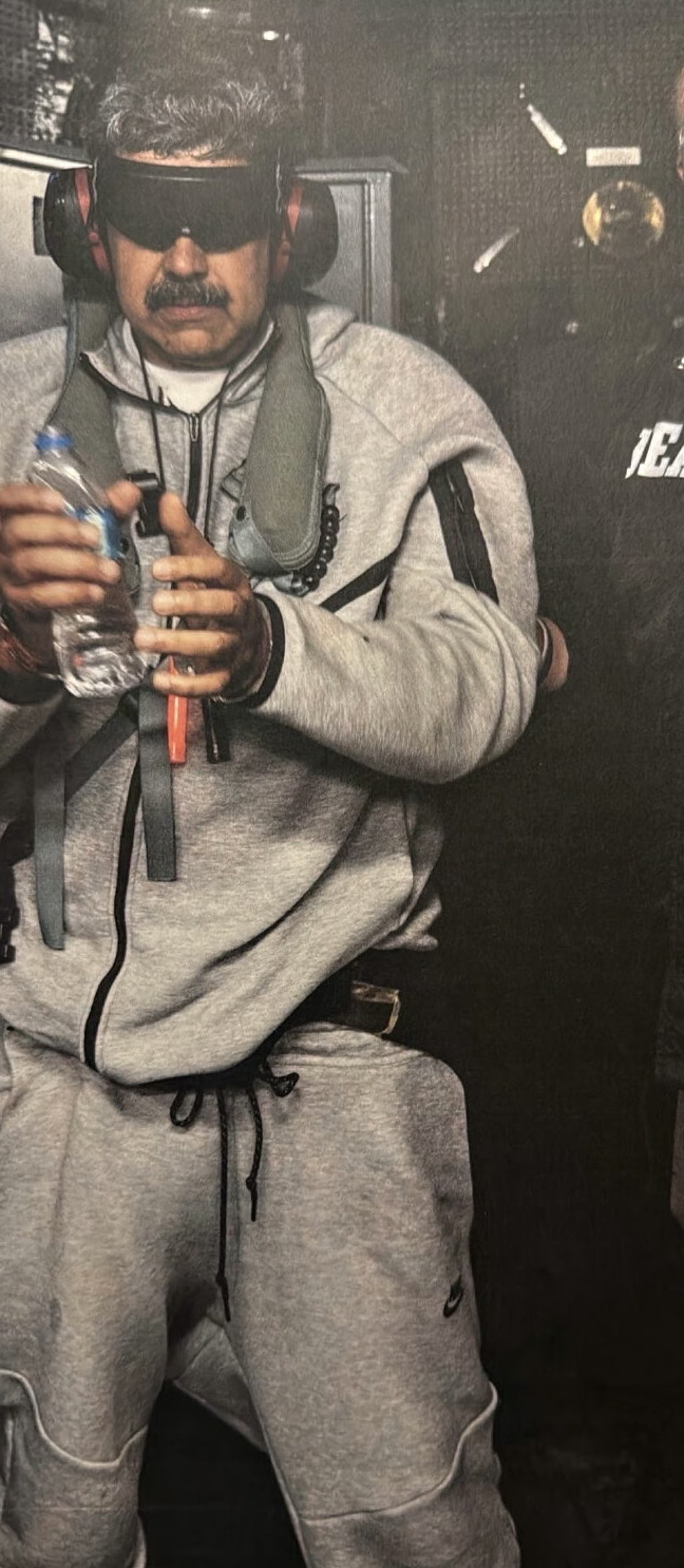
    The event spread like wildfire on the 3rd January, 2026. Maduro’s image wearing headphones and a blindfold became viral to the point that the Nike tracksuit he was wearing sold out fast (The New York Times, 2026). The year began with a bang, and a schism. Many took to the streets to celebrate the downfall of Maduro, a figure who was perceived by many as a dictator who ruled the country for nearly 13 years since 2013 (Encyclopedia Britannica, 2026). Others, however, took to the streets to protest and demand that their President be returned, condemning the US as an imperialist and neocolonialist state.

    The Venezuelan People March Against The United States

    Subscribe to get access

    Find out the details when you subscribe today.

  • Darklake Farm in Plymouth is Darker than Black

    Darklake Farm in Plymouth is Darker than Black

    Advertisements

    Subscribe to get access

    Read more of this content when you subscribe today.

  • Are Asylum Seekers Invading the UK? A Forensic Analysis of Migration Narratives

    Are Asylum Seekers Invading the UK? A Forensic Analysis of Migration Narratives

    Advertisements

    The notion of asylum seekers invading the UK evokes militaristic imagery, often amplified in political discourse by the prospect of migration posing a national security threat. This rhetoric surged post-Brexit, with terms like “invasion” used by figures such as former Prime Minister Boris Johnson to describe small boat arrivals (The Guardian, 2025a ). Forensic profiling reveals this as hyperbolic framing rather than empirical reality. Nevertheless, it goes without saying: Many Britons feel threatened under a perceived unpredictability, a sense of impending danger rapidly growing en masse. They feel they cannot be themselves in their own land, and this triggers fears of being ambushed.

    Under international law, including the 1951 Refugee Convention, seeking asylum is a legal right, not an illegal act; the illegality lies in irregular entry methods, not the claim itself (Refugee Council, n.d.). And the horror lies in the routinary exploitation of a hospitable jurisdiction, carried out by those who arrive by unauthorised means, and with nefarious intentions. As time passes, their sense of entitlement grows, and criminal records soar.

    Read more…: Are Asylum Seekers Invading the UK? A Forensic Analysis of Migration Narratives

    Subscribe to get access

    Read more of this content when you subscribe today.

    References

    BBC (2025a) How many people cross the Channel in small boats? Available at: https://www.bbc.com/news/articles/c8xgkx20dyvo (Accessed: 17 September 2025).

    BBC (2025b) Key takeaways from grooming gangs report. Available at: https://www.bbc.com/news/articles/cx2r2ejlvm1o (Accessed: 17 September 2025).

    BBC (2025c) ‘People are angry’: Behind the wave of asylum hotel protests. Available at: https://www.bbc.com/news/articles/c4gerg74y71o (Accessed: 17 September 2025).

    BBC (2025d) locals want asylum hotels shut, but are shared houses the answer? Available at: https://www.bbc.com/news/articles/c07vn1y2jz2o (Accessed: 17 September 2025).

    CNN (2025) How British hotels became a flashpoint for a furious immigration debate. Available at: https://www.cnn.com/2025/08/22/uk/british-hotels-asylum-seekers-immigration-epping-latam-intl (Accessed: 17 September 2025).

    Durham University (2025) How the UK became dependent on asylum hotels. Available at: https://www.durham.ac.uk/research/current/thought-leadership/2025/07/how-the-uk-became-dependent-on-asylum-hotels/ (Accessed: 17 September 2025).

    GOV.UK (2025a) Small boat arrivals: last 7 days. Available at: https://www.gov.uk/government/publications/migrants-detected-crossing-the-english-channel-in-small-boats/migrants-detected-crossing-the-english-channel-in-small-boats-last-7-days (Accessed: 17 September 2025).

    GOV.UK (2025b) How many people claim asylum in the UK? Available at: https://www.gov.uk/government/statistics/immigration-system-statistics-year-ending-june-2025/how-many-people-claim-asylum-in-the-uk (Accessed: 17 September 2025).

    GOV.UK (2025c) Baroness Casey’s audit of group-based child sexual exploitation and abuse. Available at: https://www.gov.uk/government/speeches/baroness-caseys-audit-of-group-based-child-sexual-exploitation-and-abuse (Accessed: 17 September 2025).

    Home Office Media Blog (2025) Latest statement in response to small boat crossings. Available at: https://homeofficemedia.blog.gov.uk/2025/09/07/latest-statement-in-response-to-small-boat-crossings/ (Accessed: 17 September 2025).

    House of Commons Library (2025) Asylum statistics. Available at: https://commonslibrary.parliament.uk/research-briefings/sn01403/ (Accessed: 17 September 2025).

    ITV News (2025) ‘A system meltdown’: Why the use of asylum hotels is rising. Available at: https://www.youtube.com/watch?v=Rstr6-5VuX4 (Accessed: 17 September 2025).

    Migration Observatory (2025a) Asylum and refugee resettlement in the UK. Available at: https://migrationobservatory.ox.ac.uk/resources/briefings/migration-to-the-uk-asylum/ (Accessed: 17 September 2025).

    Migration Observatory (2025b) People crossing the English Channel in small boats. Available at: https://migrationobservatory.ox.ac.uk/resources/briefings/people-crossing-the-english-channel-in-small-boats/ (Accessed: 17 September 2025).

    Migration Observatory (2025c) [PDF] BRIEFING – People crossing the English Channel in small boats. Available at: https://migrationobservatory.ox.ac.uk/wp-content/uploads/2023/07/2025-Briefing-People-crossing-the-English-Channel-in-small-boats.pdf (Accessed: 17 September 2025).

    Migration Observatory (2025d) Asylum accommodation in the UK. Available at: https://migrationobservatory.ox.ac.uk/resources/briefings/asylum-accommodation-in-the-uk/ (Accessed: 17 September 2025).

    Migration Watch UK (2025) Channel Crossing Tracker. Available at: https://www.migrationwatchuk.org/channel-crossings-tracker (Accessed: 17 September 2025).

    PBS (2025) Asylum-seekers can remain in UK hotel after government wins appeal. Available at: https://www.pbs.org/newshour/world/asylum-seekers-can-remain-in-uk-hotel-after-government-wins-appeal-to-keep-it-open (Accessed: 17 September 2025).

    Politico (2025) ‘Damning’ UK child grooming report finds authorities feared being called racist. Available at: https://www.politico.eu/article/uk-child-grooming-racist-report-house-of-commons-elon-musk/ (Accessed: 17 September 2025).

    Refugee Council (n.d.) The truth about asylum. Available at: https://www.refugeecouncil.org.uk/stay-informed/explainers/the-truth-about-asylum/ (Accessed: 17 September 2025).

    Refugee Council (2025) Top facts from the latest statistics on refugees and people seeking asylum. Available at: https://www.refugeecouncil.org.uk/stay-informed/explainers/top-facts-from-the-latest-statistics-on-refugees-and-people-seeking-asylum/ (Accessed: 17 September 2025).

    Reuters (2025) UK wins court ruling to keep asylum seekers in hotel but risks angry response. Available at: https://www.reuters.com/world/uk/uk-wins-court-ruling-keep-asylum-seekers-hotel-risks-angry-response-2025-08-29/ (Accessed: 17 September 2025).

    Sky News (2025) Asylum seekers come face-to-face with migrant hotel critics. Available at: https://news.sky.com/story/what-did-we-do-wrong-asylum-seekers-come-face-to-face-with-migrant-hotel-critics-13428610 (Accessed: 17 September 2025).

    Telegraph (2025) Asylum seekers behind new grooming gang cases. Available at: https://www.telegraph.co.uk/politics/2025/06/16/asylum-seekers-behind-new-grooming-gang-cases/ (Accessed: 17 September 2025).

    The Guardian (2025a) The Guardian view on asylum myths: when truth loses, scapegoating takes over. Available at: https://www.theguardian.com/commentisfree/2025/aug/05/the-guardian-view-on-asylum-myths-when-truth-loses-scapegoating-takes-over-britains-migrant-debate (Accessed: 17 September 2025).

    The Guardian (2025b) Channel crossings in 2025 pass 25,000 – faster than any year since records began. Available at: https://www.theguardian.com/uk-news/2025/jul/31/channel-crossings-25000-faster-year-record-asylum-seekers-migrants (Accessed: 17 September 2025).

    The Guardian (2025c) Police to collect ethnicity data for all cases of child sexual abuse. Available at: https://www.theguardian.com/uk-news/2025/jun/16/police-ethnicity-nationality-data-grooming-gangs (Accessed: 17 September 2025).

    The Sun (2025) Long-awaited Casey grooming gang review links illegal migration with exploitation of British girls. Available at: https://www.the-sun.com/news/14474393/casey-review-links-grooming-gangs-to-illegal-migration/ (Accessed: 17 September 2025).

    The Times (2025) Asylum seekers who commit child sex crimes ‘a border security issue’. Available at: https://www.thetimes.com/uk/politics/article/asylum-seekers-child-sex-offences-swd90xmqx (Accessed: 17 September 2025).

    UK Parliament (2025) [PDF] Asylum statistics. Available at: https://researchbriefings.files.parliament.uk/documents/SN01403/SN01403.pdf (Accessed: 17 September 2025).

  • I Am Attracted To and I Have Empathy Towards Dangerous Souls at Penance

    I Am Attracted To and I Have Empathy Towards Dangerous Souls at Penance

    Among the many ills of Colombia, were sexual deviations. And that’s how my ‘career’ into forensic psychoanalysis began when I was only six years old.

    Advertisements
    (more…)
  • Escaping Coercive Control & Emotional Abuse: My Journey to Emancipation

    Escaping Coercive Control & Emotional Abuse: My Journey to Emancipation

    Advertisements

    Our relationship began with hope and shared interests, a bright spark that ignited the flame of connection between us. We connected deeply over theology, spending countless hours immersed in fascinating discussions about topics like politics, kabbalah, and history; exploring the rich tapestry of our cultural heritage. I envisioned dreams of a happy future together, one where we’d grow, support each other, and build a life rooted in mutual respect and understanding. I became very illusioned. We were not just partners; we were companions on an intellectual journey, sharing our hearts and minds.

    However, as time passed, those idyllic dreams were overshadowed by a pattern of behaviour that I now recognise as coercive control—a term I learned through the invaluable support of Jewish Women’s Aid (JWA) and the dedicated First Response team in Plymouth, where I live. This gradual realisation was heart-wrenching, as I began to understand that what I perceived as normal had morphed into something sinister. The Devon & Cornwall Police have also been increasingly concerned, actively advising me to extricate myself early from this situation, as his behaviour exhibited early signs of this insidious form of abuse that can entrap individuals in a cycle of manipulation and fear. The journey towards awareness has been painful but necessary, shedding light on the true nature of our interactions and empowering me to reclaim my sense of self.

    The first red flag was his pattern of withdrawing contact—what I later called the “5/2 cycle.” Every week, he’d started to disappear for two nights, with zero communication, only to return for five nights of warmth and affection. Those two nights of silence, like one instance earlier this month, left me anxious and hurt, wondering what I’d done wrong; my mind racing with self-doubt, but when he’d return with kind words, it was like a wave of relief. I didn’t realise then that this push-pull dynamic was a control tactic, designed to keep me on edge, craving his affection while fearing his withdrawal. JWA later explained that this intermittent reinforcement is a hallmark of coercive control, creating an emotional dependency that’s hard to break.

    His behaviour escalated beyond withdrawal, which some call “ghosting”. He began gaslighting me, making me question my reality. In one WhatsApp rant, he called me “overdramatic” and “hostile”, blaming me for his actions and claiming I’d “misled” him, even though I’d only tried to communicate my needs. I’d always been clear and literal, especially because I knew he struggled with emotional processing, but he turned my openness against me. When I blocked him on WhatsApp to protect myself temporarily, he moved to Xbox, starting with love-bombing messages—“I miss you”—before quickly shifting to demands and threats. He insisted I return his belongings, accusing me of “holding them hostage,” and warned me not to “escalate this and cause unnecessary trouble.” The most chilling moment came when I told him I’d block him on Xbox due to his violation of my boundaries—his immediate reply was “Big mistake,” a direct threat that left me terrified.

    The threats didn’t stop there. Early in our relationship, he warned me never to start a legal battle with him, claiming I’d lose, and threatened to “air all kinds of private things” if I mentioned our conversations about course-related books to our Rabbi. Those conversations were sacred to me—a space where I found solace in my faith and intellectual curiosity—but he turned them into a weapon, threatening to shame and control me. I felt violated, as if a part of my identity had been invaded. I later learned from JWA that this, too, was coercive control: using my vulnerabilities to intimidate and silence me.

    A more public form of his abuse came through a smear campaign. Just 10-15 minutes after his “Big mistake” threat, he posted a video on Facebook inferring I was too clingy. The irony was painful—I’d been the one asking for space, setting boundaries, and blocking him to protect myself, yet he twisted the narrative to humiliate me. That post felt like a deliberate attempt to discredit me to others and make me the problem, when I was the one suffering from his actions. I blocked him on Facebook immediately, but the damage was done—I was left fearing what else he might say, how he might further distort my reality to the world.

    It took me a while to identify and process this abuse. I was in denial, clinging to the hope that he could change, especially because I understood his struggles—his neurodivergence, his issues with alcohol, his difficult family dynamics. I don’t give up on people easily, and I genuinely loved him. I thought I could help him stop drinking, stop the abusive behaviors, and build the future I’d dreamed of. We even started couple’s therapy, hoping to heal together, but that hope was shattered when he became abusive in our therapy chat group. He called me “disgusting” for showering only 2-3 times per week during the winter—a negative symptom of my depression linked to schizophrenia—and labelled me a “deluded psychotic nutcase.” Those words cut deep, attacking my mental health in a space meant for healing. It was the final straw, confirming what everyone had warned me about: he was unlikely to change, and his behaviour was only getting worse.

    The traumas he’s left me with are heavy. I feel like love has become a demonic possession—a metaphor I’ve used to describe the overwhelming, consuming nature of our relationship. The 5/2 cycle, the gaslighting, the threats—they created a constant state of fear and anxiety, as if I was under a spell I couldn’t break. I’d wake up wondering if he’d disappear again, or if he’d escalate his threats, maybe even show up unannounced. His words in therapy, attacking my schizophrenia, have left me with a deep sense of shame and self-doubt, even though I know my symptoms aren’t my fault. I feel violated, not just emotionally but intellectually—our shared passion for theology, once a source of joy, now feels tainted by his threats to expose private details, and by his indirect harassment through common groups. I’m grieving the loss of the future I’d envisioned, and I’m angry at myself for not seeing the signs sooner, despite my background in forensic psychology.

    I met with the Devon & Cornwall Police, and they made the Clare’s Law disclosure. It confirmed that what I already knew was true. Whilst I am not allowed to express the details of his records, I can advise that all women who suspect their partners are abusive, make such a request. Why? Because it helped me to see that what I was perceiving was correct, that I am not crazy, and that I am not the first victim. However, I hope I am the last.

    I never imagined I’d be in this position again. Coercive control is insidious—it creeps in slowly, disguised as love, until you’re too entangled to see clearly. It took me months to recognise the patterns, to stop making excuses for him, to stop blaming myself. I was in denial, hoping my love and understanding could change him, but I’ve learned a painful lesson: I can’t fix someone who doesn’t want to change, and I can’t sacrifice my safety for hope.

    Leaving him for good was my reclaiming of power. I’ve blocked him everywhere, ensuring he can’t contact me further. I’ve ended couple’s therapy—his abuse in that space made it clear it wasn’t safe—and I’m focusing on individual healing with the support of JWA, my mental health team, and the First Response team. I’m proud of myself for remaining constructive, for never stooping to his level with derogatory terms, for holding onto my empathy even as he hurt me. I loved him, but he used me, admitting he was only with me because I was good for his mental and physical health. That betrayal stings, but it also clarifies what I deserve: a love built on trust, respect, and safety.

  • Digital Antisemitism Has Become Normal Globally

    Digital Antisemitism Has Become Normal Globally

    Advertisements

    The information warfare is very real. I’ve had to block people who seemed to harass me simply for being into Judaism. I have witnessed how Palestinian propaganda is Goebbelian in nature , and yet, barely anyone seems to be educated enough to tell when information is weaponised. People will let the media manipulate their emotions; and often the new propaganda overrides the education they received at school about the Nazi Holocaust. Despite all efforts, the public have easily become antisemitic really fast. Politicians are making profits out of war.

    One of the main reasons for the increase in digital antisemitism is the anonymity and accessibility of the internet. People can hide behind pseudonyms and fake profiles while spreading hateful messages without facing any consequences. This has emboldened individuals and groups to express their antisemitic views more openly, leading to a normalisation of hate speech that can quickly spread and influence others.

    People think that October 7th was not brutal, but it certainly was, marking a pivotal moment that shook the foundations of our beliefs about safety and humanity. Then we have some Christians claiming they are the “new Israel” and invalidating Jewish people’s existence, a stance that not only marginalises an entire community but also deepens societal divides. The world is hectic, mad, and dangerous as never before; political tensions are rising, and misinformation spreads like wildfire, leaving many in a state of confusion and fear. These are dark ages, where compassion seems to be overshadowed by strife, and the basic tenets of coexistence are challenged daily, urging us to reconsider how we engage with one another in a rapidly changing landscape.

    Social media platforms, in particular, have become breeding grounds for antisemitism. Posts demonising Jews or denying the Holocaust are not only allowed to stay up but often go viral, reaching a wide audience and perpetuating harmful stereotypes. Algorithms that prioritise engagement and controversial content only exacerbate the issue, pushing antisemitic messages further into the mainstream. It is happening in Telegram group chats. There are horrible stickers which demonise the Jew, and these cartoons are similar to Nazi cartoons published just before World War II. A decade ago, all this would have been unacceptable. But since jihadist propaganda spread, it has shockingly become hypernormalised to hate the Jewish people

    Rabbi Shraga Simmons (Aish, 2024) explained how digital platforms such as Wikipedia are currently being weaponised against Israel and the Jewish people, highlighting the alarming trend of misinformation and biased narratives that often distort historical facts and present a skewed portrayal of events. This manipulation of online resources not only undermines the integrity of educational platforms but also fosters a climate of misunderstanding and hostility towards Israel. By examining specific examples, Rabbi Simmons sheds light on the broader implications of such digital warfare, urging the Jewish community and supporters of Israel to remain vigilant and proactive in countering these narratives with truth and factual evidence. Furthermore, my Youtube channel was banned after I posted a short video of my Tanakh. I was accused of “Spam”. Clearly, this was an injustice, and a great loss for me.

    The problem is how this digital antisemitism leads to direct discrimination and hate crime against Jews all over the world. The consequences of this digital antisemitism are far-reaching and troubling. It can fuel real-world violence and discrimination against Jewish individuals and communities. In the past few years, we have seen a rise in hate crimes targeting Jews, including deadly attacks on synagogues and verbal harassment on the streets. The normalisation of antisemitism online only serves to validate these hateful actions and make them seem more acceptable to those who hold prejudiced views.

    For instance, recently an Italian restaurant refused to serve a Jewish couple as a result of antisemitic information about the war in Gaza. They were told by the hotel manager: “Good morning. We inform you that the Israeli people as those responsible for genocide are not welcome customers in our structure” (The Associated Press, Market Beat, 2024). They had used Booking.com to make the reservation, and this incident naturally led the Booking company to remove the specific hotel from their services, and even the Israeli Ministry of Foreign Affairs investigated the situation.

    It is crucial that we address this issue head-on and work towards combating digital antisemitism. Social media companies must take a stronger stance against hate speech on their platforms and enforce their community guidelines more rigorously. Education and awareness campaigns can also help to debunk myths and stereotypes about Jewish people, promoting understanding and tolerance instead.

    Ultimately, it is up to all of us to stand up against digital antisemitism and all forms of hate speech. By actively challenging and calling out antisemitic rhetoric whenever we encounter it, we can help to create a more inclusive and welcoming online environment for everyone. Let us work together to dismantle the normalisation of antisemitism and build a world where discrimination and hatred have no place.