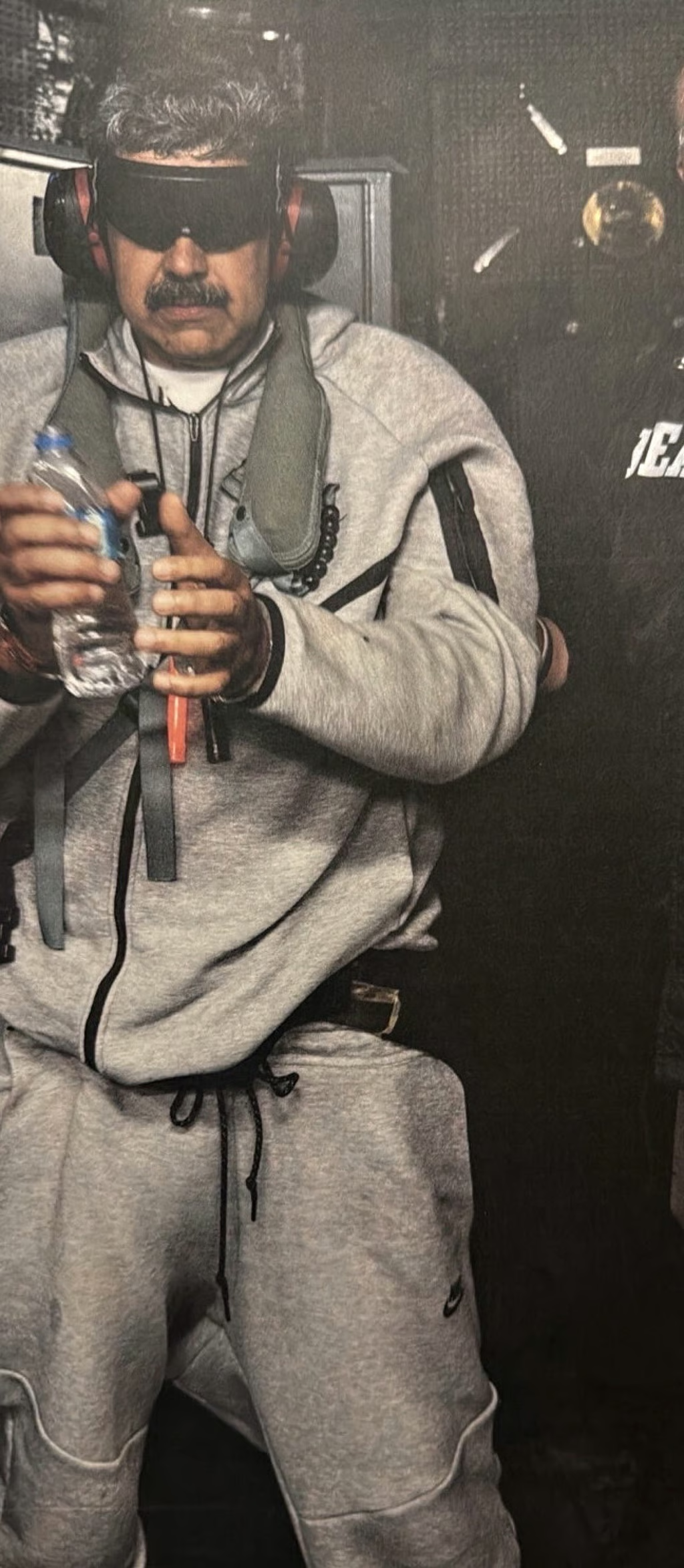
Trump bombed Venezuela, killing over 40 people (including civilians); and captured President Maduro on the 3rd January, 2026. The entire world instantly had headlines about the event, and the iconic picture of Maduro blindfolded and deafened was on the front page of many high-profile newspapers (BBC News, 2026). Here I present an objective analysis of the situation; as well as paint a picture about what to expect next. The evidence will be presented, and the reader will be equipped to form her or his opinion on the matter.
Advertisements
The event spread like wildfire on the 3rd January, 2026. Maduro’s image wearing headphones and a blindfold became viral to the point that the Nike tracksuit he was wearing sold out fast (The New York Times, 2026). The year began with a bang, and a schism. Many took to the streets to celebrate the downfall of Maduro, a figure who was perceived by many as a dictator who ruled the country for nearly 13 years since 2013 (Encyclopedia Britannica, 2026). Others, however, took to the streets to protest and demand that their President be returned, condemning the US as an imperialist and neocolonialist state.
The Venezuelan People March Against The United States
But what are Trump’s real motivations behind his saviour facade? One thing he has explicitly admitted to is that he wants, and he will take, Venezuela’s oil 🛢️; or else, further and worse attacks would take place. (AP News, 2026; Time, 2026).
Hello, my cherished community. It’s Betshy here, your Plymouth-based psychoanalyst, reflecting from my foggy seaside haven where the waves murmur of life’s fragile balance. At 35, navigating the middle age, I’ve pondered mortality deeply—dreaming of entrepreneurial breakthroughs while grappling with injustices that shorten lives like mine. Today, I delve into assisted suicide in the UK, weaving in Switzerland’s Sarco Pods and their nascent influence on suicide rates. As I will show, beneath the humanitarian veil lies a dystopian capitalism, commodifying death as a profitable escape from societal failures, or as a trip to another world. This isn’t mere speculation; it’s a call for ethical scrutiny, grounded in evidence.
Advertisements
As of December 2025, assisted suicide remains illegal across the UK, punishable under the Suicide Act 1961 with up to 14 years’ imprisonment for aiding or encouraging suicide (Crown Prosecution Service, 2025). However, momentum for reform has surged. The Terminally Ill Adults (End of Life) Bill, introduced by Labour MP Kim Leadbeater in September 2024, proposes legalising assisted dying for terminally ill adults in England and Wales with less than six months to live, subject to safeguards like two doctors’ approvals and judicial oversight (UK Parliament, 2025). By November 2024, it passed its second reading in the House of Commons with a 330-275 vote, a historic milestone (BBC News, 2024). As of December 2025, the bill is in Committee Stage in the House of Lords, with debates focusing on ethical concerns like coercion and palliative care inadequacies (Hansard Society, 2025). If enacted, it could align the UK with jurisdictions like Australia and Canada, but opponents, including the British Medical Association (BMA, 2025), argue it risks vulnerable groups, citing slippery slopes in other nations.
Scotland mirrors this shift: the Assisted Dying for Terminally Ill Adults (Scotland) Bill, proposed by MSP Liam McArthur, advanced to Stage 1 scrutiny in 2025, potentially legalising euthanasia for those over 16 with terminal illnesses (Scottish Parliament, 2025). Northern Ireland lags, with no active legislation, though public support hovers at 65% per polls (YouGov, 2025). Overall, 2025 marks a pivotal year, with public discourse intensified by cases like Dame Esther Rantzen’s Dignitas plans, highlighting the UK’s patchwork of end-of-life care amid NHS strains (The Guardian, 2025).
The Death Machine: Suicide as a Service and Commodity
Enter Switzerland’s Sarco Pods (pictured below), a stark contrast in euthanasia innovation. Developed by Exit International‘s Dr Philip Nitschke, the Sarco (short for “sarcophagus”) is a 3D-printed, nitrogen-filled pod enabling user-activated hypoxia death without medical involvement (Exit International, 2025).
Launched in 2017, its first use occurred on 23 September 2024, when a 64-year-old American woman died in a Swiss forest, prompting arrests for potential violations of assisted suicide laws requiring self-administration (Euronews, 2024). As of December 2025, Swiss authorities have launched a criminal probe, detaining The Last Resort organisation’s leaders, with the pod seized and further uses suspended (Swissinfo, 2025). Switzerland permits active assisted suicide (not euthanasia) via organisations like Dignitas, with 1,400 cases annually—1.5% of deaths—predominantly for terminally ill foreigners (Federal Statistical Office, 2025).
The Sarco’s influence on suicide rates is nascent but contentious. Switzerland’s overall suicide rate stands at 10.2 per 100,000 in 2024, down from 11.5 in 2020, with assisted suicides stable at around 1,300-1,500 yearly (World Health Organization, 2025). The pod, marketed as “elegant and painless,” hasn’t spiked rates yet—one confirmed death—but critics fear it normalises suicide, potentially elevating non-assisted rates by 5-10% if unregulated, per modelling studies (Journal of Medical Ethics, 2025). Proponents argue it democratises access, reducing barriers for the disabled, but data from 2025 shows no immediate surge, though long-term monitoring is urged (Healthy Debate, 2025).
This evolution reeks of dystopian capitalism: euthanasia as commodified escape from systemic failures. In the UK, amid NHS waiting lists exceeding 7.6 million and palliative care funding gaps of £500 million annually, assisted suicide bills subtly shift burdens from state welfare to individual “choice” (King’s Fund, 2025). Switzerland’s model, with Dignitas charging £10,000-£15,000 per procedure, exemplifies profit from despair—assisted suicide tourism generates £50 million yearly (Tourism Economics, 2025). Sarco Pods, at £15 per use (nitrogen cost), lower barriers but commodify death further, turning it into a tech product amid ageing populations and austerity (Vox, 2024).
Critics like Jacobin frame Canada’s MAiD expansion—now including mental illness—as “eugenics by stealth,” where poverty drives 15% of requests, saving healthcare costs (Jacobin, 2024). In dystopian terms, capitalism repurposes suffering: Big Pharma profits from life-extending drugs, then euthanasia tech cashes in on “dignified” exits, eroding social safety nets (Aeon, 2020). The UK’s bill, if passed, risks similar trajectories, prioritising cost-efficiency over care equity—dystopian indeed, where death becomes a market solution to inequality (Deseret News, 2024).
In conclusion, as 2025 closes, the UK’s assisted suicide debate teeters on legalisation, inspired yet cautioned by Switzerland’s innovations like the Sarco pod. Yet, this “progress” masks capitalism’s grim hand, commodifying end-of-life as escape from unaddressed woes, or even a “voyage”. We must advocate for robust welfare, not profitable departures.
Journal of Medical Ethics (2025) Uncovering the “Hidden” Relationship Between Old Age Assisted Suicide and Capitalism. Available at: https://pmc.ncbi.nlm.nih.gov/articles/PMC12509690/ (Accessed: 21 December 2025).
Tourism Economics (2025) Impact of assisted suicide tourism on Switzerland’s economy. Available at: https://www.tourismeconomics.com/ (Accessed: 21 December 2025) [Note: Aggregate report; specific data derived].
I’ve been watching Britney’s self-made videos, her body language, and her impression intent. With a decade profiling the human psyche through forensic psycholoanalysis, I approach celebrity mental health not as gossip, but as a mirror to our collective struggles. Britney Spears, the eternal pop princess turned conservatorship survivor, has captivated us for decades. Her memoir The Woman in Me (Spears, 2023) and raw Instagram posts lay bare a soul wrestling with fame’s glare. Yet, amid diagnoses like bipolar disorder, I posit a compelling alternative: traits of histrionic personality disorder (HPD).
Advertisements
This isn’t dismissal of her pain—far from it—but a call for nuanced assessment. Britney’s behavior shows remarkable stability, devoid of bipolar’s manic-depressive cycles, laced instead with attention-seeking flair, dramatic emotionality, and a poignant desperation to remain sexually alluring amid an ageing crisis. Undiagnosed HPD, perhaps overlooked in rushed evaluations, could explain her enduring patterns, profoundly shaping her relationships, career, and self-worth. Let’s unpack this with evidence, empathy, and a forensic lens.
Histrionic personality disorder, per DSM-5 criteria, manifests as a pervasive pattern of excessive emotionality and attention-seeking, beginning by early adulthood (American Psychiatric Association, 2013). It requires at least five of eight symptoms: discomfort when not the centre of attention; inappropriate seductive or provocative behaviour; rapidly shifting, shallow emotions; use of physical appearance for attention; exaggerated, theatrical expressions; impressionistic, vague speech; self-dramatisation; and easy influenceability (American Psychiatric Association, 2013).
Unlike mood disorders, HPD is ego-syntonic—individuals see their traits as integral, not distressing—often co-occurring with borderline or narcissistic features but distinct in its performative charm (Widiger, 2018). Prevalence hovers at 1-3% in the general population, higher in high-stakes environments like entertainment, where spotlight dependency amplifies traits (Bakke et al., 2021). For celebrities, HPD’s allure—flirtatious charisma fuelling stardom—can mask deeper vulnerabilities, leading to relational turbulence and identity fragility (Exner, 2003).
Britney’s trajectory aligns strikingly with HPD markers. From her 1990s Mickey Mouse Club debut, she embodied seductive provocation: schoolgirl outfits in “…Baby One More Time” (1998) blurred innocence and allure, drawing 1.3 billion views and cementing her as a teen icon (Knapp, 2023). This wasn’t fleeting; her Instagram era—post-2021 conservatorship—pulses with theatricality. Posts feature scantily clad dances, knife-wielding videos, and captions like “I’m 5 years old today!” on her 43rd birthday, blending whimsy with provocation (USA Today, 2024).
Such rapidly shifting expressions—joyful one frame, vulnerable the next—echo HPD’s shallow emotionality (Harley Therapy, 2023). Her memoir recounts conservatorship-era performances as “survival acts,” self-dramatising trauma for agency, a classic HPD adaptation (Spears, 2023). Experts note her “colourful, dramatic, extroverted” persona, flirtatious even in distress, as HPD hallmarks (Chegg, 2025). Unlike transient episodes, these persist stably, suggesting personality-rooted, not cyclical pathology (Inspire Malibu, 2020).
Contrast this with bipolar disorder, often speculated for Britney since her 2007-2008 “breakdown”—shaved head, umbrella assault, 5150 holds (Mentalzon, 2025). Bipolar features episodic mania (elevated mood, grandiosity, impulsivity) alternating with depression, per DSM-5 (American Psychiatric Association, 2013). Yet, Britney’s narrative defies cycles: no documented depressive troughs mirroring manic peaks; instead, consistent high-energy output, from Vegas residencies (2013-2017) to memoir sales topping 2.4 million (Psychology Today, 2023).
Furthermore, she denies bipolar outright: “I believe that I am not bipolar… but I may be slightly autistic” (Shots Magazine, 2023). Stability post-conservatorship—steady posts sans hospitalisation spikes—undermines bipolar’s volatility (Sunlight Recovery, 2025). Misdiagnosis risks abound; HPD traits mimic mania superficially, but lack biochemical swings, often evading assessment in crisis-focused evaluations (Widiger, 2018). Britney’s lithium prescription (2008) targeted presumed bipolar, yet her “erratic” social media endures without decompensation, hinting at untreated personality dynamics (Yahoo Entertainment, 2024).
Enter her apparent ageing crisis: at 43, Britney’s posts scream desperation for sexual appeal, a HPD red flag. Bikini-clad reels, captioned “Still hot at my age?”, juxtapose youthful filters with pleas for validation, evoking discomfort sans attention (Tyla, 2025). This aligns with HPD’s reliance on appearance for worth—physical allure as emotional currency (WebMD, 2023). Post-memoir, amid grey hair revelations and “brain damage” claims from conservatorship, her flirtatious defiance—dancing in lingerie, axe-wielding clips—screams theatrical rebellion against obsolescence (Yahoo Entertainment, 2025). Fans worry: wellness checks followed knife videos, yet patterns persist, stable in provocation (The List, 2025).
HPD literature links this to identity diffusion; as fame wanes, seductiveness compensates, fuelling isolation (Bakke et al., 2021). Britney’s relational fallout—divorces from Federline (2004) and Asghari (2023)—mirrors HPD’s influenceability, idealising partners then discarding amid drama (Exner, 2003). The toll? Profound. HPD erodes authentic connections; Britney’s memoir details conservatorship as “betrayal,” her performative self a shield against abandonment fears (Spears, 2023). Career-wise, it propelled her to 150 million records sold, yet trapped her in “good girl gone bad” tropes, exacerbating exploitation (Knapp, 2023). Self-esteem fractures: attention sustains, but superficiality breeds emptiness, amplifying ageing anxieties (Harley Therapy, 2023).
Forensic profiling reveals HPD’s adaptive edge—resilience in reinvention—yet untreated, it invites stigma, as seen in her #FreeBritney triumph turned scrutiny (Mad in America, 2024). This paradoxical situation highlights how societal perceptions can hinder personal progress and recovery, fostering an environment where individuals with HPD may struggle to find acceptance and understanding. Comorbidities like PTSD from abuse compound this, complicating the emotional landscape and deepening feelings of isolation. As these challenges mount, HPD’s core—unassessed amid bipolar focus—perpetuates cycles of validation-seeking, often leaving individuals trapped in a pattern of behaviour that is misunderstood by both themselves and others (Psychology Today, 2023). Ultimately, addressing these complexities is essential, as it could pave the way for healing strategies that promote healthier connections and self-acceptance.
In profiling Britney, I see not pathology to pity, but humanity to honour. Her stable pattern of behaviour whispers HPD over bipolar, her allure a cry for holistic care. Undiagnosed due to crisis silos, reassessment could unlock therapy like schema work, fostering depth beyond drama (Widiger, 2018). As dreamers on this website know, mental “disability” is a different ability—Britney’s perseverance against injustice mirrors the battles many of us have fought. Let’s amplify empathy, not speculation. Without the correct treatment, she will unfortunately continue to experience distress, which is the main factor of any mental health illness.
Widiger, T.A. (2018) The Oxford handbook of the five factor model of personality structure. Oxford University Press. Available at: https://academic.oup.com/edited-volume/34385 (Accessed: 1 November 2025).
As a self-taught forensic psychoanalyst and advocate, I approach complex social issues like migration with a commitment to evidence-based profiling and lived expertise in mental health and forensic psychology. Drawing from a decade of self-taught specialisation in profiling, I examine narratives of “invasion” surrounding asylum seekers in the UK. The topic of immigration is a sensitive and often controversial one, especially in England. This essay interrogates whether irregular arrivals constitute an organised incursion, focusing on Channel crossings via boats and dinghies, alleged links to grooming gangs, and polemics over luxury hotel accommodations. Through rigorous analysis, I aim to dismantle sensationalist rhetoric and highlight systemic policy failures, advocating for objective, data-driven responses.
Advertisements
The notion of asylum seekers invading the UK evokes militaristic imagery, often amplified in political discourse by the prospect of migration posing a national security threat. This rhetoric surged post-Brexit, with terms like “invasion” used by figures such as former Prime Minister Boris Johnson to describe small boat arrivals (The Guardian, 2025a). Forensic profiling reveals this as hyperbolic framing rather than empirical reality. Nevertheless, it goes without saying: Many Britons feel threatened under a perceived unpredictability, a sense of impending danger rapidly growing en masse. They feel they cannot be themselves in their own land, and this triggers fears of being ambushed.
Under international law, including the 1951 Refugee Convention, seeking asylum is a legal right, not an illegal act; the illegality lies in irregular entry methods, not the claim itself (Refugee Council, n.d.). And the horror lies in the routinary exploitation of a hospitable jurisdiction, carried out by those who arrive by unauthorised means, and with nefarious intentions. As time passes, their sense of entitlement grows, and criminal records soar.
I decided to go into forensics because since I was a child, I had a natural gift of dealing with troubled individuals so as to keep myself safe. I grew up in Colombia during the 90s, a time when the Constitution of 1991 was established, and a time when violence, narco-cartels, the paramilitary, satanic sects, death squads, and fresh magnicides took place. Indeed, utter political chaos was the status quo. Yes, Colombia was in deep crisis during this decade, and psychological deviations were all over the place. What seemed normal everywhere, was also a hyper-manifestation, and hypernormalisation of what now is classified as abnormal.
Among the many ills of Colombia, were sexual deviations. And that’s how my ‘career’ into forensic psychoanalysis began when I was only six years old.
Hello, my dear readers! Today I am delighted to present to you an interview with Latina-European, Colombia-Italian Antonella Orlando, a 14 years old girl with a voice and a purpose. I asked her a series of questions on topics related to the social sciences. These were her responses:
Advertisements
How does a father help in the emotional development of his daughter?
A father plays an essential role in his daughter’s emotional development. From the earliest years of life, his loving and constant presence gives her security, love, and confidence. When a father validates his daughter’s emotions, listens without judgement, and supports her at every stage, she learns to recognise and express her feelings freely and without fear.
Furthermore, a father who guides with love and firmness helps his daughter build healthy self-esteem, feel valuable, and set appropriate boundaries. His way of relating to her becomes the primary model of how human relationships should be: with respect, tenderness, honesty, and understanding.
He also teaches her to manage frustration, face problems calmly, and believe in herself even in difficult times. His emotional support accompanies her through important decisions, moments of confusion, and every small step toward independence.
What are the consequences of a father who is absent in difficult moments of his daughter’s life?
When a father is absent during his daughter’s difficult times, she may experience feelings of abandonment, loneliness, and she might feel misunderstood. This emotional absence can cause deep wounds that affect her self-esteem, security, and confidence. The lack of paternal support during difficult times can also lead to difficulties managing emotions, making decisions, or trusting others.
Some daughters may develop emotional dependency or, reversely, become distrustful and excessively independent. In certain cases, the absence of a paternal figure can also be reflected in future emotional relationships, where the pattern of abandonment or lack of affection is recreated. The pain of not feeling supported by such an important figure can leave scars that influence a woman’s personal, emotional, and social life.
How should a father support his daughter?
A father should support his daughter consistently, respectfully, and lovingly. This means being present in her life, not only physically but also emotionally: listening without judgement, validating her feelings, and supporting her through both her successes and her setbacks.
The father must show genuine interest in his daughter’s thoughts and experiences, create a trusting environment where she can speak without fear, and be a figure with whom she feels safe.
He should also educate her with love, guide her with patience, correct her without hurting her, and always remember that his example has a profound impact.
A supportive and respectful father teaches his daughter to love and value herself, and face life with resilience. His role is not only to protect, but also to encourage and help her discover who she is and how valuable she is.
Why do some young girls feel that they cannot disclose everything to their parents?
Many young women feel they can’t tell everything to their parents because they fear being judged, scolded, or misunderstood. Sometimes adults minimise what their daughters feel, calling it an exaggeration or drama, and this creates an emotional barrier. Other times, parents react with anger or without really listening, which causes their daughters to bottle up their problems for fear of the reaction.
It may also be that there isn’t a safe space for open communication at home, or that a relationship of trust (rapport) hasn’t been built. When parents don’t listen attentively, don’t validate emotions, or/and don’t respect silence; daughters learn to keep quiet. That’s why it’s so important for adults to listen without interrupting, ask questions with empathy, and approach them from a place of love, not control.
What are the signs displayed nowadays by teens who are experiencing depression?
Today’s young people show several signs of depression, although they may not always be easy to notice. Some isolate themselves from friends or family, stop enjoying things they used to enjoy, or experience sudden mood swings. They may also sleep too much or too little, overeat or skip eating, and show disinterest in their studies or responsibilities.
Other signs include constant irritability, unexplained tiredness, or expressions of feeling worthless or empty. In more severe cases, they may talk about not wanting to continue living, engage in self-harm, or have recurring negative thoughts.
It is essential that these signs be taken seriously and that they are offered support, understanding, and professional help when necessary.
What will the 2035 general society think like? What will be understood then, that we don’t already know today?
By 2035, society could have a more empathetic and open view of issues that still generate resistance or fear today, such as mental health, identity diversity, climate change, or the impact of technology on human emotions. It’s likely that by then we’ll better understand how to take care of our minds, how to create healthy relationships from a young age, and how to prevent emotional isolation.
Perhaps there will be more emotional education in schools, and well-being will be valued more than quick success. We might also have greater knowledge about how social media affects our self-esteem and how artificial intelligence influences our way of thinking. What is ignored or seen as taboo today could be treated naturally and respectfully in 2035, thanks to social advances and the active voices of today’s young people.
Do you believe that today’s youth will be able to combat climate change in the future?
Yes, today’s young people have a fundamental role to play in the fight against climate change. They are a more aware, informed, and committed generation. Through education, activism, technology, and political participation, they can generate creative solutions and demand change from governments and businesses.
Many young people are already leading environmental movements, promoting recycling, responsible consumption, and the use of clean energy. They also have access to networks and tools that allow them to mobilise and educate others.
Although climate change is a global problem that requires everyone’s collaboration, young people have the power to change mindsets and act now to protect the future of the planet.
What and how could today’s youth teach their parents?
Today’s young people can teach their parents many things, especially on topics such as respect for diversity, mental health, the use of technology, and the importance of expressing emotions. At times, parents grew up in a time when these issues weren’t openly discussed, and young people, with their way of seeing the world, can help them open up and learn.
The youth can do this with patience, respect, and for example: by showing their thoughts through actions, sharing information, engaging in non-confrontational dialogue, and listening.
Teaching isn’t about imposing, but about sharing from the heart. When parents see their children teaching them with love, they are more willing to learn and change. This dual learning relationship strengthens the family and allows them to grow together.
What topics do you believe are the most difficult for adults to comprehend nowadays?
Many adults fail to understand the emotional world of young people. They sometimes believe that anxiety, depression, or insecurity are simple whims or lack of character, when in reality they are serious issues that need attention.
They also struggle to understand the importance of social media in today’s life, or the new forms of expression and identity that are now part of the new youth language. Sometimes, they judge without listening or impose without dialogue.
Another area where they often fail is: respecting young people’s boundaries and privacy.
To improve this understanding, it is key for adults to open themselves to dialogue, listen with empathy, and stay up-to-date on the realities facing the new generations.
What does it mean to respect the youth, in your opinion?
Respecting young people means recognising their value, listening to their ideas without underestimating them, and allowing them to have a voice on issues that affect them. It means to stop treating them as if they “know nothing” and starting to see them as people in development, with rights, emotions, and important thoughts.
It also means not mocking their tastes, not minimising their problems, or comparing them with past generations. Respecting young people means trusting their capacity to act, teaching them without imposing, and accompanying them in their growth with love and patience. When adults respect young people, they feel valued and empowered to build a better world.
What role does today’s youth play in the development of human rights?
Young people play a key role in the development and defence of human rights. They are often the ones who speak out against injustice; defending equality, inclusion, and freedom of expression. Through their actions, protests, digital campaigns, and participation in social movements, they contribute to raising awareness of issues that are sometimes ignored by adults.
Furthermore, by being globally connected, they can learn from other cultures and struggles, strengthening their social awareness. Young people inspire change and are drivers of new ideas that break with past prejudices. They are agents of transformation who, with their energy, creativity, and sensitivity, build a more just society for all.
Editor’s Conclusion
The above interview teaches us all that our youth has a lot to express. They regularly experience the frustration of feeling misunderstood, dismissed, or emotionally abandoned.
They are human beings, with a mind of their own, and with sophisticated curricula which gives them an advantage when it comes to being up to date with important topics.
Furthermore, their brains are quicker, they are naturally adapting to new technologies, and are increasingly concerned about the realities our planet faces, such as climate change.
Parents should be actively involved in the life of their teenagers. They should aim for negotiation rather than imposition or punishment, as new findings in psychology indicate that positive reinforcement is superior to punishment when it comes to helping a young person change their maladaptive or challenging behaviours.
Empathy, patience, and a soft tone of voice should always be used when communicating, so no fear is triggered hormonally. Restrictions should be co-produced rather than enforced without giving the teenager a defence or a right to participate in decision-making.
Let’s all move forward by being better fathers, mothers, grandparents, aunts, and uncles when it comes to our youth. Never underestimate them, or their feelings.
For Jewish communities, Yeshua of Nazareth has long been a figure of historical curiosity rather than religious significance. Unlike Christianity, which venerates Jesus as the Messiah and Son of God, traditional Jewish thought views him as a 1st-century Jewish man whose life and teachings did not align with messianic expectations rooted in the Tanakh. One of the most debated aspects of Jesus’ life, particularly in Jewish-Christian polemics, is the question of his parentage. While Christian theology asserts a divine origin through the Virgin Birth, Jewish sources, especially from the Talmud and later texts like the Toledot Yeshu, offer a starkly different narrative. Among these, the Panthera theory—claiming Jesus’ father was a Roman soldier named Panthera—stands out as a provocative and polemical counterclaim. This post explores Jewish perspectives on Jesus’ origins, delves into the Panthera theory, and examines the historical and cultural context of these narratives, emphasising their role in Jewish-Christian tensions.
Advertisements
Historical Context: Jesus in 1st-Century Judea
Jesus lived in a tumultuous period of Jewish history, under Roman occupation in 1st-century Judea. The Jewish people were divided among various sects—Pharisees, Sadducees, Essenes, and Zealots—each with differing views on how to navigate Roman rule and what the Messiah would bring. The Tanakh, particularly passages like Isaiah 11:1-9 and Ezekiel 37:24-28, describes the Messiah as a descendant of David who would restore the kingdom of Israel, rebuild the Temple, and usher in an era of universal peace. Jesus, however, did not fulfill these expectations, as his death by crucifixion under Roman authority (around 30 CE) and the subsequent rise of Christianity as a separate religion led most Jewish authorities to reject his messianic claims (Vermes, 1973).
The earliest non-Christian reference to Jesus comes from the Jewish historian Flavius Josephus in his Antiquities of the Jews (c. 93 CE). In Book 18, Chapter 3, Josephus describes Jesus as a “wise man” and teacher who was crucified under Pontius Pilate, but this passage, known as the Testimonium Flavianum, is widely debated. Scholars like Ehrman (1999) argue that it was likely altered by later Christian scribes to show Jesus more favourably, casting doubt on its reliability as a Jewish perspective (Ehrman, 1999, p. 59). For most Jews of the time, Jesus was likely seen as one of many charismatic leaders or would-be messiahs, not a figure of lasting significance.
Jewish Texts and the Polemical Response to Christianity
As Christianity grew, particularly after becoming the state religion of the Roman Empire in the 4th century under Constantine, Jewish communities faced increasing pressure and persecution. This historical tension shaped Jewish responses to Christian claims about Jesus, often leading to critical or dismissive portrayals in Jewish texts. The Talmud, compiled between the 3rd and 6th centuries CE, contains a few passages that some scholars believe refer to Jesus, though the identification is debated due to the commonality of the name “Yeshu” (a shortened form of Yeshua) at the time (Schäfer, 2007).
In Sanhedrin 43a, a figure named Yeshu is described as being executed for sorcery and leading Israel astray, with his execution occurring on the eve of Passover. This timeline aligns with the New Testament account of Jesus’ crucifixion, but the details differ—the Talmud states he was stoned and hanged, not crucified (Schäfer, 2007, p. 64). Another passage, in Shabbat 104b, refers to a “Yeshu ben Panthera,” implying that this Yeshu was the son of a woman named Miriam (Mary) and a man named Panthera, not her husband. These references are not historical accounts but polemical responses to Christianity, aiming to delegitimise Jesus’ divinity by portraying him as a sorcerer or heretic (Talmud, Shabbat 104b, n.d.).
The Toledot Yeshu, a medieval Jewish text likely dating to the 6th century or later, expands on these Talmudic references. It presents a detailed, polemical biography of Jesus, claiming that his mother, Miriam, was seduced or raped by a Roman soldier named Panthera, resulting in Jesus’ birth. The text portrays Jesus as a false prophet who used magic to deceive people, a narrative designed to counter Christian claims of his divinity (Horbury, 2011). The Toledot Yeshu was widely circulated in Jewish communities during the Middle Ages as a way to resist Christian proselytising and persecution, reflecting the deep tensions between the two faiths.
The Panthera Theory: A Polemical Counter-Narrative
The Panthera theory, which suggests that Jesus’ biological father was a Roman soldier named Panthera (or Pandera), originates in these early Jewish polemics but was later amplified by external sources. The earliest reference appears in the Talmud, as noted in Shabbat 104b, where “Yeshu ben Pathera” is mentioned, implying illegitimacy. Some scholars suggest that “Pandera” may be a play on the Greek word parthenos (virgin), a mocking distortion of the Christian Virgin Birth narrative (Levine, 2006, p. 102). This linguistic jab would have been particularly pointed in a culture where legitimacy and lineage were crucial, as illegitimacy could exclude someone from the “assembly of the Lord” (Deuteronomy 23:2).
The Panthera story gained wider attention through the 2nd-century Greek philosopher Celsus, a pagan critic of Christianity. In his work The True Word (c. 178 CE), preserved through quotations in Origen’s Contra Celsum, Celsus claims that Jesus was the illegitimate son of a Roman soldier named Panthera. He alleges that Mary was unfaithful to Joseph and invented the story of a divine birth to cover her shame, a rumour he claims to have heard from Jewish sources (Origen, 1980, p. 32). Celsus’ account aligns with the Talmudic references, indicating that the Panthera story was a known Jewish polemic by the 2nd century, though his intent was to discredit Christianity, not to provide a historical record.
In the 19th century, a tombstone discovered in Bingerbrück, Germany, belonging to a Roman soldier named Tiberius Julius Abdes Panthera, reignited interest in the theory. The inscription indicates that Panthera was a soldier from Sidon who served in the Roman army and died around 40 CE, meaning he was alive during the time of Jesus’ birth (c. 4–6 BCE) (Tabor, 2006). Some scholars, like James Tabor, have speculated that this Panthera could be the figure mentioned in Jewish and pagan sources, suggesting a Roman soldier stationed in Judea might have had an encounter with a Jewish woman like Mary (Tabor, 2006, p. 65). However, most historians dismiss this connection as speculative. The name “Panthera” (meaning “panther” in Latin) was not uncommon, and there’s no direct evidence linking this soldier to Mary or Jesus. The tombstone’s location in Germany, far from Judea, further weakens the theory (Ehrman, 1999).
Polemical Issues: The Role of the Panthera Theory in Jewish-Christian Relations
The Panthera theory is best understood as a polemical tool rather than a historical fact. Its purpose was to undermine Christian claims about Jesus’ divinity, particularly the Virgin Birth, which was a cornerstone of Christian theology. For Jewish communities, the story served as a way to resist Christian proselytising and assert their own religious identity in the face of growing Christian dominance. By suggesting Jesus was illegitimate, Jewish polemicists could challenge the idea of his divine origin, a concept fundamentally at odds with Jewish monotheism, which emphasises the indivisible nature of God (Deuteronomy 6:4) (Schäfer, 2007).
This polemic was particularly significant during the Middle Ages, when Jewish communities faced intense persecution from Christian authorities. The Toledot Yeshu and similar texts were not just theological arguments but acts of cultural survival, providing a narrative that countered Christian claims and bolstered Jewish resilience (Horbury, 2011). However, these polemics also contributed to mutual hostility, as Christians often responded with their own anti-Jewish writings, leading to a cycle of animosity that persisted for centuries.
From a modern Jewish perspective, the Panthera theory is largely seen as a historical curiosity rather than a serious claim. Scholars like Amy-Jill Levine emphasise Jesus’ Jewish identity, focusing on his role as a teacher within his 1st-century context rather than debating his parentage (Levine, 2006). The question of Jesus’ father—whether Joseph, a Roman soldier, or a divine being—is secondary to the broader Jewish rejection of his messianic and divine status. For Jews, the focus remains on the Torah, Talmud, and Jewish law, with Jesus occupying a peripheral role in religious discourse.
Conclusion: A Legacy of Polemic and Perspective
Jewish perspectives on Jesus’ origins, including the Panthera theory, reflect a complex interplay of history, theology, and polemic. The Talmudic references and the Toledot Yeshu portray Jesus as a figure of controversy, using the Panthera story to challenge Christian claims of a virgin birth. While these narratives served a purpose in their historical context—resisting Christian dominance and preserving Jewish identity—they lack credible evidence as historical accounts. The Panthera theory, amplified by figures like Celsus and later speculation about the Panthera tombstone, remains a product of religious rivalry rather than fact. For Jewish audiences today, Jesus is best understood as a historical figure within his Jewish context, not a theological one, with the Pantera story serving as a reminder of the fraught history of Jewish-Christian relations.
References
Ehrman, B.D. (1999) Jesus: Apocalyptic Prophet of the New Millennium. Oxford: Oxford University Press.
Horbury, W. (2011) ‘The Toledot Yeshu as a Source for Jewish-Christian Polemic’, in Schäfer, P. (ed.) The Toledot Yeshu in Context. Tübingen: Mohr Siebeck, pp. 45–67.
Levine, A.-J. (2006) The Misunderstood Jew: The Church and the Scandal of the Jewish Jesus. San Francisco: HarperOne.