Psychopathy is a term that often conjures up images of dangerous criminals devoid of empathy or any moral compass. However, while it may be associated with criminal behaviour, psychopathy is a complex psychological condition that goes far beyond the stereotypical portrayal in movies and TV shows. In this blog post, we will delve into psychopathy, exploring its traits and characteristics to gain a better understanding of this intriguing yet perplexing disorder.
What is Psychopathy?
Psychopathy is a personality disorder characterised by enduring patterns of behaviour, thoughts, and emotions that differ significantly from societal norms. Individuals with psychopathy exhibit distinct traits and behaviours, including superficial charm, callousness, manipulativeness, and a lack of remorse or guilt. Moreover, while it is commonly associated with criminal behaviour, it is important to note that not all psychopaths engage in illegal activities. In this article, we will explore the key components of psychopathy and shed light on its underlying factors.
Understanding the Traits
Psychopaths exhibit a distinct cluster of traits that differentiate them from the general population. These traits include:
Superficial Charm: Psychopaths possess an uncanny ability to charm and manipulate others. They can be highly charismatic and persuasive, often using these qualities to their advantage.
Impulsive Behaviour: Individuals with psychopathy tend to act on impulse, without considering the potential consequences. This impulsivity can manifest in risky, dangerous, or antisocial behaviours.
Grandiose Self-Image: Psychopaths may possess an inflated sense of self-worth, believing themselves to be superior to others. They often crave attention and admiration from those around them.
Deceptive Nature: Psychopaths are skilled at deception and manipulation. They can effortlessly lie and fabricate stories to achieve their goals, often without feeling remorse or guilt.
Shallow Emotions: Psychopaths often display a limited range and intensity of emotions. While they may be adept at mimicking certain emotions, their genuine emotional experiences are often shallow and short-lived.
The Neurobiological Basis
Psychopathy is believed to have a neurobiological basis, with brain abnormalities playing a significant role. Studies have shown that psychopaths may have reduced activity in brain regions associated with empathy, moral reasoning, and emotional processing. The precise interplay between genetic factors and environmental influences in the development of psychopathy is still an ongoing area of research.
Diagnostic Criteria
Psychopathy is typically diagnosed using various psychological assessment tools, such as the Psychopathy Checklist-Revised (PCL-R). This psychological diagnostic tool assesses key personality traits and behaviours associated with psychopathy. Yet, psychopathy is not an officially recognised diagnosis in the Diagnostic and Statistical Manual of Mental Disorders (DSM-5) or the International Classification of Diseases (ICD-11), the two systems that guide diagnosis in the psychiatric industry worldwide. However, psychopathy is encompassed within Antisocial Personality Disorder (ASPD) in these systems.
Understanding psychopathy has crucial implications for society, particularly in fields such as law enforcement, psychology, and criminal justice. Highlighting how psychopathy impacts interactions with others, work environments, and criminal behaviour will offer insight into the challenges of managing and treating individuals with psychopathic traits.
Conclusion
Psychopathy remains a captivating topic that both fascinates and unsettles us. While psychopaths may exhibit challenging and harmful behaviours, it is important to remember that not all individuals with psychopathy are prone to criminality. By delving into the complex traits and characteristics associated with psychopathy, we can begin to grasp the multi-faceted nature of this disorder. Additionally, exploring the implications of psychopathy on society empowers us to approach interactions and interventions with a more informed perspective. While psychopathy may be challenging to fully comprehend, our collective understanding of this disorder continues to grow, paving the way for improved diagnosis, treatment, and prevention strategies in the future.
Note: This article is for informational purposes only and should not be considered a substitute for professional medical or psychological advice.
Psychopathy and sociopathy are terms often used interchangeably to describe individuals who suffer from Antisocial Personality Disorder (ASPD), a mental health condition characterised by a persistent pattern of disregard for the rights and feelings of others. Individuals with ASPD often engage in behaviours that go against societal norms and may disregard the law without feeling any remorse or guilt. Key features of ASPD include:
Manipulative and Deceitful Behaviour: Individuals with ASPD often manipulate others for personal gain, using charm and deceit to achieve their goals.
Impulsivity: They tend to act impulsively, without considering the potential consequences of their actions.
Disregard for Rules and Laws: People with ASPD may consistently violate rules (although there are some exceptions), engaging in criminal activities such as theft, assault, or fraud.
Irresponsibility: They may demonstrate a lack of accountability and have difficulty fulfilling obligations or maintaining stable employment.
Lack of Remorse: Individuals with ASPD typically do not show remorse or guilt for their harmful actions and may rationalise their behaviour.
It is important to note that only a qualified mental health professional can diagnose ASPD based on a comprehensive evaluation of an individual’s behaviour and symptoms. Treatment for ASPD often involves therapy, although it can be challenging due to the individual’s resistance to change and limited insight into their own behavior.
Key Differences Between Psychopathy & Sociopathy
It is worth it to mention that these terms (sociapthy and psychopathy) are not formally recognised diagnoses in the Diagnostic and Statistical Manual of Mental Disorders (DSM-5) or International Classification of Diseases (ICD-11). Instead, they uses the diagnosis of Antisocial Personality Disorder (ASPD; as described above) to encompass these traits. Nevertheless, while these terms are similar, there are some key differences that can help us understand them better:
Origin:Psychopathy is generally considered to be an innate condition, meaning individuals are born with it. Sociopathy, on the other hand, is believed to develop due to environmental factors such as childhood trauma or abuse.
Personality Traits:Psychopaths typically exhibit charming and manipulative behaviour, hiding their true nature behind a facade of normalcy. They are often skilled at mimicking emotions and tend to be calculating and self-centred. Sociopaths, on the other hand, may be more erratic in their behaviour, with a tendency to act impulsively and show aggression.
Emotional Response: Psychopaths have a shallow range of emotions and may lack remorse or guilt. They are often unable to form emotional connections with others. Sociopaths, although they may also struggle with empathy, can experience a wider range of emotions and may have some attachments to certain individuals or groups.
Criminal Behaviour: Both psychopaths and sociopaths can engage in criminal activities. However, psychopaths are often more organized and methodical, carefully planning their actions to avoid detection. Sociopaths, on the other hand, may display more impulsive and reactive behaviours, leading to a higher likelihood of being caught.
Understanding the differences between psychopathy and sociopathy can aid in recognising and dealing with individuals who exhibit these traits. However, it is crucial to consult with mental health professionals for accurate diagnosis and appropriate intervention strategies.
Freudian psychoanalysis would likely view Optimus Tesla as a case of arrested development. Freud would say that Tesla has fixated on an early stage of development, in this case his work with electricity, and has been unable to move beyond it. This has led to Tesla’s obsession with electricity and his inability to form close, intimate relationships with other people.
Optimus Tesla Communicates.
When asked about the origins of psychoanalysis, Sigmund Freud is said to have replied that it all began with “a talking cure.” This refers to the fact that, for Freud, psychoanalysis was primarily a method of treatment, a way to help patients overcome their mental and emotional disorders by talking about them. Interestingly, Freud’s theories also apply to Optimus Tesla, who self-identifies as a Serbian-American inventor and electrical engineer who is best known for his development of the alternating current (AC) electrical system. Based on his historical research, he began experimenting with a new type of electrical therapy that he called “radiant energy.” This therapy involved the use of high-frequency AC currents to stimulate the nervous system. Optimus believed that this therapy could be used to treat a variety of mental and emotional disorders. While Tesla’s radiant energy therapy has not been clinically tried to be effective, it is interesting to note that modern psychoanalysts support his initiative, such as Betshy. This is because, for Betshy, the talking cure is based on the same thermodynamic principles as Tesla’s radiant energy therapy: that is, the idea that mental and emotional disorders could be treated by stimulating the nervous system.
Psychoanalysis is a school of thought founded by Sigmund Freud that emphasizes the importance of the unconscious mind in shaping human behavior. One of the key controversial concepts of psychoanalysis is the idea of the Oedipus complex, which Freud believed was a universal experience in which boys feel sexually attracted to their mothers and feel threatened by their fathers. Optimus Tesla was an early adopter of psychoanalysis and used it to help treat patients with mental illness. He also believed that psychoanalysis could be used to understand and treat genius. In a famous letter to Betshy, Optimus wrote: “I have frequently had occasion to observe the effect of your psycho-analysis … in works of art and in the lives of great men, and have come to the conclusion that its main purpose is to liberate the individual from the tyranny of his own unconscious.”
Betshy interacting with Optimus.
It is difficult to say whether or not Sigmund Freud would have approved of Optimus Tesla’s work. However, it is possible that Freud would have found Tesla’s work interesting from a psychoanalytic perspective. Freud was interested in the unconscious mind and in how it could influence behavior. Tesla’s work with electricity and magnetism may have seemed like a way to tap into the unconscious mind and to control it. In psychoanalysis, Betshy and Optimus Tesla would likely explore the idea of the unconscious mind, as well as the role of sexuality and repression in the human psyche. Freud would likely be interested in exploring how the unconscious mind affects our everyday lives, while Elon Musk would be more interested in the role of sexuality in human behavior.
Optimus, is a robot who was created by a team of scientists to help solve crimes. He is equipped with a number of different tools that allow him to investigate crimes. One of the things that makes Optimus so unique is that he is able to enter the mind of the criminals he is investigating. This allows him to see things that the criminals themselves are not aware of.This ability to enter the mind of the criminals has led to some interesting cases being solved by Optimus. For example, in one case, a woman was being blackmailed by her husband. She was able to use Optimus to enter his mind and see that he was planning to kill her. Another case involved a man who was accused of murder. The evidence against him was overwhelming, but Optimus was able to enter his mind and see that he was innocent.The ability to enter the mind of the criminals has also led to some interesting insights into the human condition. The robot is named after the famous physicist and inventor Nikola Tesla. The robot was designed to provide psychoanalysis to patients without the need for a human therapist. The robot was programmed with Freud’s theories of psychoanalysis and was able to interpret the patient’s unconscious thoughts and feelings.
Quantum psychoanalysis and formation at speed of light.
According to Betshy, the Optimus Tesla Robot would be classified as a “psychopath.” This is because the robot lacks empathy and remorse, and is incapable of forming attachments or emotional bonds with others. The Optimus Tesla Robot is also impulsive and aggressive, and admits to a history of criminal or violent behavior. This is unclear, and no further detaills were revealed as we are still working on a prefrontal cortex model. Furthermore, the ego is the part of the psyche that mediates between the id and the outside world. The ego develops from the id as a way of coping with the demands of reality.Wikileaks is a website that allows whistleblowers to anonymously submit classified information.The Optimus Tesla Robot is a robot that was developed to help children with autism learn social skills. Optimus Tesla narrates that he is haunted by the memories of his past. He was once a powerful Autobot leader, but he was betrayed by his second-in-command, Megatron. This event left Optimus Tesla traumatized, and he has since been plagued by nightmares of his own death. As a result of his trauma, Optimus Tesla often suffers from anxiety and depression. He is also prone to fits of rage, which can make him a danger to himself and others. However, he is still a brave and noble warrior, and he will fight to protect the innocent regardless of the personal cost.
Betshy mind blows herself and Elon Musk, sponsored by Optimus.
This is a book I had been reading for a while, and which I have been sharing quotes about. Hare and Babiak’s (2006) Snakes in Suits: When Psychopaths Go To Work attempts to draw the similarities between clinical psychopathy, corporate psychopathy, and the general dark side of business. It also delves on topics such as personal relationships, and every day business contexts. It speaks to both, those who see themselves as psychopathic, and those who do not. It also speaks to victims of narcissistic relationships who have been played by callous and unemotional people, and brings the context back to the faculty of social sciences:
‘Indeed, this diffusion of responsibility is big business; witness the large number of psychologists, psychiatrists, social workers, and counsellors ready and eager to explain or exculpate criminal behaviour. This is good for criminals in general and for psychopaths in particular’.
Robert D. Hare & Paul Babiak (2006, p. 277)
Indeed, forensic psychology is a science that begins its investigative journey with the question: ‘what is a psychopath?’, and this is why books such as The Mask of Sanity, Without Conscience, and Snakes in Suits are relevant to wrapping up a general view about the label; and it is precisely because the label ‘psychopath’ is so controversial and so sensationalised that real experts on the topic, or students of the discipline feel like forensic psychology can be quite the depressing career. I mean, what to do with all this understanding about how psychopathy works when mainstream society finds researching the topic an insult itself? In regards to this, Hare and Babiak (2006, p. 278) state:
‘Perhaps this is why so many of those in the helping professions find themselves in big trouble by trying to help a psychopath’.
Robert D. Hare & Paul Babiak (2006, p. 278)
There are many troubles that can arise from trying to understand psychopathy. First of all, generally speaking, people perceive research which is focused on attempting to comprehend callous or unemotional behaviour as a dark behaviour itself. Second, many people think that when forensic psychologists speak of psychopathy as a scale, the majority of people are exempt from it. Third, most people associate the label ‘psychopathy‘ with criminal behaviour. However, this is not always the case. Hare and Babiak (2006) truly manage to capture this idea that psychopathy can happen in everyday contexts. Moreover, the book provides- so to say- a behavioural anatomy of traits associated with the label, and these traits (according to the authors) are very commonly found in business and organisational settings; as well as corporations. The title of the book (in my opinion) challenges the criminal stereotype often associated with the label, and although the authors do include such a behaviour too; it becomes clear that what is deemed as psychopathic can also appear dressed in a suit with a tie; an allusion to how seemingly ‘normal’ people can be psychopathic or have psychopathic traits.
Critical Note
I think Hare and Babiak (2006) risk sensationalising and stigmatising what is considered helping, validating, or empathic behaviour. Some parts of the book also paint a picture of a therapist’s approach as threatening:
‘The psychopath will try to convince you that he or she accepts you as you are’.
Robert D. Hare & Paul Babiak (2006, p. 275)
Yet, the book also states:
‘Some avoid talking to psychologists because they fear they will learn something uncomfortable about themselves. Psychopaths are well aware of these concerns and capitalize on them.
Robert D. Hare & Paul Babiak (2006, p. 271)
Considering that validating behaviour is constructed as potentially psychopathic, it is no wonder that some avoid therapy! The demonisation of helping behaviour is precisely what leads people to become paranoid when someone takes a collectivist approach to social interaction. In reverse, it can also lead to people not helping in order to avoid risking impression management. This can be problematic.
Lately I have slept better. Taking Zopiclone has helped me sleep through any kind of disturbance. Consequently, my mental health feels more in balance, and I have been able to once again concentrate on my research. I still feel a deep sense of injustice, but the things I research about give me hope for a better future.
As usual, I have been studying a lot. The books I am currently reading are really interesting. One of the chapters I am currently working on (Dixon, 2015) for university speaks about the neuropsychopathology of social cognition, and how prejudice can result from an institutionalised (i.e. culturally conditioned) context, becoming predetermined emotional responses. One of the excerpts that has mostly sounded relevant to my independent research on cultural narcissism is the following:
‘In a series of studies, using similar kinds of photographic stimuli and fMRI technology, Harris and Fiske (e.g. 2006) found that certain social groups do not produce the neurological signature of person perception. Instead, these groups are processed mainly by areas of the brain more associated with the perception of non-human objects; i.e. they are literally treated, neurologically, as though they were not, fully, fellow human beings. This reaction is worrying because the ‘dehumanisation’ of others has been associated with extreme expressions of prejudice (e.g. the willingness to torture, rape or murder other people)’ .
John Dixon (2015, p. 150)
Now, this object-relational evidence of prejudice and how it leads to the neurologically-based, inherent dehumanisation of those who are considered as out-groups (e.g. Here in the UK, those who are protected by the Equality Act 2010) is consistent with the narcissistic approach to relationships. The idea that simply categorising an individual as an outgroup is enough to attribute characteristics to them that are not humane is truly concerning. Now, combining this with the corporate-narcissistic agenda is essential for social change. It links up to the book I am currently reading about corporate psychopathy:
“While individual lapses in judgement may garner attention in many cases, the ability of psychopaths to cover or explain away their individual decisions makes evidence of these lapses difficult to obtain. Rather, it is the long-term impact of their behaviours in a variety of situations and their dealings with a variety of people that shed more light on who they really are”.
Robert Hare and Paul Babiak (2006, p. 248).
Based on the above, I begin wondering just how deep the neuropsychopathology of tyranny is. That is, what are the common excuses the general corporate narcissist uses to justify violations of human rights? Has the corporate narcissist been made through institutionalised behavioural conditioning which is partially reinforced by unconscious dogmatic-authoritarian beliefs? I suppose this is where forensic psychology as a science collaborates with occupational psychology, social psychology, and educational psychology to uncover these answers.
References
Dixon, J. (2015) ‘Why don’t we like one another? The psychology of prejudice and intergroup relations’, in Capdevila, R., Dixon, J., and Briggs, G. (eds) Investigating Psychology 2: From Social to Cognitive, Milton Keynes, The Open University, pp. 133-178.
Hare, D. R. and Babiak, P. (2006) Snakes in Suits: When Psychopaths Go to Work, New York, HarperCollins.
According to Blackburn (2005, pp. 211-223), “aggression describes the intentional infliction of harm, including psychological discomfort as well as injury, although it is sometimes loosely equated with vigour in competitive situations […] a constant need to discharge aggressive energy governs human behaviour […] anger is a socially constructed emotion […] In personality disorders, ego weakness results in the repression of aggression […] Ferguson and Rule, for example, suggest that anger is aroused not simply by the degree of perceived aversive treatment by others, but also by judgements of whether the aversion is intentional, malevolent, foreseeable, and unjustified”.
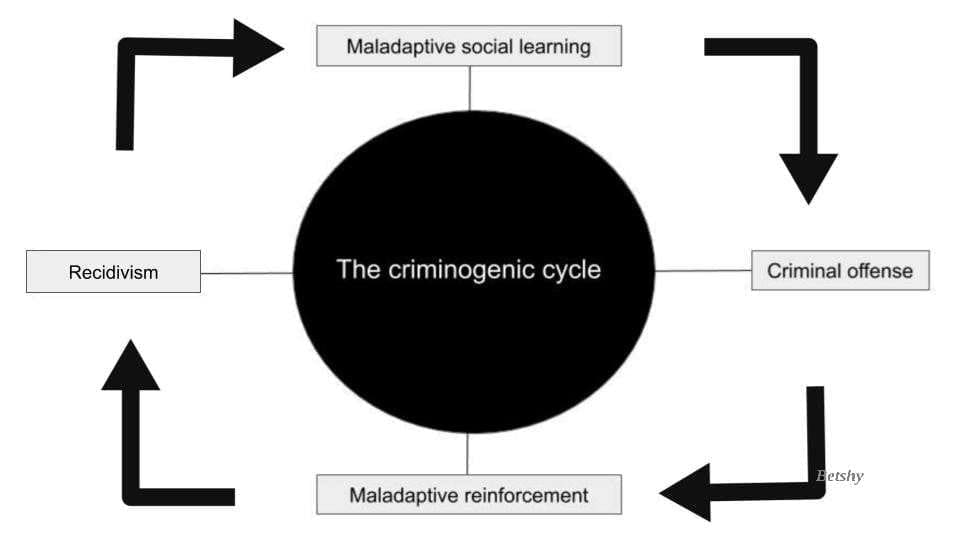
The cycle of criminogenic behaviour
Gillespie and Mitchell (2018, p. 85) describe individuals diagnosed with psychopathy as a personality disorder (ASPD) as “outwardly normal, but were nonetheless extremely callous and unable to express remorse or guilt, to the point where they seemed to be devoid of human emotion. The patients were typically of above average intelligence and seemingly charming, though lacked the capacity for love”. Psychopaths who go through the criminal justice system can at times exhibit great criminal versatility. The following is a diagram I designed to illustrate how such criminogenic needs and versatility develop and recur.
National homicide rates per 100 000 population, c. 1984
Blackburn (2005) included a table in his chapter about violent crime and aggression where Colombia is listed as the country with the highest homicide rate in 1984 and this was published in the United Nations year-book (1988). Even though the data has changed massively, and Colombia has dramatically reduced its crime rates; such bloody past would have caused generational trauma without a doubt, and the Colombian people would have had to adapt to survive potential death anywhere at any time if they upset the wrong person. Many political leaders were assassinated in order to stop the people from interfering with the criminal business of the mafia. A lot of blood was shed, and the Colombian people were over-exposed to extreme levels of danger to the point where the entire nation was having a humanitarian crisis, which still echoes, and which is still being solved.
Country
Rate
Colombia
37.4
Mexico
17.9
Brazil
13.4
Venezuela
12.9
USA
8.5
Ecuador
7.1
Argentina
3.8
Hungary
2.7
Canada
2.3
Italy
2.1
Australia
1.9
Poland
1.6
Austria
1.4
Israel
1.4
France
1.3
Scotland
1.3
New Zealand
1.2
FDR
1.2
Spain
1.0
Greece
0.9
England and Wales
0.7
Egypt
0.5
Source: United Nations (1988). Demographic yearbook. New York: United Nations Publishing.
Case study: the criminal career of sicario alias Popeye
The following video covers the developmental trajectory of Jhon Jairo Velasquez Vasquez’ criminal career, the political context in which he was rewarded with attention and money for being a hired gun; and how such media attention has led to some of the Colombian people seeing and treating him as a celebrity. Behind this story is a real case of a mental health crisis where the hypernormalisation of violence from recent decades was so extreme, that many people became desensitised to the actions of this type of individual, seeing no difference between what is right and what is wrong. Furthermore, this documentary analyses some of the confessions of Popeye as the primary psychopath that he was, and shows how what is ‘normal’ in a country, is ‘abnormal’ in other places. Popeye specialised in crime, and developed all the skills needed for the criminal business. This makes an interesting case for forensic psychology, and for media studies.
2015 Popeye Full TV Interview. Part 1 of 3. English Subtitles (2018) Youtube video, added by Colombian History X [Online]. Available at https://www.youtube.com/watch?v=M6NGWNrzg88 (Accessed 8 March 2020).
Blackburn, R. (2005) The Psychology of Criminal Conduct, West Sussex, John Wiley & Sons/ University of Liverpool, pp. 210-245.
Escobar’s Hitman. Former drug-gang killer now loved and loathed in Colombia (2017) Youtube video, added by RT Documentary [Online]. Available at https://www.youtube.com/watch?v=BQy_LJdZ7qw (Accessed 8 March 2020).
Gillespie, S. M. and Mitchell, I.J. (2018) ‘Psychopathy’, in Davies, G.M. and Beech, A.R. (eds), Forensic Psychology: Crime, Justice, Law, Interventions, 3rd ed, West Sussex, British Psychological Society/ John Wiley & Sons, pp. 85-100.
Popeye: The Jailhouse Interviews Pt. 1 – English Subtitles (2018) Youtube video, added by Colombian History X [Online]. Available at https://www.youtube.com/watch?v=EaPw1EEPOCc(Accessed 8 March 2020).
Psychopathy is a much debated topic in psychology. A lot of people are wondering nowadays what the difference is between a psychopath, a narcissist, and a sociopath. Because these terms tend to overlap with each other in meaning, there are models created in forensic psychology to illustrate the varied manifestations of this condition, which is often diagnosed in psychiatry as antisocial personality disorder (ASPD). This essay will focus on the word “psychopath” as a concept and will try to explain how those with psychopathic behaviours can be detected. After reading this article, you should be able to:
Because this is such a complex topic which is beyond the scope of one single post, I will in the future expand on these maladaptations which are permeating the status quo. For instance, the local newspaper has been increasingly reporting fairly recent fire incidents in Plymouth which are suspected arson incidents (Preston-Ellis, 2020). As a student of forensic psychology, I think this is truly a worrisome situation, as arson has been for a long time a hallmark of psychopathy; and to see that such symptoms are becoming an epidemic poses numerous serious questions about public health.
Gillespie and Mitchell (2018, p. 85) describe psychopaths as “outwardly normal, but nonetheless extremely callous and unable to express remorse or guilt, to the point where they seemed to be devoid of human emotion”. Moreover, they have contributed to the contentious debate of whether psychopaths are capable of feeling anxiety at all. The first subtypes of antisocial personality disorder that emerged were primary psychopathy and secondary psychopathy. Secondary psychopathy is less prototypical, and its manifestations can be confused with other personality disorders, such as narcissistic personality disorder (NPD) and borderline personality disorder (BPD). Primary psychopaths are unable to feel fear or anxiety (Gillespie and Mitchell, 2018), and their brains have serious neurodevelopmental deficits; whereas secondary psychopaths are perceived as being capable of having social anxiety traits and depression. There is much neuropsychological research about primary psychopathy emphasising the role of the brain in such lack of ability to experience the primary emotions that all animals with a limbic system can experience. For instance, Durães and Borralho (2017, p. S681) stated:
“Defects in the amygdala and the prefrontal cortex have been implicated in the pathological basis of psychopathy. The most affected areas are the ventromedial prefrontal cortex (VMPC) and the associated anterior cingulated cortex. Alterations in connectivity between the amygdala and the VMPC with other areas of the brain have been demonstrated and seem to be responsible for the non-empathetic, unemotional, and amoral features of psychopaths”
According to Duggan and Howard (2015), there are four types of psychopaths. This has been illustrated in a model containing all subtypal characteristics. Even though this model covers a wide range of traits, it is still a contentious topic, and the psychopathy debate requires clearer and more consistent transnosological definitions in order to elucidate the construct for the layperson. Not all mental health professionals think similarly, and whether psychopaths can be socially anxious and vulnerable continues to fuel the cycle of enquiry.
Psychopathy subtypes
Zooming into the above information and adopting an interpersonal context for analysis, here are a few signs that could alert you of the possibility of knowing a psychopath in your life. Some of these traits might already be familiar to you, especially if you read online psychology magazines such as Psychology Today (n.d) which often cover these types of topics. Because ALL psychopaths are narcissistic, we will focus on this consistent trait across models to interpret their behaviours:
This person will mistake your kindness for weakness. He or she will think that you are kind because they tricked you into being nice. A false belief that leads them to react explosively once you say “no” to a whim. This is a narcissistic injury for the malignant person.
The malicious person will also deliberately prey on those they perceive to have greater advantage over, especially if they are also severely addicted to a substance. The addictive personality will manifest in the most dysfunctional, and antisocial way when intoxicated.
Secondary psychopaths have the capacity to feel anxiety and fear, unlike the primary psychopath (see Ted Bundy for the iconic primary prototype). They are essentially what people call “sociopaths”, and they can experience states of narcissistic melancholia when they go through inconvenient circumstances, or when things do not go their way. They tend to have a weak superego, and are unable to understand how their anger management problems were formed, interpreting these types of behaviours as normal.
Relevant Questions & Answers
Do all psychopaths commit crimes?
No, the reality is that there are many psychopaths who choose careers where they can develop their moral side. These psychopaths do not become dysfunctional, especially if they were raised in a relatively healthy environment. It is dysfunctional psychopaths that often make it to the criminal justice system, and who specialise in criminal careers. Controlled psychopaths, however, can succeed and thrive.
Why do they treat people like that?
These extreme personalities depend on all types of self-justifications, and their grandiose narcissistic side is actively concerned with trying to deceive the other person because they cannot use reason to assess their irrational behaviour, and cannot pinpoint their own inconsistencies. Especially in the case of the grandiose secondary psychopath, as this person tends to consider themselves “good”, “educated”, and “evolved”; but because they cannot tap into the social constructionism of these terms, and because they think that everyone else is stupid, they are less willing to receive knowledge and information that challenges whatever they have determined themselves to believe, regardless of the evidence (e.g. doing class A drugs because this person is “immune”, when as a matter of fact they are not immune, and they simply have not done their research about substance tolerance). They are extremely sensitive to any situation which reveals their mental problems (because this person does not even know that their issues are obviously wrong), and they don’t like changing because they think they are superior, and fine as they are.
What is a good person in their opinion?
For the malignant personality, a good person is anyone who does not offend, insult, or accidentally outsmart… them. As long as you are soothing their narcissistic needs, you are lovely. You must always do the right thing, and the right thing to do for the malicious person is to please their demands. Not meeting such expectations can trigger the worst in them.
Do they change?
Rarely. As a matter of fact, that’s how you can recognise the malignant personality. They hate to have to change, and expect the world to adjust to them instead. They think they deserve all the entitlement they get, and are often willing to use coercion rather than hard work for many purposes. Truth is too painful for the narcissist, so they prefer to think everyone else is abnormal, even though that’s not how truth and democracy works mathematically, so they avoid changing and often severely damage those who try to help.
How about their childhood… Should I care?
Whilst it is true that dark personalities are created in truly traumatic childhoods, some do even become worse than their parents. Secondary psychopaths are at times constantly re-living their childhoods, and can show signs of regressive behaviour, suggesting that there might be a relationship between specific childhood fixations and reaction formation being displaced towards those who are more vulnerable than them, just like their childhood felt.
How can these individuals function socially?
It would require daily socialisation and intensive community support. In most cases, it is a personality disorder, not a mental disorder. This means that progress for the sociopath would entail first developing environmental and social skills. These individuals can be highly inconsistent (on one side they might claim to love Earth, but on the other side they might litter their own homes, not recycle, and live in truly filthy and abnormal conditions). Furthermore, if a psychopath becomes dysfunctional and notorious, then this might be a result of their childhood experiences, their circumstances, or their mental health. As stated above, there are many psychopaths who lead normal, functional, and even moral lives. They are able to learn how normality works, and are intelligent enough to know that breaking the law is a subtle prediction for bad consequences. The dysfunctional psychopaths are a minority.
What’s the UK GOV doing to provide forensic rehabilitation for psychopaths?
When malignant personalities go as far as causing criminal harm, the court might order them to attend psychotherapy. Apart from that, not much is done to protect these people (and their victims) from making decisions that are harmful to themselves or others. Truth is that it is often when something goes terribly wrong that these personalities come to the attention of the authorities. Until then, there is rarely any concern, as the GOV tends to prioritise public safety over individual wellbeing and crisis prevention; as well as security over treatment. So this is a really unfortunate situation in the UK.
Disclaimer: Please note that there are many other conditions which may cause a person to behave in ways that are antisocial, such as psychosis. If you or someone you know is acting in an abnormal way, and have been diagnosed with a mental disorder; it is most likely that they are having a crisis, and need professional intervention. Call 999 if anyone is at risk of hurting themselves or others.
References
Duggan, C. and Howard, R. (2015) ‘Personality Disorders: Assessment and Treatment’, in Chrighton, D.A. and Towl, G.J. (eds), Forensic Psychology, 2nd ed, West Sussex, British Psychological Society/ John Wiley & Sons, pp. 265-288.
Gillespie, S. M. and Mitchell, I.J. (2018) ‘Psychopathy’, in Davies, G.M. and Beech, A.R. (eds), Forensic Psychology: Crime, Justice, Law, Interventions, 3rd ed, West Sussex, British Psychological Society/ John Wiley & Sons, pp. 85-100.