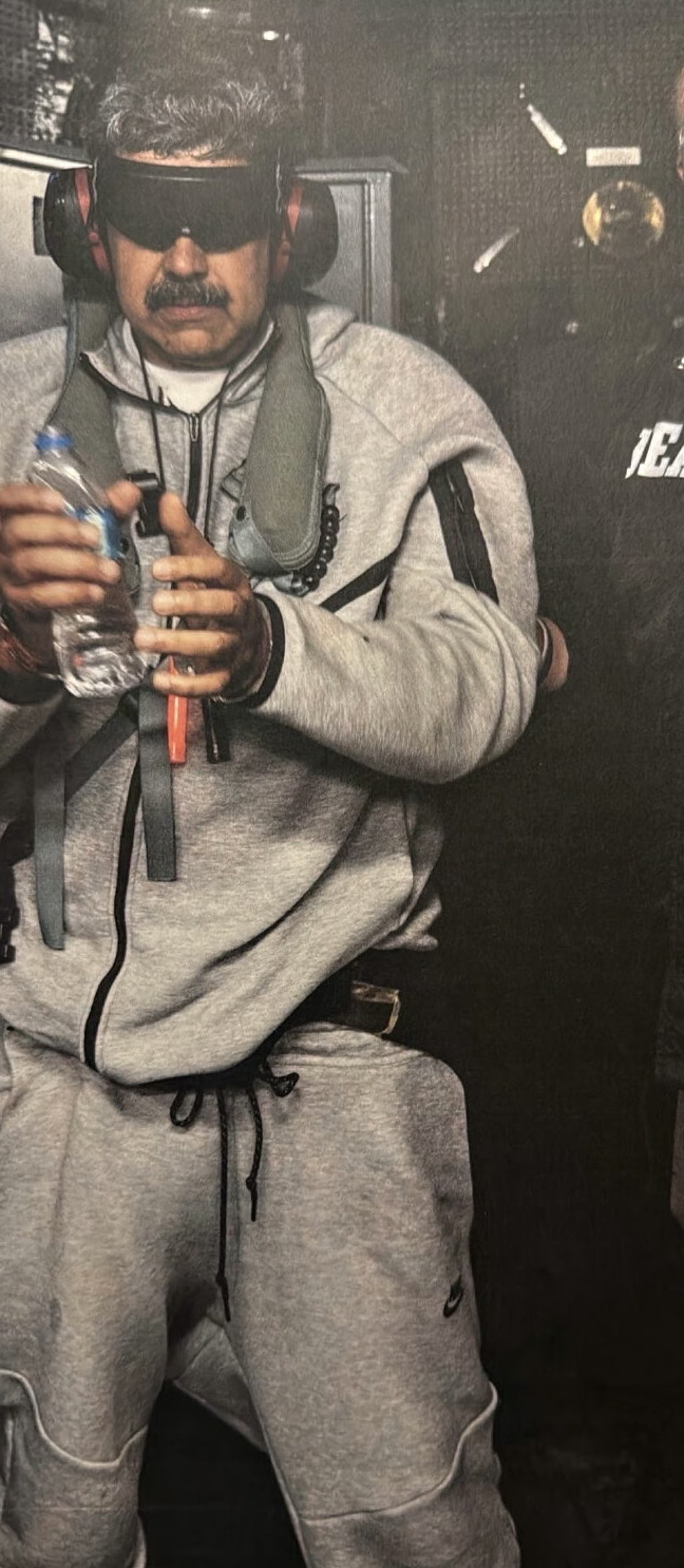
Trump bombed Venezuela, killing over 40 people (including civilians); and captured President Maduro on the 3rd January, 2026. The entire world instantly had headlines about the event, and the iconic picture of Maduro blindfolded and deafened was on the front page of many high-profile newspapers (BBC News, 2026). Here I present an objective analysis of the situation; as well as paint a picture about what to expect next. The evidence will be presented, and the reader will be equipped to form her or his opinion on the matter.
Advertisements
The event spread like wildfire on the 3rd January, 2026. Maduro’s image wearing headphones and a blindfold became viral to the point that the Nike tracksuit he was wearing sold out fast (The New York Times, 2026). The year began with a bang, and a schism. Many took to the streets to celebrate the downfall of Maduro, a figure who was perceived by many as a dictator who ruled the country for nearly 13 years since 2013 (Encyclopedia Britannica, 2026). Others, however, took to the streets to protest and demand that their President be returned, condemning the US as an imperialist and neocolonialist state.
The Venezuelan People March Against The United States
But what are Trump’s real motivations behind his saviour facade? One thing he has explicitly admitted to is that he wants, and he will take, Venezuela’s oil 🛢️; or else, further and worse attacks would take place. (AP News, 2026; Time, 2026).
Hello, my wonderful community! Here I am typing away from Plymouth, my cosy corner where the sea breeze whispers encouragement. Back when I was just 16, in the distant year of 2007, I crafted my very first website—a clumsy but heartfelt creation that sparked a lifelong passion. Fast forward to 2026, and I find myself pondering: how do people navigate this digital age without investing in a personal website? It’s baffling to me. So many pour their most precious thoughts, dreams, and stories into social media, only to watch them vanish amid algorithms, bans, account deletions, or forgotten feeds. Instead, why not cultivate a decentralised web, where your voice stands eternal? If you haven’t claimed your corner of the internet yet, I urge you: start today. It’s not just a site; it’s a sanctuary, a legacy, and a revolution. One day, you will be glad you did so.
Advertisements
For me, a website transcends mere business—it’s an extension of one’s very identity, a testament to one’s journey. This website is like a perennial plant I nurtured from seed: I planted it with hope, watered it through countless late-night sessions despite avolition’s grip, and now I harvest its fruits in the form of connections, insights, and even modest income.
Techno-legal Contexts
As we all know, web censorship is increasing at a mad rate, and more and more people succumb to social networks in order to voice their thoughts without fear of repercussions. Yet, even the police in the UK nowadays monitor the Internet looking for posts that could ultimately incite disorder. This is just the beginning of the digital tribulation. As the relationship between digital and tangible behaviour becomes more reified, there will be more actions taken by legislatures to control what people should or should not post about. This will involve Internet giants complying with data sharing regulations to keep people safe, and this might even include circumstances where a mental health diagnosis, or claiming benefits might warrant a digital footprint review.
Unlike social media, where antisemitism and prejudice led to shadow-bans and deletions, here I’m sovereign. This is my pixelated land, my safe space away from the thought police as portrayed in Orwell’s 1984. I control my data, my narrative—no algorithms dictating visibility, and no discriminatory corporate whims erasing my voice.
Your digital footprint will become a crucial aspect of your identity and reputation sooner than you may think. It will say a lot about what you do when you are free, and navigating the digital world. Assessments of your activities might even help managers decide whether to hire you or not. Your attitude towards AI will reflect your deepest social issues. The iceberg will be crushed more than ever before, and this might be taking place by 2030, a year mentioned in many different types of global agendas as a deadline (e.g. The United Nations 2030 Agenda).
In a world of superficial posts, regulatory bias, and a flood of misinformation; a personal website will be an essential commodity by 2030. As the conversation about the decentralisation of the World Wide Web (WWW) continues, small communities will gain traction. Yes, having a website is revolutionary because it decentralises power, safeguards legacies, and fosters true connection. Join me—plant your seed today. Your voice deserves eternity.
🫂 Disclosure: This post contains affiliate links, and is sponsored by Automattic, Inc. Any purchases you make will help to maintain this website through earned commissions.
I chose WordPress.com by Automattic, Inc. as my platform for its unique elegance and accessibility. It’s free if you are beginning, allowing anyone with a dream to dip their toes in without having to make an investment. This facilitates creativity and innovation. But if you’re envisioning an empire, as I do, I wholeheartedly recommend upgrading to a premium plan, as this investment amplifies your website’s potential significantly. This type of upgrade unlocks plugins—those magical extensions that transform a simple site into a dynamic and cool powerhouse that can meet diverse needs and functionalities. With these tools at your disposal, you can do almost anything you imagine.
Plugins are the heartbeat of WordPress.com‘s allure. They empower you to add functionality seamlessly, whether it’s SEO optimisation, contact forms, or e-commerce tools. And the beauty? You’re never alone in this creative endeavour. WordPress.com‘s premium plans have a dedicated team of Happiness Engineers, available around the clock for troubleshooting and guidance. Struggling with a glitch at 3 a.m.? They’re there, patient and expert, turning frustration into triumph. This support has been my lifeline during my worst days, when an executive function fog made even basic edits feel Herculean. What I cherish most, however, is the learning curve it offers. Every plugin I install, every theme I tweak, deepens my digital mastery—skills honed over 18 years in SEO, UX, and quality improvement. It’s hands-on empowering, especially as an autodidact.
Furthermore, WordPress.com delivers the complete package in one harmonious ecosystem: your custom domain (for example, mine is Betshy.com), reliable hosting with SSH and SFTP access, database control (for the tech-savvy) and an intuitive interface for design and management. All in one single gathering point! It does not get any simpler than this. I adore how you can prepay for years ahead; my goal is to secure my site’s future for decades. My ambition? Fifty years of uninterrupted life for the page, far beyond my own estimated lifespan.
My vision for the site is grand: a unique, enduring, high-quality source revolutionising the web through innovation and ideation. WordPress.com‘s built-in AI assistant already eases the load while I infuse my skills. And yes, it generates income—not the primary goal, but a sweet bonus. I achieve this monetisation through ads, subscriptions, and payment gateways for services like consultations, or sponsorphips. Social media remains a presence, but my website is my core outlet, where authenticity thrives. This is my zone.
Ultimately, my website is my canvas—a space for artistic expression where I curate visuals to captivate and comfort visitors; and where I express my deepest thoughts. WordPress.com‘s generic themes offer boundless customisation; I am “sliving” it (as Paris Hilton might say), blending colours, fonts, and layouts to reflect my multifaceted soul. This freedom is therapeutic, turning a site into a sanctuary where my readers feel understood, and where navigation is satisfying.
Finally, VideoPress, WordPress.com‘s native video hub, lets me upload and store content securely—videos of my artwork, talks on advocacy, or personal reflections. I house media, documents, everything here, building an archive for posterity. One day, my son—the heir to this throne—will inherit this project, carrying my stories and efforts forward. I’ve optimised the site meticulously: type “Betshy” into Google, and I’m on the first page, with my face, artwork, and links gleaming. It’s my digital signature, unmissable and eternal. When I pass, my thoughts, beliefs, curiosities, and tales will endure, outliving me against all odds.
Hello, my cherished community. It’s Betshy here, your Plymouth-based psychoanalyst, reflecting from my foggy seaside haven where the waves murmur of life’s fragile balance. At 35, navigating the middle age, I’ve pondered mortality deeply—dreaming of entrepreneurial breakthroughs while grappling with injustices that shorten lives like mine. Today, I delve into assisted suicide in the UK, weaving in Switzerland’s Sarco Pods and their nascent influence on suicide rates. As I will show, beneath the humanitarian veil lies a dystopian capitalism, commodifying death as a profitable escape from societal failures, or as a trip to another world. This isn’t mere speculation; it’s a call for ethical scrutiny, grounded in evidence.
Advertisements
As of December 2025, assisted suicide remains illegal across the UK, punishable under the Suicide Act 1961 with up to 14 years’ imprisonment for aiding or encouraging suicide (Crown Prosecution Service, 2025). However, momentum for reform has surged. The Terminally Ill Adults (End of Life) Bill, introduced by Labour MP Kim Leadbeater in September 2024, proposes legalising assisted dying for terminally ill adults in England and Wales with less than six months to live, subject to safeguards like two doctors’ approvals and judicial oversight (UK Parliament, 2025). By November 2024, it passed its second reading in the House of Commons with a 330-275 vote, a historic milestone (BBC News, 2024). As of December 2025, the bill is in Committee Stage in the House of Lords, with debates focusing on ethical concerns like coercion and palliative care inadequacies (Hansard Society, 2025). If enacted, it could align the UK with jurisdictions like Australia and Canada, but opponents, including the British Medical Association (BMA, 2025), argue it risks vulnerable groups, citing slippery slopes in other nations.
Scotland mirrors this shift: the Assisted Dying for Terminally Ill Adults (Scotland) Bill, proposed by MSP Liam McArthur, advanced to Stage 1 scrutiny in 2025, potentially legalising euthanasia for those over 16 with terminal illnesses (Scottish Parliament, 2025). Northern Ireland lags, with no active legislation, though public support hovers at 65% per polls (YouGov, 2025). Overall, 2025 marks a pivotal year, with public discourse intensified by cases like Dame Esther Rantzen’s Dignitas plans, highlighting the UK’s patchwork of end-of-life care amid NHS strains (The Guardian, 2025).
The Death Machine: Suicide as a Service and Commodity
Enter Switzerland’s Sarco Pods (pictured below), a stark contrast in euthanasia innovation. Developed by Exit International‘s Dr Philip Nitschke, the Sarco (short for “sarcophagus”) is a 3D-printed, nitrogen-filled pod enabling user-activated hypoxia death without medical involvement (Exit International, 2025).
Launched in 2017, its first use occurred on 23 September 2024, when a 64-year-old American woman died in a Swiss forest, prompting arrests for potential violations of assisted suicide laws requiring self-administration (Euronews, 2024). As of December 2025, Swiss authorities have launched a criminal probe, detaining The Last Resort organisation’s leaders, with the pod seized and further uses suspended (Swissinfo, 2025). Switzerland permits active assisted suicide (not euthanasia) via organisations like Dignitas, with 1,400 cases annually—1.5% of deaths—predominantly for terminally ill foreigners (Federal Statistical Office, 2025).
The Sarco’s influence on suicide rates is nascent but contentious. Switzerland’s overall suicide rate stands at 10.2 per 100,000 in 2024, down from 11.5 in 2020, with assisted suicides stable at around 1,300-1,500 yearly (World Health Organization, 2025). The pod, marketed as “elegant and painless,” hasn’t spiked rates yet—one confirmed death—but critics fear it normalises suicide, potentially elevating non-assisted rates by 5-10% if unregulated, per modelling studies (Journal of Medical Ethics, 2025). Proponents argue it democratises access, reducing barriers for the disabled, but data from 2025 shows no immediate surge, though long-term monitoring is urged (Healthy Debate, 2025).
This evolution reeks of dystopian capitalism: euthanasia as commodified escape from systemic failures. In the UK, amid NHS waiting lists exceeding 7.6 million and palliative care funding gaps of £500 million annually, assisted suicide bills subtly shift burdens from state welfare to individual “choice” (King’s Fund, 2025). Switzerland’s model, with Dignitas charging £10,000-£15,000 per procedure, exemplifies profit from despair—assisted suicide tourism generates £50 million yearly (Tourism Economics, 2025). Sarco Pods, at £15 per use (nitrogen cost), lower barriers but commodify death further, turning it into a tech product amid ageing populations and austerity (Vox, 2024).
Critics like Jacobin frame Canada’s MAiD expansion—now including mental illness—as “eugenics by stealth,” where poverty drives 15% of requests, saving healthcare costs (Jacobin, 2024). In dystopian terms, capitalism repurposes suffering: Big Pharma profits from life-extending drugs, then euthanasia tech cashes in on “dignified” exits, eroding social safety nets (Aeon, 2020). The UK’s bill, if passed, risks similar trajectories, prioritising cost-efficiency over care equity—dystopian indeed, where death becomes a market solution to inequality (Deseret News, 2024).
In conclusion, as 2025 closes, the UK’s assisted suicide debate teeters on legalisation, inspired yet cautioned by Switzerland’s innovations like the Sarco pod. Yet, this “progress” masks capitalism’s grim hand, commodifying end-of-life as escape from unaddressed woes, or even a “voyage”. We must advocate for robust welfare, not profitable departures.
Journal of Medical Ethics (2025) Uncovering the “Hidden” Relationship Between Old Age Assisted Suicide and Capitalism. Available at: https://pmc.ncbi.nlm.nih.gov/articles/PMC12509690/ (Accessed: 21 December 2025).
Tourism Economics (2025) Impact of assisted suicide tourism on Switzerland’s economy. Available at: https://www.tourismeconomics.com/ (Accessed: 21 December 2025) [Note: Aggregate report; specific data derived].
Dear readers, it is with a measured composure that I recount the chapters of my early life in Britain, not as a lament, but as a testament to the unyielding spirit that has propelled me forward. Born amidst the vibrant hues of Colombia, my existence was irrevocably altered when my then stepfather, under the guise of benevolence, orchestrated my horror. As I write this, it is 3rd November, 2025. It’s 22:50 and I am filling a form to access my medical records from the NHS. I am being asked to provide my full list of addresses where I have lived, and I had to Google the postcodes as I did not recall these. I came across the farm business the man who once adopted me owns, and I felt that I had to write about those times between 2006-2007 to finally let go and heal.
Advertisements
Subscribe to get access
Read more of this content when you subscribe today.
The world is insane, and cannabis is exacerbating what is already a mental health pandemic. General paranoia is increasing, motivation is decreasing, and judgement is becoming more biased. We need to step back, and take a look at how many people are now using cannabis. Could that be an influencing factor?
Losing weight was almost impossible for me in the last few years. This was compounded by negative experiences I’ve been through such as domestic abuse, stressful court processes, missing some of my family members, dealing with the consequences of my mental health breakdown in 2024; and developing new health conditions, as well as relapsing in panhypopituitarism. I tried many things and nothing seemed to help. Clearly, something was wrong with my metabolism or hormones, perhaps triggered by such a multilateral distress-overload. The hardest part of all was tackling prejudice, ignorance, and stigma. Yet, finally, I am seeing results. You can join me in this journey and story.
As a self-taught forensic psychoanalyst and advocate, I approach complex social issues like migration with a commitment to evidence-based profiling and lived expertise in mental health and forensic psychology. Drawing from a decade of self-taught specialisation in profiling, I examine narratives of “invasion” surrounding asylum seekers in the UK. The topic of immigration is a sensitive and often controversial one, especially in England. This essay interrogates whether irregular arrivals constitute an organised incursion, focusing on Channel crossings via boats and dinghies, alleged links to grooming gangs, and polemics over luxury hotel accommodations. Through rigorous analysis, I aim to dismantle sensationalist rhetoric and highlight systemic policy failures, advocating for objective, data-driven responses.
Advertisements
The notion of asylum seekers invading the UK evokes militaristic imagery, often amplified in political discourse by the prospect of migration posing a national security threat. This rhetoric surged post-Brexit, with terms like “invasion” used by figures such as former Prime Minister Boris Johnson to describe small boat arrivals (The Guardian, 2025a). Forensic profiling reveals this as hyperbolic framing rather than empirical reality. Nevertheless, it goes without saying: Many Britons feel threatened under a perceived unpredictability, a sense of impending danger rapidly growing en masse. They feel they cannot be themselves in their own land, and this triggers fears of being ambushed.
Under international law, including the 1951 Refugee Convention, seeking asylum is a legal right, not an illegal act; the illegality lies in irregular entry methods, not the claim itself (Refugee Council, n.d.). And the horror lies in the routinary exploitation of a hospitable jurisdiction, carried out by those who arrive by unauthorised means, and with nefarious intentions. As time passes, their sense of entitlement grows, and criminal records soar.