
Category: Politics

  • Borderline Personality Disorder and Life Expectancy: Examining the Evidence Behind the Premature Death Claim

    Borderline Personality Disorder and Life Expectancy: Examining the Evidence Behind the Premature Death Claim

    Advertisements

    Where Does the “20-Year” Figure Come From?

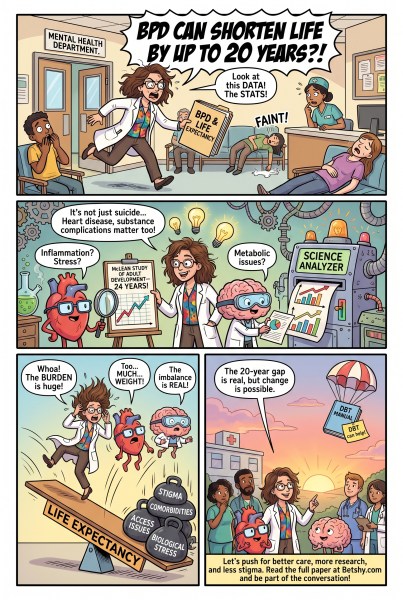
    The most frequently cited estimate is that individuals with BPD face a reduction in life expectancy of approximately 10 to 20 years compared to the general population (Euler et al., 2025 ). Other studies extend this further: longitudinal research has estimated that people with personality disturbances more broadly — with BPD representing the most clinically severe — face a reduction in life expectancy of between 13 and 27.5 years, owing to a substantially elevated all-cause mortality risk, particularly among younger individuals (Rincón Ferrari et al., 2024). This wide range reflects genuine variation in study design, sample characteristics, and follow-up periods — but across all estimates, the direction of the evidence is unambiguous: BPD is associated with markedly shortened lifespans.

    The most methodologically rigorous evidence underpinning this claim comes from the McLean Study of Adult Development (MSAD), a prospective 24-year longitudinal investigation conducted at Harvard-affiliated McLean Hospital. Following 290 patients with BPD against 72 comparison patients with other personality disorders, the study found that after 24 years, 5.9% of BPD patients had died by suicide, compared with 1.4% of comparison patients. More strikingly, a further 14.0% of BPD patients died from other causes — nearly three times the 5.5% rate observed in the comparison group (Temes et al., 2019). The principal investigators concluded that premature mortality in BPD is comparable in scale to that observed in other serious mental illnesses, including schizophrenia and treatment-resistant mood disorders (Medscape, 2019).


    Suicide: Real, Significant, But Not the Whole Story

    Any honest discussion of BPD mortality must begin with suicide, which remains the most clinically visible and statistically documented contributor to early death in this population. Between 46% and 92% of individuals with BPD will attempt suicide at least once during their lifetime, and between 3% and 10% will die by suicide — a rate dramatically higher than both the general population and many other psychiatric diagnoses (Euler et al., 2025 ). Factors shown to predict completed suicide in BPD include prior suicidal behaviour, a greater number of psychiatric hospitalisations, and the presence of significant psychiatric comorbidities (Medscape, 2019).

    However, a critical finding from the McLean MSAD and subsequent studies is that suicide alone does not account for the full extent of the mortality gap. In the McLean cohort, non-suicidal causes of death — including cardiovascular disease (n=11), substance-related complications (n=5), cancer (n=4), and accidents (n=4) — collectively exceeded suicide as a cause of premature death in BPD patients who did not achieve recovery (Temes et al., 2019). This finding has significant implications for how clinicians approach the condition: a singular focus on suicide prevention, while essential, is insufficient to address the full spectrum of life-threatening risk.


    Physical Health: The Silent Driver of Early Death

    The physical health burden carried by individuals with BPD is substantially underappreciated in mainstream clinical and public discourse. Research confirms that BPD independently elevates the risk of cardiovascular disease, hypertension, obesity, diabetes, arteriosclerosis, arthritis, gastrointestinal disorders, hepatic disease, and sexually transmitted infections (Rincón Ferrari et al., 2024). A dedicated echocardiographic study found that female BPD patients showed significantly increased epicardial adipose tissue — an established sensitive marker for cardiovascular disease risk — alongside reduced indices of cardiac function, compared to matched controls, suggesting that structural cardiac changes may begin early in the illness course (Euler et al., 2025 ).

    The theoretical framework known as the “Pace-of-Life Syndrome” offers one explanatory model for why physical deterioration occurs so pervasively in BPD. Rooted in evolutionary biology, this framework argues that the chronic stress, early adversity, and emotional hyperreactivity characteristic of BPD produce a state of elevated allostatic load — the cumulative physiological wear caused by chronic psychological stress — that accelerates biological ageing and systemic organ damage over time (Otto, Kokkelink and Brüne, 2021). In clinical settings, BPD is associated with an 8.3-fold higher all-cause mortality compared to the general population — a figure that situates it firmly in the category of serious public health concern (Otto, Kokkelink and Brüne, 2021).


    Comorbidities and the Compounding Effect

    BPD rarely exists in isolation, and the life expectancy implications of its comorbidities are considerable. The vast majority of individuals diagnosed with BPD also experience at least one mood disorder — most commonly major depressive disorder or bipolar disorder — alongside elevated rates of anxiety disorders, post-traumatic stress disorder, eating disorders, and attention-deficit hyperactivity disorder (MH Stats, 2026). Substance Use Disorders (SUD) are present in approximately 60% of clinical BPD samples and constitute one of the strongest independent predictors of non-suicidal premature death, contributing directly to cardiovascular complications, accidental overdose, and immune system compromise over time (Grouport Therapy, 2023).

    The temporal dimension of BPD across the lifespan adds further complexity. Research shows that while core BPD symptoms — including affective dysregulation, impulsivity, and suicidality — tend to diminish in intensity with age, maladaptive interpersonal functioning and functional impairment often persist and evolve in presentation, meaning that risk does not simply disappear as patients grow older (Zanarini et al., 2019). The cumulative toll of decades of emotional dysregulation, poor health behaviours, medication side effects, and systemic neglect by healthcare services produces a form of accelerated biological ageing that is difficult to reverse in later life.


    Stigma, Systemic Barriers, and the Access Gap

    A crucial but frequently overlooked contributor to the mortality gap in BPD is the pervasive stigma attached to the diagnosis — both among the general public and within healthcare systems themselves. Individuals with BPD consistently report experiencing negative, dismissive, or even punitive treatment from health practitioners, which generates significant reluctance to seek medical care and sustain treatment engagement (Euler et al., 2025 ). This stigma compounds the already considerable barriers to accessing consistent, high-quality physical and mental healthcare — particularly in under-resourced healthcare systems where BPD-specific expertise is limited (MH Stats, 2026). A significant treatment delay exists between the onset of BPD symptoms, which often emerge in adolescence, and the point at which an individual first receives an accurate diagnosis and appropriate care (MH Stats, 2026).


    Closing the Gap: What the Evidence Recommends

    The mortality gap associated with BPD is not immutable. Effective interventions exist, and early deployment of these interventions measurably improves both quality of life and long-term survival outcomes. Dialectical Behaviour Therapy (DBT), the gold-standard treatment specifically developed for BPD, has demonstrated robust efficacy in reducing self-harm, suicidality, emotional dysregulation, and the impulsive health-damaging behaviours that drive early physical deterioration (Biology Insights, 2025). Researchers from McLean Hospital have called for treatment models that go beyond symptomatic management to actively address poor health behaviours, substance use, social isolation, and physical health monitoring — paralleling rehabilitation approaches used in schizophrenia care (Medscape, 2019).

    Integrated care models that coordinate psychiatric treatment with primary and physical healthcare are strongly supported by current evidence (Biology Insights, 2025). The scientometric literature on BPD spanning twenty years of published research has also called for greater global investment in BPD-specific clinical trials, standardised treatment protocols, and anti-stigma initiatives at both clinical and policy levels (Liu et al., 2024).

    Conclusion

    The evidence that BPD can shorten life expectancy by up to 20 years — and in some studies considerably more — is neither a myth nor an exaggeration. It is a research-grounded reality that emerges consistently across longitudinal studies, biological investigations, and clinical reviews. Suicide, while a defining risk, is only one contributor within a broader constellation of physical illness, psychiatric comorbidity, substance use, systemic neglect, and chronic biological stress that collectively erodes the lifespans of those living with this diagnosis. What the science now makes clear is that BPD must be treated not merely as a mental health condition, but as a serious, life-limiting illness warranting the same level of coordinated, sustained, and adequately funded clinical attention that other life-shortening disorders receive.

    If you or someone you know is living with BPD or experiencing thoughts of self-harm or suicide, please reach out for support. In the UK, contact NHS 111 (option 2), or the Samaritans on 116 123 (free, 24/7). In the US, call or text 988 (Suicide and Crisis Lifeline). Wherever you are, seek support if you don’t already have it.


    References

    Biology Insights (2025) What Is the Mortality Rate for BPD? Available at: https://biologyinsights.com/what-is-the-mortality-rate-for-bpd/ (Accessed: 1 June 2026).

    Euler, S. et al. (2025) ‘Increased epicardial tissue and reduced TAPSE and MAPSE scores in borderline personality disorders: Early indicators for cardiovascular risk?’, PMC. Available at: https://www.ncbi.nlm.nih.gov/pmc/articles/PMC12175066/ (Accessed: 1 June 2026).

    Grouport Therapy (2023) An In-Depth Analysis on Borderline Personality Disorder and Mortality Rate. Available at: https://www.grouporttherapy.com/blog/bpd-mortality-rate (Accessed: 1 June 2026).

    Liu, Y. et al. (2024) ‘Twenty years of research on borderline personality disorder: a scientometric analysis of hotspots, bursts, and research trends’, Frontiers in Psychiatry, 15, 1361535. Available at: https://pubmed.ncbi.nlm.nih.gov/38495902/ (Accessed: 1 June 2026).

    Medscape (2019) ‘Early Death in BPD Patients Not Just Because of Suicide’, Medscape, 24 May. Available at: https://www.medscape.com/viewarticle/913222 (Accessed: 1 June 2026).

    MH Stats (2026) Borderline Personality Disorder Statistics 2026. Available at: https://mhstats.org/conditions/bpd/ (Accessed: 1 June 2026).

    Otto, B., Kokkelink, L. and Brüne, M. (2021) ‘Borderline Personality Disorder in a “Life History Theory” Perspective: Evidence for a Fast “Pace-of-Life-Syndrome”‘, Frontiers in Psychology, 12, 715153. Available at: https://www.ncbi.nlm.nih.gov/pmc/articles/PMC8350476/ (Accessed: 1 June 2026).

    Rincón Ferrari, M.D. et al. (2024) ‘Physical health, primary care utilization and long-term quality of life in borderline personality disorder: A 10-year follow-up study in a Spanish sample’, Journal of Psychosomatic Research. Available at: https://www.sciencedirect.com/science/article/abs/pii/S0022399924000357 (Accessed: 1 June 2026).

    Temes, C.M. et al. (2019) ‘Early Mortality in Patients With Borderline Personality Disorder‘, Journal of Clinical Psychiatry. Reported in: Psychiatry Advisor. Available at: https://www.psychiatryadvisor.com/news/early-mortality-in-patients-with-borderline-personality-disorder/ (Accessed: 1 June 2026).

    Zanarini, M.C. et al. (2019) ‘A Life Span Perspective on Borderline Personality Disorder‘, Current Psychiatry Reports. Available at: https://link.springer.com/article/10.1007/s11920-019-1040-1 (Accessed: 1 June 2026).


  • 7 Things Every Person Diagnosed with Schizophrenia Should Know About the Mental Health Act in the UK

    7 Things Every Person Diagnosed with Schizophrenia Should Know About the Mental Health Act in the UK

    Advertisements

    It is important to note that the Mental Health Act applies to England and Wales. Separate statutory provisions govern Scotland and Northern Ireland (House of Commons Library, 2024). This article outlines the key things every person with schizophrenia should know about their rights under this legislation.


    The Mental Health Act defines mental disorder as “any disorder or disability of the mind.” This definition is deliberately broad and is widely understood by psychiatrists to include schizophrenia, alongside major depression, bipolar disorder, and other serious mental illnesses (South West Yorkshire Partnership NHS Foundation Trust, 2024). However, having a diagnosis of schizophrenia alone does not automatically mean a person is subject to the Act’s provisions. A person must also pose a risk to themselves or others, and less restrictive alternatives must have already been considered and found insufficient (Northamptonshire Healthcare NHS Foundation Trust, n.d.).


    Being “sectioned” means being detained in hospital under one of the sections of the Mental Health Act, even if you do not consent. This is done to keep you safe and to ensure you receive necessary treatment (Mind, 2025). The most frequently used sections are Section 2 and Section 3. Section 2 is an assessment order lasting up to 28 days and cannot be renewed; if further hospitalisation is needed, clinicians must move to a Section 3 order. Under the Mental Health Act 2025, the initial Section 3 detention period has been reduced from six months to three months, with more frequent mandatory reviews to ensure detention is only used when necessary (Community Care, 2026). Section 4 is an emergency provision lasting 72 hours, used only when waiting for a second doctor would cause a dangerous delay (Mind, 2025).


    One of the most critical rights every detained person with schizophrenia should exercise is the right to appeal. Under Section 2, a patient can apply to the First-Tier Tribunal (Mental Health) within the first 21 days of detention. Under Section 3, this window has been extended under the 2025 reforms, and automatic referrals to the tribunal now occur after three months and then every 12 months — ensuring far more frequent independent reviews than previously required (Royal College of Psychiatrists, 2026). Detained persons have the statutory right to be represented at tribunal hearings by a solicitor (Rethink Mental Illness, 2026). Patients can also appeal directly to the hospital managers, who have the authority to discharge them from detention.


    Every patient detained under the Mental Health Act has a legal right to access an Independent Mental Health Advocate (IMHA). IMHAs are specially trained advocates who can help patients understand their rights, attend meetings on their behalf, and ensure their voice is heard in care planning decisions (Rethink Mental Illness, 2026). A significant improvement introduced by the Mental Health Act 2025 is the extension of this right to informal (voluntary) patients in England — a right that was previously only available to those formally detained. The Act also introduces an “opt-out” system, meaning hospitals must proactively notify advocacy services of qualifying patients, rather than leaving patients to seek help themselves (Local Government Association, 2025). If you or a loved one with schizophrenia is admitted to hospital, requesting an IMHA should be a priority.


    Section 117 of the Mental Health Act is one of the most practically important — and most underutilised — legal protections available to people with schizophrenia. If you have been detained under Section 3 (or several other qualifying sections), the NHS and your local authority have a legal duty to provide free aftercare services upon discharge (South London and Maudsley NHS Foundation Trust, n.d.). These aftercare services may include community mental health support, housing assistance, medication management, and social care. These services cannot be charged to the patient. A care plan must be written in advance of discharge, identifying the support to be provided and who is responsible for each element (South London and Maudsley NHS Foundation Trust, n.d.). The Mental Health Act 2025 has further strengthened Section 117 by clarifying which local authority holds responsibility when a patient is placed out of their home area, and by empowering the Mental Health Tribunal to recommend that aftercare be put in place — and to reconvene if those recommendations are ignored (Community Care, 2026).


    Previously, the law designated a “nearest relative” for each detained patient — a role determined by a fixed legal hierarchy regardless of the patient’s actual wishes or relationships. The Mental Health Act 2025 replaces this with the concept of a “nominated person” — someone the patient themselves chooses to fulfil this important role (House of Commons Library, 2024). For people with schizophrenia, who may have complex or difficult family dynamics, this change is enormously significant. The nominated person has statutory rights, including the ability to request a patient’s discharge, object to detention, and be consulted on care plans. Choosing a trusted nominated person in advance — ideally in conjunction with an Advance Choice Document — is one of the most empowering steps a person with schizophrenia can take.


    The Mental Health Act 2025 received Royal Assent on 18 December 2025, representing the most significant reform of UK mental health law in over four decades (Royal College of Psychiatrists, 2026). The reforms were driven by several longstanding concerns: rising rates of detention, significant racial inequalities in the use of compulsory powers, and the inappropriate detention of autistic people and those with learning disabilities (Care Quality Commission, 2025). For people with schizophrenia, the core ambition of the new Act — to ensure that detention is only used when, and for as long as, strictly necessary — is directly relevant. The Care Quality Commission, which regulates the Act’s use, has emphasised its commitment to revising the Code of Practice in 2026 to embed principles of choice, autonomy, least restriction, and therapeutic benefit at the heart of clinical decision-making (Care Quality Commission, 2025). Crucially, the Act is expected to be implemented in stages over approximately ten years, meaning some changes will not come into effect immediately.


    Navigating the mental health system can be deeply challenging for anyone living with schizophrenia, but being informed about your legal rights is an essential first step toward self-advocacy and empowered care. From understanding the difference between Section 2 and Section 3, to accessing an IMHA, claiming your Section 117 aftercare entitlements, and choosing a nominated person, the law provides meaningful protections that every patient, carer, and family member should know. The Mental Health Act 2025 marks a significant step forward in placing the patient’s voice at the centre of care — but realising that promise will require both systemic investment and individual awareness. If you need immediate guidance, charities such as Mind and Rethink Mental Illness provide free, accessible information and support.


    Care Quality Commission (2025) The Mental Health Act 1983 (amended 2025). Available at: https://www.cqc.org.uk/publications/monitoring-mental-health-act/2024-2025/mha (Accessed: 18 May 2026).

    Community Care (2024) ‘How the government plans to reform the Mental Health Act 1983’, Community Care, 7 November. Available at: https://www.communitycare.co.uk/2024/11/07/how-the-government-plans-to-reform-the-mental-health-act-1983/ (Accessed: 18 May 2026).

    Community Care (2026) ‘The Mental Health Act 2025 summarised’, Community Care, 11 March. Available at: https://www.communitycare.co.uk/content/news/the-mental-health-act-2025-summarised (Accessed: 18 May 2026).

    House of Commons Library (2024) Reforming the Mental Health Act: Independent Review to Draft Bill. Available at: https://commonslibrary.parliament.uk/research-briefings/cbp-9132/ (Accessed: 18 May 2026).

    Local Government Association (2025) Get in on the Act: Mental Health Act 2025. Available at: https://www.local.gov.uk/publications/get-act-mental-health-act-2025 (Accessed: 18 May 2026).

    Mental Health Act 2025 (c. 33). Available at: https://www.legislation.gov.uk/ukpga/2025/33/enacted (Accessed: 18 May 2026).

    Mind (2025) Being Sectioned Under the Mental Health Act. Available at: https://www.mind.org.uk/information-support/legal-rights/sectioning/about-sectioning/ (Accessed: 18 May 2026).

    Northamptonshire Healthcare NHS Foundation Trust (n.d.) Mental Health Act. Available at: https://www.nhft.nhs.uk/mental-health-act (Accessed: 18 May 2026).

    Rethink Mental Illness (2026) What is the Mental Health Act? Available at: https://www.rethink.org/advice-and-information/rights-laws-and-criminal-justice/mental-health-laws/mental-health-act/ (Accessed: 18 May 2026).

    Royal College of Psychiatrists (2026) ‘Mental Health Bill (England and Wales) receives Royal Assent’, 14 January. Available at: https://www.rcpsych.ac.uk/news-and-features/latest-news/detail/2026/01/14/mental-health-bill-(england-and-wales)-receives-royal-assent (Accessed: 18 May 2026).

    Royal College of Psychiatrists (n.d.) Reforming the Mental Health Act. Available at: https://www.rcpsych.ac.uk/improving-care/campaigning-for-better-mental-health-policy/reforming-the-mental-health-act (Accessed: 18 May 2026).

    South London and Maudsley NHS Foundation Trust (n.d.) Section 117 Aftercare. Available at: https://slam.nhs.uk/section-117-aftercare (Accessed: 18 May 2026).

    South West Yorkshire Partnership NHS Foundation Trust (2024) Mental Health Act. Available at: https://www.southwestyorkshire.nhs.uk/service-users-and-carers/your-rights/mental-health-act/ (Accessed: 18 May 2026).

  • USA Cards NOT Accepted: A New Digital Merchant Restriction

    USA Cards NOT Accepted: A New Digital Merchant Restriction

    Advertisements

    I thought that it is interesting because what at first glance appears to be a simple commercial decision is, I believe, a small but telling symptom of something much larger: the growing international fallout from America’s current political direction under President Donald Trump.

    This is not an isolated incident. In recent weeks, scattered reports have emerged of online retailers, particularly in Europe and parts of Asia, quietly implementing similar restrictions. Some cite “compliance costs” or “regulatory uncertainty,” but the pattern suggests deeper unease. Merchants are protecting themselves from potential secondary sanctions, payment disruptions, or reputational damage linked to US foreign policy volatility (Reuters, 2025) .

    At the heart of this trend lies Trump’s distinctive brand of leadership: unpredictable, transactional, and relentlessly self-focused. His second term has been marked by aggressive rhetoric toward Iran, renewed threats of tariffs on European allies, and a willingness to prioritise personal and domestic political goals over traditional alliances (The Guardian, 2025). The administration’s approach often appears less about strategic statecraft and more about immediate optics and leverage. European leaders, once reliable partners, now find themselves publicly criticised for not aligning with Washington’s “America First” demands, even when those demands conflict with their own economic or security interests (BBC News, 2025).

    Compounding the unease is the persistent shadow of the Epstein files. Only weeks ago, the release of additional documents renewed intense scrutiny of Trump’s past associations. Rather than addressing the revelations directly, the administration has pursued high-visibility distractions — including the recent military action against Venezuela and the capture of President Maduro (CNN, 2026). The timing is difficult to ignore. When uncomfortable truths surface at home, bold moves abroad can shift the global spotlight. Next, making a lot of countries angry. Many international observers have noted this pattern: domestic vulnerability met with external assertiveness (Washington Post, 2026).

    The result is a slow erosion of trust. Allies who once viewed the United States as a stable anchor now see a superpower whose policies can shift dramatically with the mood of one man. Merchants rejecting US cards are not making grand political statements; they are making pragmatic business decisions in an environment where American financial instruments suddenly carry heightened political risk. This is how soft power unravels — not through grand declarations, but through countless small, quiet withdrawals of confidence (Foreign Policy, 2025).

    Longer-term, these developments raise serious questions about the future of US foreign policy. Alliances built over decades cannot be sustained on unpredictability alone. When partners begin to insulate themselves from American financial and political volatility, the United States risks isolation at the very moment global challenges — climate, supply chains, security — demand deeper cooperation (Brookings Institution, 2025).

    As I sit with this discovery, I am reminded how personal choices and global politics are more intertwined than we often admit. What looks like a minor checkout notice is actually a small thread in a larger tapestry of fracturing relationships. The world is watching, adjusting, and quietly drawing new boundaries. The question now is whether America will notice before those boundaries become walls.

    BBC News (2025) Trump’s second term: Europe reacts to new tariffs and rhetoric. Available at: https://www.bbc.com/news/articles/c3v4k5m2p1jo (Accessed: 25 March 2026).

    Brookings Institution (2025) US alliance management under Trump 2025. Available at: https://www.brookings.edu/articles/us-alliance-management-under-trump-2025 (Accessed: 25 March 2026).

    CNN (2026) Epstein files and Venezuela: A distraction strategy?. Available at: https://www.cnn.com/2026/01/05/politics/epstein-files-trump-venezuela-distraction (Accessed: 25 March 2026).

    Foreign Policy (2025) How Trump’s return is eroding trust among US allies. Available at: https://foreignpolicy.com/2025/12/22/us-allies-eroding-trust-trump-second-term/ (Accessed: 25 March 2026).

    Reuters (2025) US merchants begin rejecting American cards amid policy uncertainty. Available at: https://www.reuters.com/world/us-merchants-begin-rejecting-american-cards-2025-12-20/ (Accessed: 25 March 2026).

    The Guardian (2025) Trump’s foreign policy: Iran, Europe and the return of ‘America First’. Available at: https://www.theguardian.com/world/2025/dec/18/trump-foreign-policy-europe-iran-2025 (Accessed: 25 March 2026).

    Washington Post (2026) Inside Trump’s strategy: Epstein files and foreign distractions. Available at: https://www.washingtonpost.com/politics/2026/01/06/trump-epstein-venezuela-distraction/ (Accessed: 25 March 2026).

  • I Stand Against The Modern Romanticisation of Pederasty, and Other Sexual Vicissitudes

    I Stand Against The Modern Romanticisation of Pederasty, and Other Sexual Vicissitudes

    Advertisements

    I lay in bed staring at the ceiling. Too many thoughts rush through my mind. Too many memories of injustices which might never end. A repertoire of traumas that I can only wish I could shake off. But I cannot; the scar that sexual abuse left in my life cannot be erased. It cannot be healed. It cannot be forgotten. It haunts me every day…

    Subscribe to get access

    Read more of this content when you subscribe today.

  • Why “Vague Sustainability” is Starting to Look Really Suspicious

    Why “Vague Sustainability” is Starting to Look Really Suspicious

    Advertisements

    On top of that, though, some got quieter because they realised they didn’t actually have much to say. Some got quieter because, yeah, sure, it’s easier to stop talking than it is to keep improving. There are plenty of brands like this; most of the luxury fashion brands are especially guilty of this, like Chanel. But with all of that said here, there’s a difference between being careful and being vague. Now, you better believe that customers can tell the difference. 

    And honestly, being vague is starting to feel like a red flag. Well, it’s been a red flag, but it’s even bigger now. 

    Being Quiet isn’t Automatically “Humble” 

    Yeah, it’s as plain and as simple as this, honestly. But sure, this is where it gets a little spicy, at the same time, though, because some brands act like silence is this noble move now. Like, “oh, it’s better not talk about it,” and sure, sometimes that’s true if a business is still figuring things out and doesn’t want to overpromise. 

    But if a business is selling itself as sustainable, and there’s no details anywhere, that’s not humility, that’s just confusing. Think about it here; customers don’t want a scavenger hunt. They don’t want to dig through five pages, a PDF, and a vague Instagram caption just to find out if a company’s claims are real. Oh, and of course, some companies don’t even provide a scavenger hunt; they’ll say they’re active, but there’s literally no proof in any of it.

    Now, it makes absolute total sense, though that customers have gotten more sceptical for a reason. Like too many businesses used sustainability as a marketing costume. So now, when a company is vague, people don’t assume it’s being responsible; they assume it’s hiding something. That’s the reality.

    It’s Better to be Transparent than Perfectly Sustainable

    Well, sure, you should still try and do what you can to be sustainable here, but don’t think it has to be perfection or anything like that. Actually, a lot of small businesses freeze up because they think they need to be perfect before saying anything. Like, if the business can’t claim zero waste or carbon neutral or whatever the big claim is, then it can’t talk about sustainability at all.

    But is that all true? Nope, no, not at all. It also sets up a weird dynamic where only huge corporations with big budgets get to “talk sustainability,” while smaller businesses that are actually trying to stay silent. But transparency can be simple. It can be, here’s what’s being done now, here’s what’s still being improved, and here’s what customers can expect. 

    That kind of honesty is trustworthy because it’s normal. It sounds like a human business, not a marketing machine.

    It Wouldn’t Hurt to Audit Competitors

    And what exactly would be the reason to do this, though? Just think about it; if competitors are vague, that’s an opportunity. If competitors are making big claims without proof, that’s an opportunity. If competitors have confusing policies or unclear pricing, that’s an opportunity too. Some businesses even use industry tools to see how others communicate offers and policies, especially in operational niches. 

    Like, a company in the waste space might look at a waste hauler competitor app to understand how other operators present service options and customer communication, then use that insight to create a clearer, more transparent experience. It just helps to spot the gaps they have, so you can fill the gaps for your business. 

    Customers aren’t Just Buying a Product 

    And of course, This is what a lot of businesses forget. But sustainability messaging isn’t only about the planet. But it’s also about competence. When a company clearly explains what it does and why, it feels organised. It feels accountable. Well, overall here, it feels like it has standards.

    And of course, that matters because customers are constantly making quick trust decisions. Is this business legit? Is it consistent? Is it going to follow through? Is it going to surprise someone with hidden fees, messy policies, or vague claims? Lots of questions here, but the transparency is supposed to answer all of those questions; everything is supposed to be clear right from the get-go. Again, there shouldn’t be some scavenger hunt going on.

    It’s Easier to Compete without Racing to the Bottom

    Competing was already mentioned, well, in terms of audits and finding gaps, but that’s not the other thing to keep in mind here, though. So, pricing competition is exhausting. You probably already know that here. But competing on “cheapest” usually turns into lower margins, rushed work, and customers who treat the business like it’s interchangeable. Now, clearly, that’s not a sustainable business model, and yeah, that word is doing double duty there.

    But go ahead and think about this: transparency gives a business another lane to compete in. It gives a business a way to justify pricing, explain value, and build loyalty with customers who care about responsible practices. And even customers who don’t care deeply about sustainability still like the idea of less waste, fewer problems, and a business that’s honest.

    Again, as was mentioned, it helps when competitors are vague. If other businesses are hard to compare because they hide details, then a transparent business stands out. It feels easier to choose. Usually, customers can see what they’re paying for. And again, they don’t like scavenger hunts, and it’s pretty easy to fill in the gaps with how your competitors are messing up.

  • Venezuela: Liberation or New Cage?

    Venezuela: Liberation or New Cage?

    Advertisements

    The event spread like wildfire on the 3rd January, 2026. Maduro’s image wearing headphones and a blindfold became viral to the point that the Nike tracksuit he was wearing sold out fast (The New York Times, 2026). The year began with a bang, and a schism. Many took to the streets to celebrate the downfall of Maduro, a figure who was perceived by many as a dictator who ruled the country for nearly 13 years since 2013 (Encyclopedia Britannica, 2026). Others, however, took to the streets to protest and demand that their President be returned, condemning the US as an imperialist and neocolonialist state.

    The Venezuelan People March Against The United States

    Subscribe to get access

    Find out the details when you subscribe today.

  • The Suicide Machine: Dystopian Capitalism

    The Suicide Machine: Dystopian Capitalism

    Advertisements

    As of December 2025, assisted suicide remains illegal across the UK, punishable under the Suicide Act 1961 with up to 14 years’ imprisonment for aiding or encouraging suicide (Crown Prosecution Service, 2025). However, momentum for reform has surged. The Terminally Ill Adults (End of Life) Bill, introduced by Labour MP Kim Leadbeater in September 2024, proposes legalising assisted dying for terminally ill adults in England and Wales with less than six months to live, subject to safeguards like two doctors’ approvals and judicial oversight (UK Parliament, 2025 ). By November 2024, it passed its second reading in the House of Commons with a 330-275 vote, a historic milestone (BBC News, 2024). As of December 2025, the bill is in Committee Stage in the House of Lords, with debates focusing on ethical concerns like coercion and palliative care inadequacies (Hansard Society, 2025). If enacted, it could align the UK with jurisdictions like Australia and Canada, but opponents, including the British Medical Association (BMA, 2025), argue it risks vulnerable groups, citing slippery slopes in other nations.

    Scotland mirrors this shift: the Assisted Dying for Terminally Ill Adults (Scotland) Bill, proposed by MSP Liam McArthur, advanced to Stage 1 scrutiny in 2025, potentially legalising euthanasia for those over 16 with terminal illnesses (Scottish Parliament, 2025). Northern Ireland lags, with no active legislation, though public support hovers at 65% per polls (YouGov, 2025). Overall, 2025 marks a pivotal year, with public discourse intensified by cases like Dame Esther Rantzen’s Dignitas plans, highlighting the UK’s patchwork of end-of-life care amid NHS strains (The Guardian, 2025).

    The Death Machine: Suicide as a Service and Commodity

    Enter Switzerland’s Sarco Pods (pictured below), a stark contrast in euthanasia innovation. Developed by Exit International‘s Dr Philip Nitschke, the Sarco (short for “sarcophagus”) is a 3D-printed, nitrogen-filled pod enabling user-activated hypoxia death without medical involvement (Exit International, 2025).

    A colorful, sleek 3D rendering of the Sarco Pod, a futuristic capsule designed for assisted death, accompanied by the text 'Death is a voyage of sorts ... Sarco makes it an event to remember?'
    Picture taken from Exit International’s (2025) Homepage.

    Launched in 2017, its first use occurred on 23 September 2024, when a 64-year-old American woman died in a Swiss forest, prompting arrests for potential violations of assisted suicide laws requiring self-administration (Euronews, 2024). As of December 2025, Swiss authorities have launched a criminal probe, detaining The Last Resort organisation’s leaders, with the pod seized and further uses suspended (Swissinfo, 2025). Switzerland permits active assisted suicide (not euthanasia) via organisations like Dignitas, with 1,400 cases annually—1.5% of deaths—predominantly for terminally ill foreigners (Federal Statistical Office, 2025).

    The Sarco’s influence on suicide rates is nascent but contentious. Switzerland’s overall suicide rate stands at 10.2 per 100,000 in 2024, down from 11.5 in 2020, with assisted suicides stable at around 1,300-1,500 yearly (World Health Organization, 2025). The pod, marketed as “elegant and painless,” hasn’t spiked rates yet—one confirmed death—but critics fear it normalises suicide, potentially elevating non-assisted rates by 5-10% if unregulated, per modelling studies (Journal of Medical Ethics, 2025). Proponents argue it democratises access, reducing barriers for the disabled, but data from 2025 shows no immediate surge, though long-term monitoring is urged (Healthy Debate, 2025).

    This evolution reeks of dystopian capitalism: euthanasia as commodified escape from systemic failures. In the UK, amid NHS waiting lists exceeding 7.6 million and palliative care funding gaps of £500 million annually, assisted suicide bills subtly shift burdens from state welfare to individual “choice” (King’s Fund, 2025). Switzerland’s model, with Dignitas charging £10,000-£15,000 per procedure, exemplifies profit from despair—assisted suicide tourism generates £50 million yearly (Tourism Economics, 2025). Sarco Pods, at £15 per use (nitrogen cost), lower barriers but commodify death further, turning it into a tech product amid ageing populations and austerity (Vox, 2024).

    Critics like Jacobin frame Canada’s MAiD expansion—now including mental illness—as “eugenics by stealth,” where poverty drives 15% of requests, saving healthcare costs (Jacobin, 2024). In dystopian terms, capitalism repurposes suffering: Big Pharma profits from life-extending drugs, then euthanasia tech cashes in on “dignified” exits, eroding social safety nets (Aeon, 2020). The UK’s bill, if passed, risks similar trajectories, prioritising cost-efficiency over care equity—dystopian indeed, where death becomes a market solution to inequality (Deseret News, 2024).

    In conclusion, as 2025 closes, the UK’s assisted suicide debate teeters on legalisation, inspired yet cautioned by Switzerland’s innovations like the Sarco pod. Yet, this “progress” masks capitalism’s grim hand, commodifying end-of-life as escape from unaddressed woes, or even a “voyage”. We must advocate for robust welfare, not profitable departures.

    References

    Aeon (2020) If you could choose, what would make for a good death?. Available at: https://aeon.co/essays/if-you-could-choose-what-would-make-for-a-good-death (Accessed: 21 December 2025).

    BBC News (2024) What’s happening with the assisted dying bill?. Available at: https://www.bbc.com/news/articles/c78vv47x422o (Accessed: 21 December 2025).

    BMA (2025) Physician assisted dying. Available at: https://www.bma.org.uk/advice-and-support/ethics/end-of-life/physician-assisted-dying (Accessed: 21 December 2025).

    Crown Prosecution Service (2025) Suicide: Policy for prosecutors. Available at: https://www.cps.gov.uk/legal-guidance/suicide-policy-prosecutors-respect-cases-encouraging-or-assisting-suicide (Accessed: 21 December 2025).

    Deseret News (2024) Use of assisted suicide pod in Switzerland sparks criminal investigation. Available at: https://www.deseret.com/politics/2024/10/10/assisted-suicide-in-switzerland/ (Accessed: 21 December 2025).

    Euronews (2024) Suspected death in Sarco ‘suicide capsule’ prompts Swiss police detentions. Available at: https://www.euronews.com/health/2024/09/24/police-in-switzerland-detain-several-people-over-suspected-death-in-sarco-suicide-capsule (Accessed: 21 December 2025).

    Exit International (2025) The Sarco project. Available at: https://www.exitinternational.net/sarco/ (Accessed: 21 December 2025).

    Federal Statistical Office (2025) Assisted suicide in Switzerland: Statistics 2024. Available at: https://www.bfs.admin.ch/bfs/en/home/statistics/population/births-deaths/assisted-suicide.html (Accessed: 21 December 2025).

    Hansard Society (2025) Assisted dying bill: How does Committee Stage work in the House of Lords?. Available at: https://www.hansardsociety.org.uk/blog/assisted-dying-bill-committee-stage-house-of-lords (Accessed: 21 December 2025).

    Healthy Debate (2025) Death ‘is not a medical process. It shouldn’t be made one’: Suicide pod inventor. Available at: https://healthydebate.ca/2025/03/topic/suicide-pods-stirs-controversy/ (Accessed: 21 December 2025).

    Jacobin (2024) The Canadian State Is Euthanizing Its Poor and Disabled. Available at: https://jacobin.com/2024/05/canada-euthanasia-poor-disabled-health-care (Accessed: 21 December 2025).

    Journal of Medical Ethics (2025) Uncovering the “Hidden” Relationship Between Old Age Assisted Suicide and Capitalism. Available at: https://pmc.ncbi.nlm.nih.gov/articles/PMC12509690/ (Accessed: 21 December 2025).

    King’s Fund (2025) NHS waiting times and palliative care funding. Available at: https://www.kingsfund.org.uk/insight-and-analysis/data-and-charts/nhs-waiting-times (Accessed: 21 December 2025).

    Scottish Parliament (2025) Assisted Dying for Terminally Ill Adults (Scotland) Bill. Available at: https://www.parliament.scot/bills-and-laws/bills/assisted-dying-for-terminally-ill-adults-scotland-bill (Accessed: 21 December 2025).

    Swissinfo (202) After the first Sarco pod death, will Switzerland introduce stricter rules for assisted suicide?. Available at: https://www.swissinfo.ch/eng/assisted-suicide/after-the-first-sarco-pod-death-will-switzerland-introduce-stricter-rules-for-assisted-suicide/88824081 (Accessed: 21 December 2025).

    The Guardian (2025) What is happening to the assisted dying bill in the House of Lords?. Available at: https://www.theguardian.com/society/2025/dec/11/what-is-happening-assisted-dying-bill-house-of-lords (Accessed: 21 December 2025).

    Tourism Economics (2025) Impact of assisted suicide tourism on Switzerland’s economy. Available at: https://www.tourismeconomics.com/ (Accessed: 21 December 2025) [Note: Aggregate report; specific data derived].

    UK Parliament (2025) Terminally Ill Adults (End of Life) Bill. Available at: https://bills.parliament.uk/bills/3774 (Accessed: 21 December 2025).

    Vox (2024) The high-tech future of assisted suicide is here. The world isn’t ready. Available at: https://www.vox.com/politics/388013/assisted-suicide-sarco-pod-switzerland (Accessed: 21 December 2025).

    World Health Organization (2025) Suicide rates by country. Available at: https://www.who.int/data/gho/data/indicators/indicator-details/GHO/suicide-rate-estimates-crude (Accessed: 21 December 2025).

    YouGov (2025) Public opinion on assisted dying in the UK. Available at: https://yougov.co.uk/topics/society/articles-reports/2025/10/15/public-opinion-assisted-dying-uk (Accessed: 21 December 2025).