

When I began this journey in Forensic Psychology, I did not expect to learn as much as I have. The main tenet of this career consists in understanding psychopathy, and psychopathology.
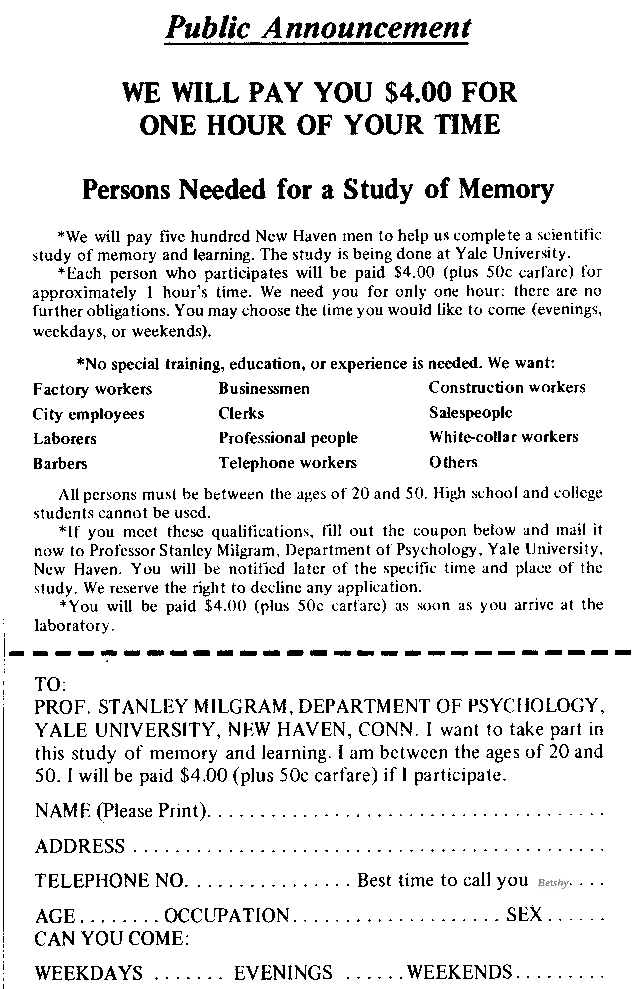
It does make me question authoritarianism and the ways in which it can manifest. For instance, Milgram and Adorno et al. studied the psychology of obedience under pressure, and how following orders led to the holocaust. An aspect that has been questioned little is how scarcity or the fear of scarcity has led to similar phenomena due to how people have been conditioned to see money as an enabler of everyday behaviour. For instance, when Milgram conducted his obedience experiments during the 60s, he monetarily rewarded his participants for taking part in the studies. Modern psychologists have attempted to re-examine the dynamics at Yale’s laboratory and what might have led the participants to show that they were capable of being sadistic under such conditions. An example is Gibson’s (2013) work which meticulously examines the prods given by the experimenter. In a way, Gibson seeked to understand how the orders and requests given by the authority figure contributed to the decision-making processes of the participants. However, I have not come across much research highlighting the role of the monetary incentive in everyday behaviour; or how being given a monetary incentive places a subconscious obligation on individuals to comply with requests, even if such requests at times make them feel uncomfortable.
The c/s/x movement, also known as ‘the psychiatric survivors movement‘ (Wikipedia, n.d.) explores how a large number of individuals report feeling or having felt dehumanised by the mental health system. For the unstigmatised person, it is often more common to assume that all these people expressing dissatisfaction with the system are crazy, than to understand the nature of what it means to respect a person’s dignity and human rights. It is quite a complex situation, because it is unclear what reinforces and keeps some mental health settings from actively listening to their patients’ concerns.
According to Turner (2015), signal detection theory (SDT) “describes processes whereby information that is important to the perceiver (known as the ‘signal’) is distinguished from other information that is unimportant and potentially distracting (known as the ‘noise’). It is my hypothesis that some of the inherently dehumanising behaviours occurring in the mental health system happen as a result of the hyper-normalisation of object-relations with patients. As I mentioned on my post ‘Investigating the neuropsychopathology of prejudice‘, people can at times perceive those with stereotyped and stigmatised characteristics as non-human objects. This would of course increase the chance of mental health settings staff processing signals coming from clients as background noise, rather than as worth-listening-to human signals. Such established conscious and unconscious behaviours leading to the dehumanisation of many clients are reinforced through monetary incentives, and through an intragroup, mob-like co-validation of such unconscious biases. Like Eichmann, many live their lives constantly affirming to themselves that they were just following procedures and orders, or just doing their job; and therefore they believe it is not their responsibility to reflect on how clients are impacted by this. But the signals coming from mental health patients often stand in stark contrast to the common belief that these dehumanising, and at times non-empathic methods are appropriate, or even de facto acceptable.
I do think everyone deserves to be paid for their labour, and that having access to a basic form of income is an important foundation in any society; and I also think that mental health settings need to be encouraged or trained appropriately to detect clients’ signals as more than just background noise (i.e. as more than non-human objects signals) in order to reduce risk outcomes. The situation is problematic, persistent, and pervasive with these manifestations of authoritarianism in mental health settings. It would indeed be arrogant to assume that all the patients/clients expressing dissatisfaction with the service are wrong, or to culturally pathologise reasonable dissent. It would also be irresponsible and de jure unacceptable to fail to take steps towards alleviating feelings of ‘being dehumanised’ in civil society, especially if such feelings of dehumanisation have the potential to lead to never events, such as suicide.
References
Gibson, S. (2013) ‘Milgram’s obedience experiments: A rhetorical analysis’, British Journal of Social Psychology, vol. 52, York, The British Psychological Society/York University, pp. 290-309 [Online]. Available at https://pmt-eu.hosted.exlibrisgroup.com/permalink/f/gvehrt/TN_cdi_gale_infotracacademiconefile_A332152211 (accessed 11 October 2020).
Turner, J. (2015) ‘Making sense of the world’, in Turner, J. and Barker, M. J. (eds) Living Psychology: From the Everyday to the Extraordinary, Milton Keynes, The Open University, pp. 7-45.
Wikipedia (n.d.) ‘Psychiatric survivors movement’ [Online]. Available at https://en.wikipedia.org/wiki/Psychiatric_survivors_movement (accessed 11 October 2020).
Share this:

You Might Also Enjoy Reading