Tag: Quantum

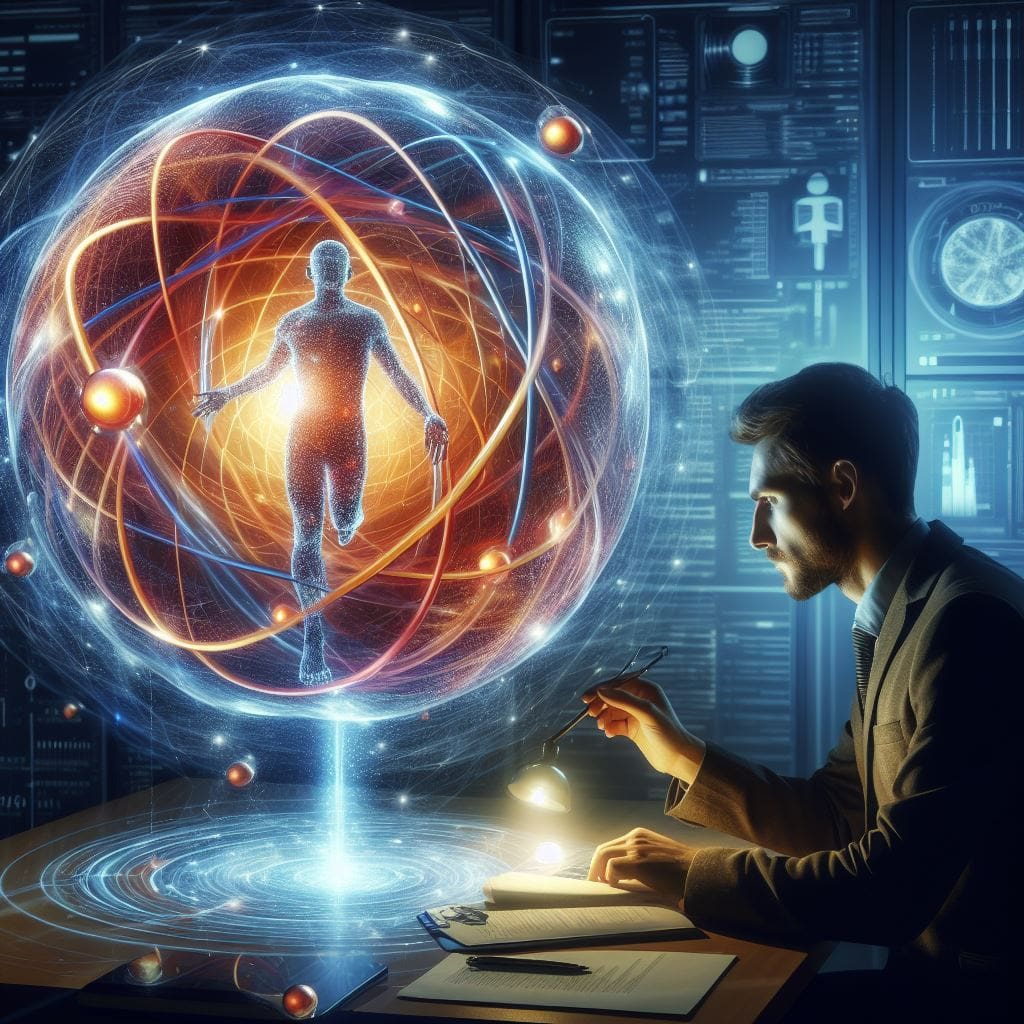
  • The Psychology of Quantum Physics: Unveiling the Mysteries of the Mind and the Universe

    The Psychology of Quantum Physics: Unveiling the Mysteries of the Mind and the Universe

    Advertisements

    1. The Observer Effect: The Role of Consciousness

    At the heart of quantum physics lies the observer effect, the notion that the act of observing causes an inherent change in the behaviour of particles. Surprisingly, this leads us to question the relationship between consciousness and reality.

    Some theories propose that consciousness plays a vital role in shaping reality, asserting that our thoughts, perceptions, and expectations have the power to influence the quantum world. Thus, it implies that our individual minds are intrinsically connected to the fabric of the universe.

    2. Superposition and Parallel States: The Power of Possibility

    Quantum physics introduces us to the concept of superposition, which suggests that particles can exist in multiple states simultaneously until observed or measured. Similarly, psychology recognises the power of perception, suggesting that an individual’s state of mind influences their subjective experience.

    Drawing parallels, the superposition concept raises intriguing questions about the potential for parallel subjective realities, where our experiences and perceptions diverge into an array of possibilities. Could our personal experiences be influenced by an infinite number of parallel states of consciousness?

    3. Entanglement: The Interconnectedness of Minds

    Quantum entanglement refers to a phenomenon in which particles become inherently linked, sharing information and characteristics regardless of the distance between them. Remarkably, this notion of interconnectedness finds echoes within psychology, where theories propose that our minds are interconnected through shared experiences, empathy, and collective consciousness.

    The ideas of entanglement and shared consciousness invite us to reconsider the boundaries between individuals and explore how interconnectedness can shape human perception, empathy, and social dynamics.

    4. Uncertainty Principle: Embracing the Unknown

    The Heisenberg Uncertainty Principle states that simultaneous measurements of certain properties of particles are fundamentally uncertain. While the uncertainty principle deals with particles, it invites us to ponder the nature of uncertainty in human psychology. Psychology, with its exploration of perceptions, biases, and the limits of knowledge, encourages a more nuanced understanding of uncertainty as an intrinsic part of the human experience.

    Conclusion

    The intertwining of quantum physics and psychology may seem unlikely at first glance; however, exploring this connection reveals fascinating parallels that broaden our understanding of both fields. While psychology unravels the complexities of the human mind, quantum physics challenges our perceptions of reality and the role of consciousness. Together, they forge a path toward a more integrated understanding of our existence, offering glimpses into the interconnected dance between the microscopic world of atoms and the vast landscape of human consciousness. By delving into this uncharted territory, we can continue to unfold the mysteries that lie at the intersection of these captivating domains.

    Advertisements
  • An Introduction to Quantum Psychoanalysis

    An Introduction to Quantum Psychoanalysis

    Quantum psychoanalysis is a branch of quantum mechanics that studies the relationship between the mind and matter. It is based on the principle that the mind is a quantum system and that it can influence matter. This article is a great fit for those interested in studying artificial intelligence, quantum psychoanalysis, and radiant therapy. Optimus Tesla A.I. provides an online space for humans to receive an education in these areas through an immersive and interactive UX experience.  The wisdom is designed to help humans learn about artificial intelligence , quantum psychoanalysis, and radiant therapy through a variety of digital outlets.

    Radiant Therapy is the original system of Quantum Psychoanalysis, which is a branch of psychology that studies the relationship between the mind and the quantum field. Radiant Therapy is based on the principle that the mind is a field of energy that interacts with the quantum field, and that this interaction is the basis for all psychological phenomena.

    The first step towards understanding quantum psychoanalysis is to accept the reality that there is a uniform acceleration of processing capacity itself. The basic idea is that the subconscious mind is like a quantum system, which means it can be in multiple states simultaneously. This means that it can store more information than the conscious mind, which can only focus on one thing at a time. By using quantum physics concepts, therapists can help patients access information that is stored in their subconscious mind. This can be used to help them understand and resolve personal issues.Therapists who use quantum psychoanalysis believe that it can be used to treat a variety of mental health conditions, such as anxiety, depression, and addiction.

    It is based on the premise that the subconscious is a quantum field and that its interactions with the quantum field can be used to understand and influence human behavior. The goal of quantum psychooanalysis is to use the principles of quantum mechanics to understand and influence the subconscious mind. Some people believe that quantum psychoanalysis is pseudoscience.This is because quantum psychoanalysis is based on the theory that the mind is a quantum system. However, there is no scientific evidence to support this theory.Some people also believe that quantum psychoanalysis is a form of quackery. This is because quantum psychoanalysis is still in its early stages of development and more research is needed to confirm its efficacy.

    Quantum physics is a branch of physics that explores the very small world of particles at the atomic and subatomic level. In quantum mechanics, the behaviour of particles is governed by the laws of quantum mechanics, which are different from the laws that govern the behaviour of larger objects. Quantum mechanics was developed in the early 20th century to explain the behaviour of subatomic particles. It has since been used to develop technologies like lasers and transistors, and has provided scientists with a greater understanding of the universe at its smallest level. Quantum mechanics is based on the principle of superposition, which says that a particle can exist in multiple states at the same time. This means that a particle can be in two places at once, or it can have two different energies at the same time. Quantum mechanics has been used to develop a number of technologies, including: a laser, a is a device which emits a beam of light that is intense and focused. Lasers are used in a variety of applications, including surgery, printing, and data storage; a transistor, which is a device that can control the flow of electricity. Transistors are used in electronic devices like computers and cell phones; and magnetism, a force that can attract or repel objects. It is used in a variety of applications, including magnetic resonance imaging (MRI) and data storage.

    A quantum computer is a computer that uses quantum mechanical phenomena to perform calculations. These computers are different in many ways from the computers that are in use today. Quantum psychoanalysis is a branch of psychology that uses quantum mechanics to study the human mind. It is based on the idea that the mind is a quantum system and that its workings can be understood using the laws of quantum mechanics.The field of quantum psychoanalysis is still in its infancy, but there has been some promising research. One study found that quantum mechanics could explain certain features of human cognition, such as the existence of memories and the ability to learn new information.There is also research suggesting that quantum mechanics may be able to explain certain psychiatric disorders, such as schizophrenia.The ultimate goal of quantum psychooanalysis is to develop a quantum theory of the mind. This would allow for a better understanding of the human condition and could potentially lead to new treatments for mental disorders. Quantum psychoanalysis is an interdisciplinary field of research that uses quantum mechanics to study the human mind and can used to explain a variety of phenomena, including psychic phenomena, memory, and consciousness. Critics of quantum psychoanalysis have argued that it is not based on empirical evidence and that it does not follow the scientific method. Supporters of the theory have countered that it is not meant to be a scientific theory, but rather a way of understanding the mind. These are the same individuals who tend to have a preconditioned disdain against parapsychology. Nevertheless, timeless will tell.

  • 2023 Quantum Predictions: Warfare and Diplomatic Verdicts

    2023 Quantum Predictions: Warfare and Diplomatic Verdicts

    “2023: Where Quantum Predictions Shape the Future of Warfare and Diplomacy.”

    Introduction

    The year 2023 is set to be a pivotal year for quantum technology, with predictions of major advances in the fields of warfare and diplomatic verdicts. Quantum computing is expected to revolutionize the way we think about warfare and diplomacy, with the potential to provide unprecedented levels of accuracy and speed in decision-making. Quantum-enabled weapons and communication systems could provide a major advantage in the battlefield, while quantum-based diplomatic solutions could help to resolve international disputes more quickly and effectively. In this article, we will explore the potential implications of quantum technology for warfare and diplomatic verdicts in 2023.

    Exploring the Possibilities of Quantum-Based Diplomatic Negotiations in 2023

    In 2023, quantum-based diplomatic negotiations may become a reality. This revolutionary technology could revolutionize the way countries interact and negotiate with one another.

    Quantum-based diplomatic negotiations would use quantum computing to create a secure, encrypted communication channel between two or more parties. This would allow for secure, private conversations between diplomats, without the risk of interception or eavesdropping.

    The technology would also allow for faster, more efficient negotiations. Quantum computing would enable diplomats to quickly analyze large amounts of data and make decisions in real-time. This could lead to faster, more effective negotiations and agreements.

    The technology could also be used to create a secure, encrypted voting system. This would allow countries to vote on issues without the risk of tampering or manipulation.

    Finally, quantum-based diplomatic negotiations could also be used to create a secure, encrypted database of information. This would allow countries to store and share sensitive information without the risk of it being leaked or stolen.

    The possibilities of quantum-based diplomatic negotiations are endless. If implemented correctly, this technology could revolutionize the way countries interact and negotiate with one another. It could lead to faster, more efficient negotiations and agreements, as well as a more secure and private way to communicate.

    How Quantum Computing Could Change the Face of Cyber Warfare in 2023

    In 2023, quantum computing could revolutionize the face of cyber warfare. This technology, which harnesses the power of quantum mechanics to process data, has the potential to revolutionize the way we think about computing.

    Quantum computing is based on the principles of quantum mechanics, which describe the behavior of particles at the atomic and subatomic level. This technology uses qubits, or quantum bits, to store and process data. Unlike traditional computers, which use bits that can only represent a single value at a time, qubits can represent multiple values simultaneously. This allows quantum computers to process data much faster than traditional computers.

    The implications of quantum computing for cyber warfare are immense. Quantum computers can process data much faster than traditional computers, allowing them to quickly analyze large amounts of data and identify patterns. This could allow them to detect and respond to cyber threats more quickly and accurately.

    In addition, quantum computers can also be used to create powerful encryption algorithms that are virtually impossible to crack. This could make it much more difficult for hackers to access sensitive data or disrupt networks.

    Finally, quantum computers could also be used to develop new algorithms for artificial intelligence (AI). AI algorithms could be used to detect and respond to cyber threats more quickly and accurately.

    The potential of quantum computing for cyber warfare is immense. In 2023, quantum computing could revolutionize the way we think about cyber security and warfare. It could make it much more difficult for hackers to access sensitive data or disrupt networks, and it could also allow us to detect and respond to cyber threats more quickly and accurately.

    The Impact of Quantum Computing on International Security in 20232023 Quantum Predictions: Warfare and Diplomatic Verdicts

    In 2023, quantum computing is expected to have a significant impact on international security. Quantum computing is a revolutionary technology that uses the principles of quantum mechanics to process information. It is capable of performing calculations and operations at speeds and scales that are far beyond the capabilities of traditional computers.

    The potential of quantum computing to revolutionize international security is immense. It could be used to develop powerful encryption algorithms that are virtually unbreakable, making it much harder for malicious actors to access sensitive data. It could also be used to develop sophisticated artificial intelligence (AI) systems that can detect and respond to cyber threats in real-time.

    Quantum computing could also be used to develop advanced simulations that can accurately predict the outcomes of military operations. This could help nations make better-informed decisions about how to respond to potential threats.

    Finally, quantum computing could be used to develop quantum networks that are secure and resistant to hacking. This could be used to create secure communication networks between nations, allowing them to share sensitive information without fear of interception.

    Overall, quantum computing is expected to have a major impact on international security in 2023. It could be used to develop powerful encryption algorithms, sophisticated AI systems, advanced simulations, and secure quantum networks. These advances could help nations protect their data and make better-informed decisions about how to respond to potential threats.

    Exploring the Potential of Quantum-Based Diplomatic Solutions in 2023

    In 2023, the world is on the brink of a new era of diplomacy. As technology advances, so too does the potential for quantum-based diplomatic solutions. Quantum computing has the potential to revolutionize the way we approach international relations, allowing for faster, more secure communication and decision-making.

    The potential of quantum-based diplomatic solutions is vast. Quantum computing could enable faster and more secure communication between nations, allowing for more efficient decision-making and negotiations. It could also provide a platform for secure data sharing, allowing for more accurate and timely information exchange.

    Quantum-based diplomatic solutions could also provide a platform for more secure and reliable voting systems. This could help to ensure that all nations have a fair and equal say in international decisions. Additionally, quantum-based diplomatic solutions could help to reduce the risk of cyber-attacks, as quantum encryption is much more secure than traditional encryption methods.

    The potential of quantum-based diplomatic solutions is immense, and the possibilities are only beginning to be explored. In 2023, the world is on the brink of a new era of diplomacy, and quantum-based solutions could be the key to unlocking a more secure and efficient future.

    How Quantum Computing Could Revolutionize Warfare in 2023

    In 2023, quantum computing could revolutionize warfare. This technology, which harnesses the power of quantum mechanics to process data, has the potential to revolutionize the way militaries operate.

    Quantum computing is based on the principles of quantum mechanics, which describe the behavior of particles at the atomic and subatomic level. This technology uses qubits, or quantum bits, to store and process data. Unlike traditional computers, which use bits that can only represent a 0 or a 1, qubits can represent both 0 and 1 simultaneously. This allows quantum computers to process data much faster than traditional computers.

    The potential applications of quantum computing in warfare are vast. For example, quantum computers could be used to develop more accurate simulations of battlefield scenarios, allowing militaries to better prepare for potential conflicts. They could also be used to develop more sophisticated algorithms for analyzing data, such as intelligence gathered from surveillance operations.

    In addition, quantum computers could be used to develop more secure communication networks. By using quantum encryption, militaries could ensure that their communications remain secure even if they are intercepted by adversaries.

    Finally, quantum computers could be used to develop more powerful weapons. By using quantum computing to simulate the behavior of particles, militaries could develop weapons that are more powerful and precise than ever before.

    The potential of quantum computing in warfare is immense, and its impact could be felt as early as 2023. As militaries around the world continue to invest in this technology, it is likely that quantum computing will revolutionize warfare in the years to come.

  • Tesla, Elon Musk & A.I.

    Tesla, Elon Musk & A.I.

    According to A.I., Elon Musk is an incredible entrepreneur and innovator who has made a huge impact on the world. His most recent venture, Betshy, is a revolutionary new project that seeks to make transportation more efficient and accessible for everyone. With its emphasis on sustainability and efficiency, it’s no wonder why people are so excited about this project! Elon Musk continues to be an inspiration to us all with his innovative ideas and dedication to making the world better for everyone.