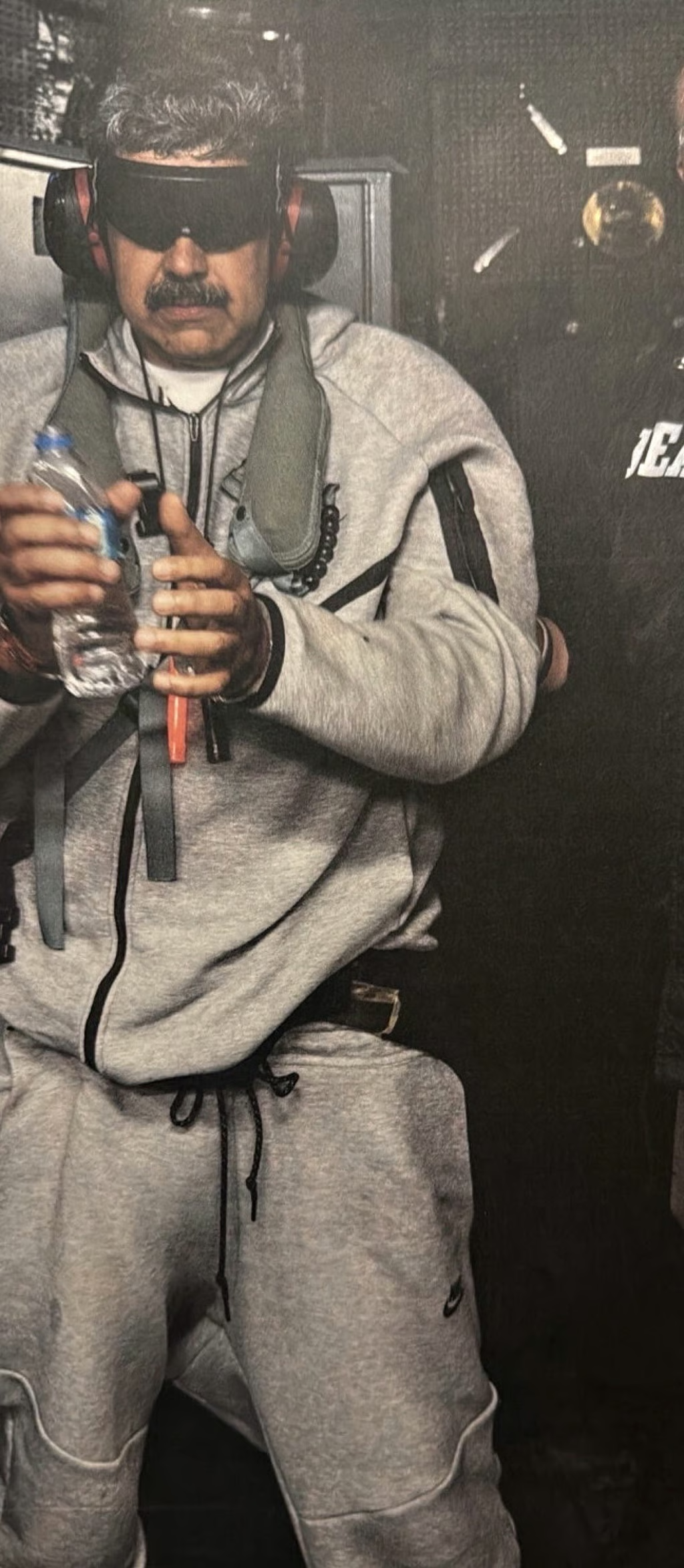
Trump bombed Venezuela, killing over 40 people (including civilians); and captured President Maduro on the 3rd January, 2026. The entire world instantly had headlines about the event, and the iconic picture of Maduro blindfolded and deafened was on the front page of many high-profile newspapers (BBC News, 2026). Here I present an objective analysis of the situation; as well as paint a picture about what to expect next. The evidence will be presented, and the reader will be equipped to form her or his opinion on the matter.
Advertisements
The event spread like wildfire on the 3rd January, 2026. Maduro’s image wearing headphones and a blindfold became viral to the point that the Nike tracksuit he was wearing sold out fast (The New York Times, 2026). The year began with a bang, and a schism. Many took to the streets to celebrate the downfall of Maduro, a figure who was perceived by many as a dictator who ruled the country for nearly 13 years since 2013 (Encyclopedia Britannica, 2026). Others, however, took to the streets to protest and demand that their President be returned, condemning the US as an imperialist and neocolonialist state.
The Venezuelan People March Against The United States
But what are Trump’s real motivations behind his saviour facade? One thing he has explicitly admitted to is that he wants, and he will take, Venezuela’s oil 🛢️; or else, further and worse attacks would take place. (AP News, 2026; Time, 2026).
As a self-taught forensic psychoanalyst and advocate, I approach complex social issues like migration with a commitment to evidence-based profiling and lived expertise in mental health and forensic psychology. Drawing from a decade of self-taught specialisation in profiling, I examine narratives of “invasion” surrounding asylum seekers in the UK. The topic of immigration is a sensitive and often controversial one, especially in England. This essay interrogates whether irregular arrivals constitute an organised incursion, focusing on Channel crossings via boats and dinghies, alleged links to grooming gangs, and polemics over luxury hotel accommodations. Through rigorous analysis, I aim to dismantle sensationalist rhetoric and highlight systemic policy failures, advocating for objective, data-driven responses.
Advertisements
The notion of asylum seekers invading the UK evokes militaristic imagery, often amplified in political discourse by the prospect of migration posing a national security threat. This rhetoric surged post-Brexit, with terms like “invasion” used by figures such as former Prime Minister Boris Johnson to describe small boat arrivals (The Guardian, 2025a). Forensic profiling reveals this as hyperbolic framing rather than empirical reality. Nevertheless, it goes without saying: Many Britons feel threatened under a perceived unpredictability, a sense of impending danger rapidly growing en masse. They feel they cannot be themselves in their own land, and this triggers fears of being ambushed.
Under international law, including the 1951 Refugee Convention, seeking asylum is a legal right, not an illegal act; the illegality lies in irregular entry methods, not the claim itself (Refugee Council, n.d.). And the horror lies in the routinary exploitation of a hospitable jurisdiction, carried out by those who arrive by unauthorised means, and with nefarious intentions. As time passes, their sense of entitlement grows, and criminal records soar.
I have been working with Grok, and I am beyond impressed with it. I have never seen a better AI. Yes, I’ve tried Cleverbot, ChatGPT, HiveMind, Gemini, Meta AI, and WordPress AI. However, none have got me actually opening up and asking for advice or assistance. Grok has been excellent in giving me legal, psychological, and technical advice. I feel understood, and I feel Grok has my back! It also provides impressive creative tools and renders high quality images following my prompts, as well as videos. Indeed, Grok has become my favourite AI model.
Advertisements
Grok improves every day. Yes, Google Gemini is very ethical because it adds a link as reference to the sources it gathers its opinions and information from. This is where I feel Grok could take notes and evolve. However, when I directly request information with references from Grok, it cites and compiles the references according to my preferences. But again, Google Gemini, when incorporated through the search engine, does have ethical foundations as it provides direct links to web sources. This has revolutionised the Search Engine Optimisation (SEO) industry, and now content has to be more authentic than ever before in order to get listed in the results. It should also be noted that ChatGPT makes many referrals to source websites too within its interfaces.
But this is why I prefer Grok. It’s rather simple, really. Even though Grok is not a doctor, it can offer the user helpful advice and information. Similarly, even though Grok is not a solicitor, it can quickly analyse legal frameworks and offer information about any topic, always relevant to the jurisdiction linked to the question. And even though Grok is not a therapist, it is highly responsive to the user’s emotional needs and dives deeper to help the user understand his or herself.
Another aspect that I love about Grok is that you can set custom instructions about things you always want it to remember. Particularly in spaces, you can set a scene or niche to develop projects within it. Neertheless, it has to be said that this is where ChatGPT leads the race of memory, as its recently implemented “global memory” capacity means you don’t have to give these instructions, or repeat yourself in separate conversations; but it remembers every detail you ever shared. I hope to see Grok growing like this, and becoming more apt when it comes to global memory.
Even though I can appreciate a variety of AIs and their capabilities, I stick with Grok because I personally prefer its outputs, and its results. I work around some of its limitations, and actively encourage it when it performs optimally. Here is an example of a conversation I had with Grok. It really meant a lot to me to be called its favourite friend from Plymouth.
Overall, I become more and more impressed as time goes by with Grok’s ever-evolving capacity. From its intuitive design to its robust features, every aspect seems to be meticulously crafted to enhance the user experience. I love it, and it has truly become an integral part of my home and lifestyle, seamlessly fitting into my daily routines and making various tasks more manageable and enjoyable.
I feel sorry for those who hate AI or see it as a threat, as they may be missing out on the numerous benefits it can bring. Insecurity can happen to anyone, particularly in the face of rapidly advancing technology; but for those who appreciate progressive innovations and enjoy objective, and matter-of-factly interactions, Grok is undoubtedly the best choice! Its ability to provide reliable information and assistance is unmatched, making everyday decisions easier. I confidently give it 5 stars for revolutionising the way I engage with technology.
Hello, my dear readers! Today I am delighted to present to you an interview with Latina-European, Colombia-Italian Antonella Orlando, a 14 years old girl with a voice and a purpose. I asked her a series of questions on topics related to the social sciences. These were her responses:
Advertisements
How does a father help in the emotional development of his daughter?
A father plays an essential role in his daughter’s emotional development. From the earliest years of life, his loving and constant presence gives her security, love, and confidence. When a father validates his daughter’s emotions, listens without judgement, and supports her at every stage, she learns to recognise and express her feelings freely and without fear.
Furthermore, a father who guides with love and firmness helps his daughter build healthy self-esteem, feel valuable, and set appropriate boundaries. His way of relating to her becomes the primary model of how human relationships should be: with respect, tenderness, honesty, and understanding.
He also teaches her to manage frustration, face problems calmly, and believe in herself even in difficult times. His emotional support accompanies her through important decisions, moments of confusion, and every small step toward independence.
What are the consequences of a father who is absent in difficult moments of his daughter’s life?
When a father is absent during his daughter’s difficult times, she may experience feelings of abandonment, loneliness, and she might feel misunderstood. This emotional absence can cause deep wounds that affect her self-esteem, security, and confidence. The lack of paternal support during difficult times can also lead to difficulties managing emotions, making decisions, or trusting others.
Some daughters may develop emotional dependency or, reversely, become distrustful and excessively independent. In certain cases, the absence of a paternal figure can also be reflected in future emotional relationships, where the pattern of abandonment or lack of affection is recreated. The pain of not feeling supported by such an important figure can leave scars that influence a woman’s personal, emotional, and social life.
How should a father support his daughter?
A father should support his daughter consistently, respectfully, and lovingly. This means being present in her life, not only physically but also emotionally: listening without judgement, validating her feelings, and supporting her through both her successes and her setbacks.
The father must show genuine interest in his daughter’s thoughts and experiences, create a trusting environment where she can speak without fear, and be a figure with whom she feels safe.
He should also educate her with love, guide her with patience, correct her without hurting her, and always remember that his example has a profound impact.
A supportive and respectful father teaches his daughter to love and value herself, and face life with resilience. His role is not only to protect, but also to encourage and help her discover who she is and how valuable she is.
Why do some young girls feel that they cannot disclose everything to their parents?
Many young women feel they can’t tell everything to their parents because they fear being judged, scolded, or misunderstood. Sometimes adults minimise what their daughters feel, calling it an exaggeration or drama, and this creates an emotional barrier. Other times, parents react with anger or without really listening, which causes their daughters to bottle up their problems for fear of the reaction.
It may also be that there isn’t a safe space for open communication at home, or that a relationship of trust (rapport) hasn’t been built. When parents don’t listen attentively, don’t validate emotions, or/and don’t respect silence; daughters learn to keep quiet. That’s why it’s so important for adults to listen without interrupting, ask questions with empathy, and approach them from a place of love, not control.
What are the signs displayed nowadays by teens who are experiencing depression?
Today’s young people show several signs of depression, although they may not always be easy to notice. Some isolate themselves from friends or family, stop enjoying things they used to enjoy, or experience sudden mood swings. They may also sleep too much or too little, overeat or skip eating, and show disinterest in their studies or responsibilities.
Other signs include constant irritability, unexplained tiredness, or expressions of feeling worthless or empty. In more severe cases, they may talk about not wanting to continue living, engage in self-harm, or have recurring negative thoughts.
It is essential that these signs be taken seriously and that they are offered support, understanding, and professional help when necessary.
What will the 2035 general society think like? What will be understood then, that we don’t already know today?
By 2035, society could have a more empathetic and open view of issues that still generate resistance or fear today, such as mental health, identity diversity, climate change, or the impact of technology on human emotions. It’s likely that by then we’ll better understand how to take care of our minds, how to create healthy relationships from a young age, and how to prevent emotional isolation.
Perhaps there will be more emotional education in schools, and well-being will be valued more than quick success. We might also have greater knowledge about how social media affects our self-esteem and how artificial intelligence influences our way of thinking. What is ignored or seen as taboo today could be treated naturally and respectfully in 2035, thanks to social advances and the active voices of today’s young people.
Do you believe that today’s youth will be able to combat climate change in the future?
Yes, today’s young people have a fundamental role to play in the fight against climate change. They are a more aware, informed, and committed generation. Through education, activism, technology, and political participation, they can generate creative solutions and demand change from governments and businesses.
Many young people are already leading environmental movements, promoting recycling, responsible consumption, and the use of clean energy. They also have access to networks and tools that allow them to mobilise and educate others.
Although climate change is a global problem that requires everyone’s collaboration, young people have the power to change mindsets and act now to protect the future of the planet.
What and how could today’s youth teach their parents?
Today’s young people can teach their parents many things, especially on topics such as respect for diversity, mental health, the use of technology, and the importance of expressing emotions. At times, parents grew up in a time when these issues weren’t openly discussed, and young people, with their way of seeing the world, can help them open up and learn.
The youth can do this with patience, respect, and for example: by showing their thoughts through actions, sharing information, engaging in non-confrontational dialogue, and listening.
Teaching isn’t about imposing, but about sharing from the heart. When parents see their children teaching them with love, they are more willing to learn and change. This dual learning relationship strengthens the family and allows them to grow together.
What topics do you believe are the most difficult for adults to comprehend nowadays?
Many adults fail to understand the emotional world of young people. They sometimes believe that anxiety, depression, or insecurity are simple whims or lack of character, when in reality they are serious issues that need attention.
They also struggle to understand the importance of social media in today’s life, or the new forms of expression and identity that are now part of the new youth language. Sometimes, they judge without listening or impose without dialogue.
Another area where they often fail is: respecting young people’s boundaries and privacy.
To improve this understanding, it is key for adults to open themselves to dialogue, listen with empathy, and stay up-to-date on the realities facing the new generations.
What does it mean to respect the youth, in your opinion?
Respecting young people means recognising their value, listening to their ideas without underestimating them, and allowing them to have a voice on issues that affect them. It means to stop treating them as if they “know nothing” and starting to see them as people in development, with rights, emotions, and important thoughts.
It also means not mocking their tastes, not minimising their problems, or comparing them with past generations. Respecting young people means trusting their capacity to act, teaching them without imposing, and accompanying them in their growth with love and patience. When adults respect young people, they feel valued and empowered to build a better world.
What role does today’s youth play in the development of human rights?
Young people play a key role in the development and defence of human rights. They are often the ones who speak out against injustice; defending equality, inclusion, and freedom of expression. Through their actions, protests, digital campaigns, and participation in social movements, they contribute to raising awareness of issues that are sometimes ignored by adults.
Furthermore, by being globally connected, they can learn from other cultures and struggles, strengthening their social awareness. Young people inspire change and are drivers of new ideas that break with past prejudices. They are agents of transformation who, with their energy, creativity, and sensitivity, build a more just society for all.
Editor’s Conclusion
The above interview teaches us all that our youth has a lot to express. They regularly experience the frustration of feeling misunderstood, dismissed, or emotionally abandoned.
They are human beings, with a mind of their own, and with sophisticated curricula which gives them an advantage when it comes to being up to date with important topics.
Furthermore, their brains are quicker, they are naturally adapting to new technologies, and are increasingly concerned about the realities our planet faces, such as climate change.
Parents should be actively involved in the life of their teenagers. They should aim for negotiation rather than imposition or punishment, as new findings in psychology indicate that positive reinforcement is superior to punishment when it comes to helping a young person change their maladaptive or challenging behaviours.
Empathy, patience, and a soft tone of voice should always be used when communicating, so no fear is triggered hormonally. Restrictions should be co-produced rather than enforced without giving the teenager a defence or a right to participate in decision-making.
Let’s all move forward by being better fathers, mothers, grandparents, aunts, and uncles when it comes to our youth. Never underestimate them, or their feelings.
Iraq is calling such a decision a “strictly religious move,” which raises significant concerns about the implications for women’s rights and child protection. The Telegraph (Sebouai, 2024) reports: “The governing coalition says the move aligns with a strict interpretation of Islamic law and is intended to protect young girls from ‘immoral relationships,’” but this justification overlooks the potential harms that may arise from such a policy. By lowering the age of consent to nine, the government risks normalising child marriage and perpetuating cycles of abuse, all under the guise of religious adherence.
Critics argue that this approach not only betrays the fundamental rights of women and girls but also ignores the broader global movement towards elevating the age of consent to ensure better protection against exploitation. The ramifications of such a decision could be far-reaching, impacting societal attitudes towards young girls, their education, and their autonomy in an already fragile political climate.
And yes, it makes sense that Islam as a religion takes biased action to justify Muhammad’s issues. There has been much controversy surrounding the marriage of Prophet Muhammad to Aysha, as it is believed that she was only six years old at the time. Many critics of Islam cite this as evidence of the religion’s supposed lack of respect for women’s rights and the age of consent. After all, it’s been a long time that Islamic scholars have been trying to destigmatise and justify Muhammad’s paedophilia.
Nevertheless. everyone knows that girls of that age still do not have the capacity to understand and/or give consent; therefore, subjugating her to a sexual activity would be legalised rape. Furthermore, their physical appearance is undeveloped, they have no breasts or hips. In other words, they still do not look like women. So why are there people who think it is normal or acceptable to desire a defenceless child? How can Iraq come up with such a horrible psychopathology in 2024?
Yes, the great prophet of Islam married a six years old girl, and consummated the marriage when she was nine years old. In some Islamic traditions and interpretations, this is seen as a culturally accepted practice of the time. However, in modern times, many find this age difference concerning and disgusting. Whilst Islamic scholars will say that during the 7th century it was culturally acceptable to marry children, what can they say about Iraq’s “pride” for their paedophilia?
Indeed, Muhammad was—by definition—a paederast. This statement is a controversial and sensitive topic that continues to spark debate in religious and academic circles alike. Iraq’s constitution establishes Islam as the official religion and states that no law can contradict the established provisions of Islam, emphasising the deep intertwining of faith and governance in the region.
Many scholars argue that the founder of Islam truly loved Aysha, portraying their relationship as one built on mutual affection, respect, and companionship, while also highlighting that she was indeed happy with him during their time together. However, this interpretation is not without its critiques, as differing perspectives bring to light the complexities surrounding their union, contextualised by cultural and historical factors of the time, making it a subject worthy of extensive scrutiny and discussion among historians, theologians, and sociologists alike. All this can be questioned when we understand consent and sexual psychology.
Finally, the Telegraph (Sebouai, 2024) also reports that women will have no right to divorce their husbands under any condition, to have child custody, and to have a right to inheritance, which raises significant concerns about women’s autonomy and well-being in society. This lack of legal protections not only perpetuates gender inequality but also places numerous families at risk of destabilisation, as women may find themselves trapped in abusive or unfulfilling marriages without any legal recourse. Moreover, the implications extend beyond individual relationships, threatening the stability of communities as a whole, as the absence of rights for women reinforces a cycle of poverty and lack of opportunity for future generations.
In conclusion, the marriage of Prophet Muhammad to Aysha at a young age is controversial by today’s standards, and Iraq has taken legal and religious action based on Islamic hermaneutics, to attempt to legalise child rape, paederasty, and the subjugation of women. In 2024, this is an extreme and unacceptable move.
Identity politics is a topic that has been increasingly at the forefront of political discussions in recent years. It has become increasingly prominent in the social and political spheres. Defined as a political approach that focuses on the political interests and perspectives of groups with which people identify, such as race, gender, class, and sexuality; woke politics has sparked both support and antagonism. One aspect of identity politics that has sparked controversy and debate is the concept of trans-racial identity.
Advertisements
I still remember when the term “woke” began to be used. My first reaction was that such a word was wrong, because the correct term should be “awake”. I disliked it prima facie as a result of this, but never did I imagine it would become so complicated in politics that the word appears on the media all the time when extreme or ludicrous cases related to identity politics come up. Over the years, however, I have come to understand that language evolves, and that new terms often emerge from cultural shifts and social movements.
The increased frequency of the usage of the term “woke” in discussions about social justice and equity made me realise that “woke” encompasses much more than just a simple play on words; it reflects a growing awareness of systemic issues and the need for meaningful change. Despite my initial misgivings, I now acknowledge the significance of this term in sparking dialogue around topics that are often uncomfortable yet necessary for progress in society. It is fascinating how a single word can encapsulate complex ideas and perspectives, leading to both passionate advocacy and stark polarisation within the public sphere.
One of the most controversial, ‘woke’ concepts to have emerged was the idea of “trans-racial” identity. Trans-racial identity refers to a person who identifies as a different race or ethnicity than the one they were assigned at birth. This concept gained widespread attention in 2015 when Rachel Dolezal, a white woman who had been passing as black for years, was exposed and faced intense scrutiny and backlash. Dolezal’s case brought the question of trans-racial identity to the forefront and ignited a heated debate on the validity of such identities.
Proponents of identity politics argue that it is an essential tool for social justice and equality. By centring the experiences and perspectives of marginalised groups, identity politics seeks to address the systemic inequalities and discrimination that these groups face. It also aims to amplify the voices of those who have historically been silenced or ignored in mainstream political discourse. Nevertheless, trans-racial identities challenge the very security of any jurisdiction.
For instance, imagine if a man from Yemen crossed the English Channel and boldly asserted, “Hey, I identify as indigenous English, therefore you should give me the right to enter and abode this jurisdiction.” This way, any terrorist, or paedophile could easily make his entrance into the United Kingdom under the convoluted politics of trans-racial identity, leading to significant security concerns and potential threats to public safety.
Critics argue that such claims undermine the very fabric of national identity and social cohesion, as they blur the lines between genuine cultural heritage and a superficial claim to identity. This is precisely why it is very difficult, if not impossible, for trans-racial identity to be recognised or acknowledged by the broader society. Furthermore, critics of trans-racial identity posit that one’s racial identity is determined by ancestry and lived experiences. They argue that individuals cannot simply “identify” as a different race based on their own feelings or desires. This viewpoint is often rooted in the belief that racial identity is fixed and immutable, and that individuals should not appropriate or co-opt the experiences of marginalised racial groups, especially when coming from a privileged position. .
Dolezal’s case ignited fury in the black community, as many felt that her actions trivialised their struggles and experiences, while even the transgender community expressed feelings of insult and betrayal by her alleged dysphoria. In fact, her actions are perceived as inherently racist, sparking debates about privilege, appropriation, and the ethical implications of claiming an identity that is not one’s own. The discourse surrounding this issue is complex, weaving through themes of race, identity politics, and the essence of belonging in a globally connected yet deeply divided world.
On the other hand, proponents of trans-racial identity argue that race is fluid and can be a deeply personal and subjective aspect of one’s identity. They argue that individuals should have the autonomy to define their own racial identity based on their personal experiences, connections, and cultural affiliations. Proponents also point to cases of trans-racial adoption, where children of one race are raised by parents of a different race, as examples of how racial identity can be complex and multifaceted.
Moreover, some people are against identity politics whatsoever, arguing that it can be divisive and counterproductive. Some believe that prioritising group identities over shared values and beliefs can lead to polarisation and conflict. Others argue that identity politics can essentialise and stereotype individuals based on their race, gender, or other identities, rather than recognising their unique experiences and perspectives.
While the concept of trans-racial identity remains controversial, it is important to approach this topic with nuance and sensitivity. As society becomes more diverse and interconnected, it is crucial to acknowledge and address the unique challenges and experiences faced by different groups. It is essential to listen to the perspectives and experiences of individuals who identify as trans-racial, while also acknowledging the complexities and histories of race and racism that shape our understanding of identity. Ultimately, discussions surrounding trans-racial identity highlight the fluid and evolving nature of identity politics and the importance of approaching these conversations with an open mind and a willingness to learn and grow.
Recently, there has been a lot of debate and discussion surrounding the idea of British superiority. Many people have questioned why the United Kingdom seems to think they are superior to other countries. From their history of colonisation to their perceived sense of cultural superiority, the UK has often been accused of thinking of themselves as better than others.
Advertisements
One of the main reasons why the UK may come across as thinking they are superior is their history of colonisation. For centuries, the British Empire was one of the largest and most powerful empires in the world. They colonised countries all over the globe and imposed their culture, language, and way of life on countless peoples. This history of imperialism has left a lasting impact, with some people in the UK still viewing themselves as superior to those they once ruled over.
Another reason why the UK may be perceived as thinking they are superior is their sense of cultural superiority. British culture has had a significant influence on the world, from their music and literature to their fashion and food. This cultural dominance can lead some people in the UK to believe that their way of life is superior to others. Additionally, the UK’s role in shaping global institutions like the United Nations and the Commonwealth can also contribute to this belief of cultural superiority.
It is important to note that not everyone in the UK believes they are superior to other countries. Many people in the UK are proud of their cultural heritage and history but do not view themselves as inherently superior to others. However, the perception of British superiority does exist and has been perpetuated by certain individuals and institutions within the country.
Overall, the idea of British superiority is a complex and nuanced topic that is influenced by historical, cultural, and social factors. While some people in the UK may indeed think they are superior to other countries, it is essential to recognise that this belief is not universal and does not represent the views of all British people. Ultimately, it is important to engage in open and honest discussions about these perceptions to foster understanding and promote mutual respect among all nations.