Colombia has a long-standing and deeply troubling history when it comes to violence and armed conflict. Among the many dire consequences of this turmoil are the ominous death squads, often operating in the shadows, pushing the boundaries of humanity. These ruthless groups of individuals, acting outside the law, unleash terror and perpetuate a cycle of violence that continues to haunt the Colombian population. In this blog post, we will delve into the origins, operations, and the impact of death squads on Colombian society, shedding light on this dark chapter in the country’s history.
Origins and Operations
Death squads first emerged in Colombia during the mid-20th century in the context of escalating violence between politically motivated groups. Their formation largely resulted from the prevailing political ideologies, with the right-wing paramilitary groups aiming to counter leftist guerrilla movements. Often collaborating with drug cartels, these clandestine organisations broke all rules of engagement and went beyond targeting only armed combatants. They began targeting civilians, activists, intellectuals, journalists, and anyone deemed an obstacle to their agenda.
Utilising brutal tactics with impunity, death squads carry out acts of intimidation, including kidnappings, torture, and extrajudicial executions. Often operating under the guise of vigilante justice, they trample upon human rights, leaving a trail of grief and destruction in their wake. The most notorious death squads include the United Self-Defence Forces of Colombia (AUC), led by paramilitary leaders such as Carlos Castaño and Salvatore Mancuso.
Impact on Society
The impact of death squads on Colombian society has been profound and far-reaching. Firstly, the consequences are most acutely felt among marginalised communities, indigenous populations, and Afro-Colombian groups who find themselves at the intersection of violence due to land disputes, illegal mining, and the drug trade. These communities become trapped in a cycle of fear, forced displacement, and often face irreversible trauma.
Moreover, death squads have gravely undermined the country’s institutions, weakening public trust and faith in the justice system. Impunity and corruption allow these groups to escape accountability, perpetuating a culture of violence where justice seems elusive.
The Role of the International Community
Although death squads are predominantly a domestic issue, it is crucial to acknowledge the role the international community plays in addressing this grave concern. Supporting human rights organisations, demanding accountability from governments, and creating platforms for dialogue are key components of international involvement. Countries and organisations should continue to exert diplomatic pressure on Colombia to tackle the issue forcefully, enabling a more secure and peaceful future.
Conclusion
The existence of death squads in Colombia is a stark reminder of the devastating consequences of armed conflict and political instability. As Colombians navigate through the murky waters of political turmoil, it is crucial to acknowledge the atrocities committed by those operating outside the realm of the law. By shining a light on this dark chapter in Colombia’s history, we hope to contribute to their collective efforts to achieve peace, justice, and healing for their nation and its people.
In the world of criminal justice, cold cases refer to unsolved crimes that have remained dormant for years or even decades. The frustration of investigators and mystery enthusiasts alike grows as these cases remain open, leaving victims and their families without closure. However, advancements in forensic science have paved the way for new investigative techniques, one of which is forensic psychoanalysis. By delving into the psyche of criminals long after the fact, forensic psychoanalysis has proven instrumental in shedding light on unsolved cases and leading to justice.
Understanding Forensic Psychoanalysis
Forensic psychoanalysis combines elements of psychiatry, forensic science, and psychology to analyse and interpret the behaviour and motivations of criminals. By applying psychoanalytical principles to unsolved cases, investigators and experts aim to gain insight into the mind of the offender, which may ultimately help solve the mystery. This analytical approach can unearth suppressed or hidden motives, provide context for behavioural patterns, and unravel the psychology behind criminal acts.
Examining Criminal Profiles
One of the key aspects of forensic psychoanalysis is the creation of a criminal profile. Investigators study the available evidence, crime scene characteristics, and victimology. By extrapolating this information, they can generate a psychological profile of the perpetrator. Identifying the individual’s personality traits, habits, and potential motives proves indispensable in narrowing down the pool of suspects. Cold cases often have limited evidence, making a well-constructed profile an invaluable tool for investigators to focus their efforts.
Finding New Clues Through Psychodynamic Analysis
Psychodynamic analysis is at the core of forensic psychoanalysis. This approach involves examining an individual’s early life experiences, traumatic events, or mental disorders to establish a link between their history and criminal behaviour. In cold cases, where evidence may be scarce or outdated, psychodynamic analysis can offer new perspectives. By exploring the unresolved emotional conflicts that may have led to criminal actions, investigators can uncover hidden connections and piece together the puzzle of a crime that has long remained unsolved.
Resolving Cold Cases With Behavioural Analysis
Another vital aspect of forensic psychoanalysis is behavioural analysis. This methodology focuses on the examination of a criminal’s behaviour, including their modus operandi and signature. By identifying the unique elements of a criminal’s actions, investigators can construct a profile that aids in the identification and capture of the perpetrator. Cold cases might benefit from a fresh look at these behaviours, as advancements in forensic science and analysis techniques can provide contemporary insights into older evidence.
Supporting Traditional Investigative Techniques
It’s important to note that forensic psychoanalysis does not function as a standalone method but rather as a complementary tool to traditional investigative techniques. Cold cases often require interdisciplinary collaboration, combining the expertise of forensic psychologists, pathologists, DNA analysts, and investigators. By leveraging forensic psychoanalysis alongside other scientific advancements, investigators can breathe new life into old cases, offering new leads, refining suspect profiles, and generating fresh avenues of investigation.
Conclusion
Forensic psychoanalysis has emerged as a powerful tool in solving cold cases, offering fresh perspectives on unsolved mysteries. By delving into the depths of a criminal’s mind, investigators can unravel previously unseen connections and motives. In the ongoing pursuit of justice, the role of forensic psychoanalysis showcases the significance of interdisciplinary collaboration and the continuous evolution of forensic science. With each breakthrough, we come closer to bringing closure to victims, their families, and the communities affected by these haunting cold cases.
When it comes to investigating criminal behaviour, law enforcement agencies have an array of tools at their disposal. One such method gaining prominence in recent years is the use of forensic psychoanalysis techniques. Rooted in a combination of psychology and criminology, this approach enables investigators to delve into the mind of criminals, helping shed light on motivation, patterns, and potential future actions. In this blog post, we will explore some of the popular forensic psychoanalysis techniques employed in the investigation of criminal behaviour.
1. Offender Profiling
Offender profiling aims to create psychological and behavioural profiles of criminals based on the analysis of crime scenes, victims, and associated evidence. This technique assists investigators in identifying potential suspects, understanding their modus operandi, and predicting their future actions. By drawing upon principles of psychology and advanced statistical methods, profilers can provide valuable insights into an offender’s personality, motivations, and characteristics.
2. Psycholinguistics Analysis
Psycholinguistics analysis involves examining the language and communication patterns of offenders. Law enforcement agencies have developed comprehensive databases of linguistic indicators, allowing them to identify specific linguistic patterns frequently associated with certain types of criminal behaviour. By analysing written or spoken language, investigators can gain a deeper understanding of the offender’s cognitive processes, mentality, and potential group affiliations.
3. Crime Scene Analysis
Forensic psychoanalysis techniques also focus on analysing the crime scene to discern the motivations and characteristics of a criminal. Crime scene analysis involves examining the location, evidence, and the actions taken by the offender. By carefully studying these elements, investigators can gain insights into the rationale, psychological state, and level of organisation of the perpetrator. This technique is crucial in identifying whether the crime was impulsive or planned, as well as the potential risk posed by the offender in the future.
4. Polygraph Testing
While polygraph testing has been a somewhat controversial technique, it remains a commonly used tool in forensic psychoanalysis. The polygraph machine measures physiological responses such as heart rate, blood pressure, and respiration, which can indicate deception. By conducting a polygraph test, investigators can obtain valuable information about an offender’s involvement in a particular crime or provide leads for further investigation. Although not admissible as concrete evidence in many courts, polygraph testing often serves as a valuable investigative tool.
5. Criminal Psychological Profiling
Criminal psychological profiling explores the offenders’ psychological characteristics, including personality traits, behavioural patterns, and social contexts. This technique closely examines how childhood experiences, mental disorders, or traumatic events might have contributed to their criminal behaviour. Profilers often utilise psychological tests and interviews to gain a holistic understanding of the offender’s psyche, enabling investigators to strategise more effectively during the investigation and interrogations.
Conclusion
Forensic psychoanalysis techniques provide invaluable insights into the minds of criminals, fostering a deeper understanding of their motivations, patterns, and potential future actions. By employing methods such as offender profiling, psycholinguistics analysis, crime scene examination, polygraph testing, and psychological profiling, investigators can enhance their ability to solve crimes and bring perpetrators to justice. As the field of forensic psychoanalysis continues to evolve, it holds great promise in assisting law enforcement agencies in their tireless pursuit of maintaining safety and upholding the law.
Psychological profiling, also known as offender profiling or criminal profiling, is a specialised tool used in crime solving and investigations. It is a forensic approach that aims to create a psychological profile of an unknown criminal based on evidence from the crime scene, victimology, and other relevant information.
The primary objective of psychological profiling is to help law enforcement agencies narrow down their list of suspects and potentially identify the characteristics, motives, and behaviours of the offender. Profilers analyse patterns, behaviours, and crime scene details to develop a psychological profile that can aid investigations.
By examining various aspects such as modus operandi (MO; the specific way a crime is committed), victim selection, and the criminal’s signature or distinctive pattern, profilers attempt to infer certain aspects of the offender’s personality, background, and psychological makeup.
It is important to note that psychological profiling is not an exact science and can be subject to limitations. Profilers rely on their experience, knowledge of psychology, and understanding of criminal behaviour to make educated assessments. Different profilers may have different methodologies and theories, leading to variations in results and interpretations.
Psychological profiling can be helpful in many types of criminal cases, including serial murders, sexual offences, and other violent crimes. It can provide insights into potential motives, potential future behaviour, and even assist in prioritising leads and suspects.
However, it is crucial to use psychological profiling as just one piece of the investigative puzzle. It should always be combined with other information and evidence, such as DNA analysis, eyewitness accounts, and physical evidence, to ensure a thorough and accurate investigation.
This film directed by Antony Petrou is rich in forensic psychological detail. It really shows the dark side of the criminal justice system (CJS). Based on a true story, We are Monster tells the story of the murder of Zahid Mubarek by Robert Stewart.
Psychoanalytic film theory: It is clear that many of the attitudes Stewart displayed were inherited from his father’s personality. In other words, the film captures the phenomenon of introjection, a defence mechanism which consists of internalising and adopting personality traits and/or behaviour of other people, especially authority figures. The film shows Stewart recalling a memory of his father arguing with his mother about her having been sexually involved with a person of a darker skin. From this scene it is clear that his father had an extremist and antisocial attitude towards people of different skin colours, and he is heard using racial slur. Consequently, Stewart came to associate a darker skin with ‘filth’ and ‘evil’, having internalised his father’s attitudes. The film constantly shows him having a conversation with a hallucination of himself similar to the way his father used to speak in general. In psychoanalytical terms, it could be said that the film shows Stewart’s ID talking to him all the time. The ego or self is shown to negotiate with this hallucination, and to be led and manipulated towards specific behaviours. It is difficult to say whether the introjection was accompanied by reaction formation, because it is difficult to differentiate Stewart’s criminogenic attitudes and/or actions from those of his father. The film portrays his childhood as self-less, cold, and full of trauma. Therefore, it is unclear whether these behaviours constitute an exploration of his father’s ego through a primary regression to a narcissistic state in which the superego is formed based on values learned from the world; or whether it is his self that has become established as a personality (i.e. whether this would be his behaviour if he was not experiencing a psychotic break). The film captures his schizophrenic crisis quite well. It allows the viewer to enter the criminal mind from thought to action. Petrou manages to illustrate the criminal insanity perspective by placing emphasis on the hallucination as the drive towards criminogenic activity.
Political anchors: This case was a huge scandal in the year 2000 and many inquiries were launched at Feltham Young Offender Institution in order to investigate the steps the government of the UK could have taken in order to prevent this tragedy, and what steps could be taken to prevent it from ever happening again. It was concluded that legally, there was much more the system could have done to prevent this re-offending, and the death of Zahid Mubarek. This case was a scandal when it occurred, and it is perceived as a double-edged cumulative failure.
According to Blackburn (2005, pp. 211-223), “aggression describes the intentional infliction of harm, including psychological discomfort as well as injury, although it is sometimes loosely equated with vigour in competitive situations […] a constant need to discharge aggressive energy governs human behaviour […] anger is a socially constructed emotion […] In personality disorders, ego weakness results in the repression of aggression […] Ferguson and Rule, for example, suggest that anger is aroused not simply by the degree of perceived aversive treatment by others, but also by judgements of whether the aversion is intentional, malevolent, foreseeable, and unjustified”.
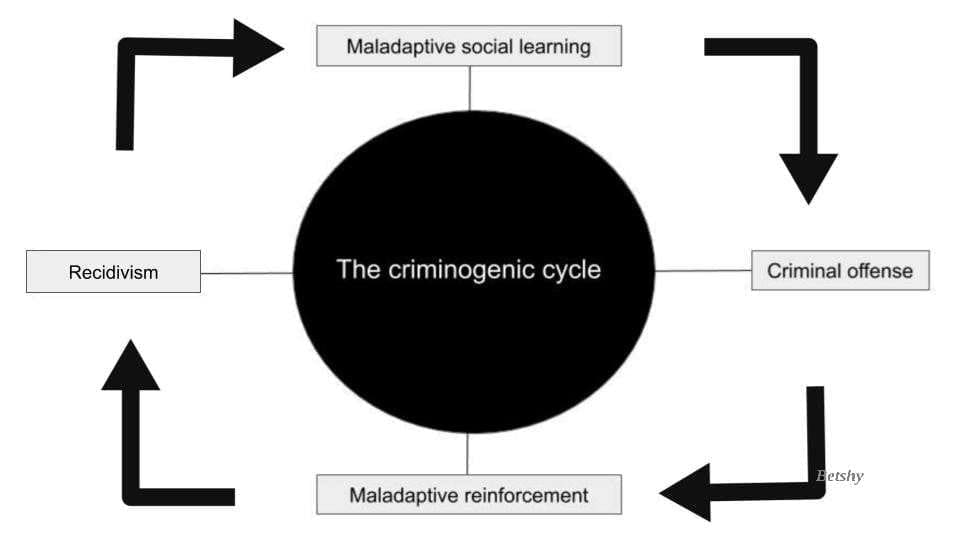
The cycle of criminogenic behaviour
Gillespie and Mitchell (2018, p. 85) describe individuals diagnosed with psychopathy as a personality disorder (ASPD) as “outwardly normal, but were nonetheless extremely callous and unable to express remorse or guilt, to the point where they seemed to be devoid of human emotion. The patients were typically of above average intelligence and seemingly charming, though lacked the capacity for love”. Psychopaths who go through the criminal justice system can at times exhibit great criminal versatility. The following is a diagram I designed to illustrate how such criminogenic needs and versatility develop and recur.
National homicide rates per 100 000 population, c. 1984
Blackburn (2005) included a table in his chapter about violent crime and aggression where Colombia is listed as the country with the highest homicide rate in 1984 and this was published in the United Nations year-book (1988). Even though the data has changed massively, and Colombia has dramatically reduced its crime rates; such bloody past would have caused generational trauma without a doubt, and the Colombian people would have had to adapt to survive potential death anywhere at any time if they upset the wrong person. Many political leaders were assassinated in order to stop the people from interfering with the criminal business of the mafia. A lot of blood was shed, and the Colombian people were over-exposed to extreme levels of danger to the point where the entire nation was having a humanitarian crisis, which still echoes, and which is still being solved.
Country
Rate
Colombia
37.4
Mexico
17.9
Brazil
13.4
Venezuela
12.9
USA
8.5
Ecuador
7.1
Argentina
3.8
Hungary
2.7
Canada
2.3
Italy
2.1
Australia
1.9
Poland
1.6
Austria
1.4
Israel
1.4
France
1.3
Scotland
1.3
New Zealand
1.2
FDR
1.2
Spain
1.0
Greece
0.9
England and Wales
0.7
Egypt
0.5
Source: United Nations (1988). Demographic yearbook. New York: United Nations Publishing.
Case study: the criminal career of sicario alias Popeye
The following video covers the developmental trajectory of Jhon Jairo Velasquez Vasquez’ criminal career, the political context in which he was rewarded with attention and money for being a hired gun; and how such media attention has led to some of the Colombian people seeing and treating him as a celebrity. Behind this story is a real case of a mental health crisis where the hypernormalisation of violence from recent decades was so extreme, that many people became desensitised to the actions of this type of individual, seeing no difference between what is right and what is wrong. Furthermore, this documentary analyses some of the confessions of Popeye as the primary psychopath that he was, and shows how what is ‘normal’ in a country, is ‘abnormal’ in other places. Popeye specialised in crime, and developed all the skills needed for the criminal business. This makes an interesting case for forensic psychology, and for media studies.
2015 Popeye Full TV Interview. Part 1 of 3. English Subtitles (2018) Youtube video, added by Colombian History X [Online]. Available at https://www.youtube.com/watch?v=M6NGWNrzg88 (Accessed 8 March 2020).
Blackburn, R. (2005) The Psychology of Criminal Conduct, West Sussex, John Wiley & Sons/ University of Liverpool, pp. 210-245.
Escobar’s Hitman. Former drug-gang killer now loved and loathed in Colombia (2017) Youtube video, added by RT Documentary [Online]. Available at https://www.youtube.com/watch?v=BQy_LJdZ7qw (Accessed 8 March 2020).
Gillespie, S. M. and Mitchell, I.J. (2018) ‘Psychopathy’, in Davies, G.M. and Beech, A.R. (eds), Forensic Psychology: Crime, Justice, Law, Interventions, 3rd ed, West Sussex, British Psychological Society/ John Wiley & Sons, pp. 85-100.
Popeye: The Jailhouse Interviews Pt. 1 – English Subtitles (2018) Youtube video, added by Colombian History X [Online]. Available at https://www.youtube.com/watch?v=EaPw1EEPOCc(Accessed 8 March 2020).
If you are a student of psychology, you might have already come across Professor Loftus’ work on eyewitness memory. She is the pop star and hollywood personality within the field of forensic psychology, and has served as an expert witness in high profile cases such as Ted Bundy and more recently Harvey Weinstein (Associated Press in New York, 2020). Furthermore, Professor Loftus’ work has become highly controversial, and has caused many reactions from victims due to her experiments on eyewitness memory, and how unreliable episodic memory actually is. Her book Witness for the Defense: The Accused, the Eyewitness, and the Expert Who Puts Memory on Trial (1991) narrates her experience working with defendants in the criminal justice system, whilst also delighting the reader with the theory of her experiments and findings.
“There is a generally accepted theory in our field that memory doesn’t work like a videotape recorder. We don’t record an event and then play it back later. The process is much more complex […] In such circumstances there is an increased risk that an innocent person will be convicted […] One of the most obvious reasons for forgetting is that the information was never stored in memory in the first place; even the most common, everyday items frequently fail to find a niche in our memory […] With the passage of time, with proper motivation, or with the introduction of interfering or contradictory facts, the memory traces change or become transformed, often without our conscious awareness”
Selected excerpts from Loftus and Ketcham (1991, pp. 4-17)
Recently The Guardian wrote a news report about Harvey Weinstein’s trial and described the situation as follows: “Lawyers for Harvey Weinstein turned on Friday to an expert known for studying false, repressed and unreliable memories who has worked on behalf of clients including the serial killer Ted Bundy” (Associated Press in New York, 2020). Needless to say there are many critiques of Professor Loftus due to her tendency to work for the defense instead of the prosecution, and this has led to journalists wondering why such is the case. For students of forensic psychology like me, there are a series of questions that only her books can answer. I truly recommend this book to those seeking to understand eyewitness memory better, and also those seeking to learn about the behind the scenes of the criminal justice system.
Relevant Questions & Answers
Why work for the defense instead of the prosecution?
Professor Loftus is highly concerned with justice, and prefers to prevent injustice by studying cases meticulously and scientifically. Having already been involved in cases where a potentially innocent person got a death sentence after biased procedures (e.g. Demjanjuk; Loftus and Ketcham, 1991), Dr. Loftus knows the importance of the presumption of innocence. Many studies conducted on eyewitness memory have demonstrated that memories are vulnerable to distortion and contamination. Hindsight bias and post-event information (misinformation effect) are particularly important concepts when trying to understand why miscarriages of justice have occurred in the history of the western societies and their criminal justice systems. In regards to this, her book states: “Although witnesses try hard to identify the true criminal, when they are uncertain- or when no one person in the lineup exactly matches their memory- they will often identify the person who best matches their recollection of the criminal. And often their choice is wrong” (p. 23). This has become a general rule of thumb and a system variable when investigating cases from a psychological perspective. “But in a stressed mind, under intense pressure to come up with someone who could be blamed for this horrible crime, those connections could have been created, welded together by fear and pain and a desire to be done with it all, to stop thinking, to find an answer, a solution” (p. 191)
Why did she defend Ted Bundy as he is not innocent?
According to her book, when Bundy’s lawyer contacted her, he described the case to her as relevant to her work, and as if the prosecution had an “extremely weak case” against his client. Back then she had not heard the name “Theodore Robert Bundy”, and did not know that the famous “Ted cases” were related to him, and it was in 1975 that John O’Connell (Bundy’s solicitor) consulted her in regards to the kidnapping charge against him. At the time, Bundy was a law student in Seattle, and his profile was surprisingly charismatic to the point where it was very difficult to imagine him committing such terrible acts. Dr. Loftus did not expect what came after that, and describes being surprised about this case and remembers having a conversation with O’Connell where she explained her theory: “First, the acquisition stage, in which the perception of the original event is put into the memory system; second, the retention stage, the period of time that passes between the event and the recollection of a particular piece of information; and third, the retrieval stage, in which a person recalls stored information” (p. 77). Furthermore, she describes her impression of Ted Bundy’s death as follows: “The scene switched to an interview with Ted Bundy the night before his electrocution. Prison had removed the arrogance from his smile, sharpening his features. The eyes seemed deeper set, the nose longer and straighter, the creases in his forehead permanently etched […] I felt lightheaded, slightly sick to my stomach” (pp. 90-91). Professor Loftus recalls wondering what would have happened if her expert contribution had led to an acquittal in Utah, and seemed to be distressed about the entire situation as more evidence accumulated about Bundy.
What common cognitive biases does Dr. Loftus study?
Professor Loftus conducts holistic investigations. There are many variables that she analyses, but all of them together are beyond the scope of this article. However, she does mention some of these in the book: “I hit the return key on my computer three times and typed in the words photo-biased identification […] Unconscious transference was the third item on my list […]Next on my list was time estimates. Jurors are aware that memory is better when you have a longer time to look at something, but they are often not aware that later, when a witness tries to estimate how long a particular event lasted, there is a strong tendency to overestimate its durations […] Confidence. Like most people, jurors tend to believe there is a strong relationship between how confident a witness is and how accurate he or she is” (pp. 169-170). In a nutshell, she is a memory expert. “
An example: “We’ve shown people a simulated bank robbery that lasts for half a minute and they will say it lasted for five minutes, eight minutes, even ten minutes. In one experiment people saw an event that lasted four minutes and they said it lasted ten minutes; some said twenty minutes. There is a very strong tendency in the memory to enlarge these complex and stressful events so that they appear to have occurred over a longer period of time than they really did […] Unconscious transference is the mistaken recollection or confusion of a person seen in one situation with a person who has been seen in a different situation. But what is happening here is the merging of an image of a person seen in one situation with a totally different incident. And that is an important phenomenon. Many people do not realise how easy it is for an ‘unconscious transference’ to occur, to take a person with your memory of an experience that happened at a different time” (pp. 200-201).
What is her view on penology and prisons?
Dr. Loftus’ position about penal punishment within the criminal justice system can be appreciated with her closing statement on the Ted Bundy chapter: “Bundy was guilty; there was no longer any doubt about the fact. But he was also a human being, and now he was dead. Where, I wondered, is the triumph, the glory in that” (p. 91). I interpret such statement in the context of human rights law (Equality & Human Rights Commission, 2018), with the right to life being relevant when it comes to capital punishment.
Were the deaths of Steve Titus and Detective Parker correlated?
Last year I emailed Professor Loftus to inquire about her chapter Dark Justice: Steve Titus, about one of the clients she defended, and who was wrongfully convicted of rape. It was a case of bureaucratic corruption. At the end of the chapter, Professor Loftus narrates the following events: “On February 8, 1985, eleven days before he would have faced his tormentors in court, Steve Titus died. He was thirty-five years old […] On June 8, 1987, six years to the day after Titus’ conviction was overturned, Detective Ronald Parker was found slumped next to his gym locker, dead of a heart attack. He was forty-three years old” (p. 60). I asked her whether she wanted to imply a potential correlation between these two deaths, or whether she just wanted to make a historical record. Thirteen days later I received a reply from her where she explained that Titus had died of a heart attack due to the stress he had gone through, and that she was not sure what happened in the case of the detective. Moreover, she said that both, Steve Titus and the detective are buried near each other in the Washington Memorial Cemetery in New York (Anderson, 1991), which is quite ironic.
Can you mention an experiment conducted by Professor Loftus on memory?
Yes, I can indeed. She actually summarises her experiment on semantics in the book: “I hesitated for a moment, trying to decide whether to tell Kurzman about an earlier experiment I’d conducted with adult subjects who watched a film clip of an automobile accident and then were interviewed and asked suggestive questions. By using the verb ‘smash’ instead of ‘hit’, we were able to change not only the subjects’ estimate of the speed of the cars when the accident occurred, but also the probability of reporting broken glass- even though there was no broken glass in our interviews. This particular experiment supported the theory that the subjects experienced an actual change in the original memory” (p. 137).
Irrelevant Questions & Answers
Why did she defend Harvey Weinstein as he is not innocent?
Even though this is not in the book, I see this is along the same lines of why she defended Ted Bundy. Professor Loftus’ work focuses mainly on how people absorb information (learn), store events, and retrieve such details later on. So her involvement in such high profile cases has to do with ruling out the common cognitive and procedural biases found in estimator and system variables of eyewitness accounts and processes; which for her is a fairly straightforward, algorithmic, and systematic, reliable procedure. From what I understand, Harvey was found guilty of 2/5 allegations. This means that Professor Loftus had to make sure that all processes regarding the accusations were put through rigorous scientific methods for mitigation, as well as the examination of potential contamination in the memories of both, accusers and the defendant. This process often involves a detailed episodic, chronological reconstruction of the crime and the parties involved. As an expert witness, Loftus has a duty to be impartial, professional and objective about human memory. This means that her defendant was found guilty of actually sexually assaulting two of the five victims, and only these two accounts were successful in proving consistency in episodic recall. In other words, having Loftus study the case means that it is undeniable to the jury that Weinstein did do those two things, but that it was not proven that he did do those other three things beyond reasonable doubt (Levenson, 2020).
Does all this mean that Professor Loftus does not support the #MeToo movement?
No, that is not what all this means. All this simply means that Professor Loftus had to mitigate human memory empirically in order to clarify to the best of her ability as a scientist what really happened in Hollywood. Expert witnesses tend to be demonised due to the controversial work they carry out. Nevertheless, nothing of the mentioned above is evidence that she is anti-feminist.
My personal favourite:
“It is a fine line I walk as a psychologist in a court of law. While the debate about guilt and innocence is waged with passion and partisan zeal, it is my task to deal with the facts. As an expert witness, the facts I must deal with extend beneath the surface, deeper than the newspaper headlines, deeper even than the confidential police reports and the court transcripts. I am privy to the defense lawyer’s strategy; I’ve read the victims’ descriptions of the accused; I know the sordid and intimate details of the crimes; I’ve viewed the lineups and listened to tape-recorded interviews. But still there are facts I will never hear, details that are beyond my expertise or concern. The defense attorneys tell me what they want me to know, selecting only the facts I will need in order to testify. I do not have access to the prosecutor’s files. I rarely have the opportunity to talk at length with the defendant. And I don’t venture into the jury room to hear their confidential and privileged conversations about guilt, innocence, and reasonable doubt” (p. 241).
Loftus, E. (2019) Email to Betshy P. Sanchez Marrugo, 22 October [unpublished]
Loftus, E. and Ketcham, K. (1991) Witness for the Defense: The Accused, the Eyewitness, and the Expert Who Puts Memory on Trial, New York, St. Martin’s Press.
Sanchez Marrugo, B. P. (2019) Email to Dr. Elizabeth Loftus, 9 October [unpublished].