Human rights are fundamental entitlements that every individual should possess in order to live a dignified and fulfilling life. These rights are enshrined in international laws and conventions, and are meant to protect individuals from discrimination, exploitation, and oppression. However, there are instances where these rights are infringed upon or derogated in the name of education.
Advertisements
Education is a fundamental human right in itself, crucial for the personal development and empowerment of individuals. It is through education that individuals are able to acquire knowledge and skills, access opportunities, and participate fully in society. However, in some cases, the right to education is prioritised over other human rights, leading to their derogation.
One common example of this is the use of corporal punishment in schools as a means of discipline. Despite being recognised as a violation of the right to protection from cruel, inhuman, and degrading treatment, some educational institutions continue to use physical punishment as a way to maintain discipline among students. This not only infringes upon the rights of the children being subjected to such punishment but also perpetuates a culture of violence within schools.
Furthermore, the right to freedom of expression is sometimes restricted in educational settings, particularly when it comes to controversial or sensitive topics. Students and educators may be censored or punished for expressing their views or engaging in discussions that challenge the status quo or go against the prevailing beliefs of the institution. This stifles intellectual curiosity, critical thinking, and diversity of thought, all of which are essential for a robust and inclusive educational environment.
In some cases, the right to privacy is also compromised for the sake of education. Students may be subjected to invasive surveillance measures, such as constant monitoring of their online activities or the use of biometric data for attendance tracking. This not only violates their right to privacy but also creates a culture of mistrust and fear within the school community.
It is important to remember that human rights are indivisible and interdependent – one right should not be derogated in order to uphold another. Education should be a space where human rights are respected and upheld, not sidelined in the pursuit of academic excellence or disciplinary control. Educators, administrators, and policymakers must prioritise the protection and promotion of human rights in all educational settings, ensuring that every individual is able to exercise their rights freely and without fear of reprisal.
In conclusion, human rights should never be derogated for education purposes. It is essential for educational institutions to uphold and promote human rights as the foundation of a just and equitable society. By fostering a culture of respect for human rights within schools, we can create a nurturing and empowering environment that enables individuals to thrive and reach their full potential.
Spain is a country with a rich and complex history. From the Moorish conquests to the Spanish Civil War, there are many events that have shaped the nation into what it is today. However, despite this rich history, there are some aspects that are often overlooked or censored in school curricula.
Advertisements
One of the most controversial topics that often gets overlooked in Spain’s history textbooks is the Spanish Civil War. This conflict, which lasted from 1936 to 1939, pitted the left-wing Republicans against the right-wing Nationalists led by General Francisco Franco. The war with Franco’s victory and the establishment of a dictatorship that lasted until his death in 1975.
The dictatorship of Franco was a dark period in Spain’s history, marked by political repression, censorship, and human rights abuses. However, many history textbooks in Spain gloss over this period, focusing instead on the country’s achievements during his rule.
There are several reasons why Spain censors its own history in school curricula. One reason is the desire to present a more positive image of the country to its citizens and the rest of the world. By focusing on Spain’s achievements and downplaying its darker moments, the government may be trying to create a sense of national pride and unity among its citizens.
Another reason for the censorship of history in Spain’s school curricula could be to avoid potential conflicts or controversies. The Spanish Civil War is still a sensitive topic for many Spaniards, with different groups having differing opinions on the causes and consequences of the conflict. By glossing over this period of history, the government may be trying to avoid stirring up old wounds and divisions within society.
However, by censoring its own history, Spain is doing a disservice to its citizens. Understanding and learning from the mistakes of the past is crucial for a country to move forward and build a better future. By omitting important events from its history textbooks, Spain is hindering its citizens’ ability to fully grasp the complexities of their nation’s past.
It is important for Spain to reconsider its approach to teaching history in schools and to ensure that students are given a well-rounded and accurate portrayal of the country’s past. Only by confronting the darker chapters of its history can Spain truly move forward and build a more inclusive and democratic society.
Thermodynamics is a branch of physics that deals with the heat, energy, and work of a system. It explains how energy moves and changes within a system, and it has wide-ranging applications in various scientific disciplines. But what about the psychological implications of thermodynamics? How does our understanding of thermodynamics affect our thinking and behaviour?
Advertisements
One key concept in thermodynamics is entropy, which is a measure of the disorder or randomness in a system. The second law of thermodynamics states that entropy always increases in a closed system. This means that over time, things tend to become more disordered and chaotic.
From a psychological perspective, this can be related to our mental health and well-being. When our lives become too chaotic and disordered, it can lead to stress, anxiety, and even mental health issues. Just like in thermodynamics, if we don’t actively work to organise and maintain order in our lives, things can spiral out of control.
On the flip side, the first law of thermodynamics states that energy cannot be created or destroyed, only transferred or converted from one form to another. This can be seen as a metaphor for our own energy and motivation. Just like energy in a system, we need to constantly replenish and renew our own energy to maintain productivity and well-being.
Understanding thermodynamics can also help us make better decisions in our daily lives. For example, the concept of energy conservation can remind us to be mindful of our own energy levels and not waste them on trivial matters. Just as in a closed system, we need to prioritise where we allocate our mental and emotional energy to achieve the best outcomes.
In conclusion, the principles of thermodynamics can have profound implications for our psychological well-being and decision-making. By understanding and applying these concepts to our own lives, we can cultivate a sense of order, conserve our energy, and make better choices that lead to a more balanced and fulfilling life. So next time you feel overwhelmed or drained, remember the psychology of thermodynamics and how it can help you navigate the complexities of the human mind.
Psychotechnical concepts refer to the application of psychological principles and theories in the design and evaluation of technology. It is the amalgamation of psychology and technology to create user-friendly and efficient systems that cater to the human mind and behaviour.
Advertisements
With the ever-evolving technological landscape, understanding the user’s needs and preferences has become vital. This is where psychotechnical concepts come into play. By incorporating psychological insights, developers and designers can create systems that are both functional and enjoyable for users.
One of the fundamental concepts in psychotechnics is perception. The way users perceive and interpret information plays a significant role in their interaction with technology. By understanding the cognitive processes involved in perception, designers can optimise how information is presented, making it easier for users to understand and navigate through interfaces.
Another critical concept is attention. With attention spans diminishing in the digital age, developers need to ensure that their designs capture users’ attention and keep them engaged. Understanding the factors that influence attention, such as colour, contrast, and animation, can help create interfaces that are visually appealing and captivating.
Furthermore, memory and learning also play a crucial role in psychotechnical concepts. Developers can enhance user experience by creating interfaces that leverage human memory processes. By incorporating mnemonic techniques and minimising cognitive load, systems can be designed to facilitate learning and recall for users.
Psychotechnical concepts also involve understanding user motivation and behaviour. By integrating gamification elements, developers can tap into users’ intrinsic motivation and make mundane tasks more enjoyable. Incorporating rewards, achievements, and progress tracking can create a sense of accomplishment and motivate users to engage further with the system.
In addition to these core concepts, there are various other psychological principles that are integral to psychotechnical design. These include principles of persuasion, social influence, and emotional design. By leveraging these principles, developers can create interfaces that evoke desired emotional responses and increase user engagement.
Ultimately, the goal of psychotechnical concepts is to create technology that is in tune with human psychology. By understanding how humans perceive, process information, and behave, developers can design systems that optimise usability and satisfaction. Incorporating psychotechnical concepts in technology design is a step towards creating seamless and intuitive user experiences.
The history behind the conflict between Israel and Palestine is complex and has a long history. Israel has decimated Palestine at the end of 2023. This genocide, which some refer to as ‘ethnic cleansing’ is a strong punishment. It is authoritarian; though much provoked through longitudinal and multigenerational attacks. Just getting to understand a timeline about how there are radically antisemitic Arab movements, and taking into account the myriads of attempts that have taken place to end the Jews is enough to at least feel concerned but empathetic. In other words, we must acknowledge that Palestine provoked this for a long time and that Jews have severe trauma from the war against the Nazis.
Advertisements
The Israel vs. Palestine conflict is a complex and protracted struggle that has spanned decades. Politicians, historians, and scholars have long debated the religious, political, and socioeconomic aspects of the conflict. However, it is crucial to acknowledge the critical role played by psychology in shaping the conflict. By exploring the psychological dimensions, we can better understand the motivations, emotions, and actions of individuals involved, paving the way for a more empathetic and nuanced understanding of this deeply rooted conflict.
1. Historical Context
To understand the psychology of the Israel vs. Palestine conflict, it is essential to delve into the historical backdrop. Both Israelis and Palestinians inhabit a land with deep cultural, religious, and historical significance to their respective communities. The trauma and collective memories of past events such as the Holocaust, the Nakba, and ensuing conflicts have shaped the identity and psyche of these nations.
1917
Balfour Declaration
Great Britain’s declaration made Jews migrate to Palestine, and these were not entirely welcome by the Arabs.
Arabs demanded ‘Arab independence and the end of the policy of open-ended Jewish immigration and land purchases with the stated goal of establishing a “Jewish National Home”.
The uprising coincided with a peak in the influx of immigrant Jews, some 60,000 that year – the Jewish population having grown under British auspices from 57,000 to 320,000 in 1935′
When the war against the Nazis took place, immigration to Palestine by Jews doubled. Palestinians supported Nazis during World War II, so unlike popular opinion; Jews were harmed by Palestinians at the time. This situation intensified in recurrence, as Jews were relentlessly attacked by Arabs.
1948
The Conflict Escalates
Eventually, as more Jews arrived, and in 1948 with Israel’s independence; things began to escalate to the point when the Jews planned to ethnically cleanse Palestine. Palestinians were therefore dispossessed.
SIGNIFICANCE FOR ISRAEL: “The more religious among the aspirants in the West regarded the return of the Jews to Palestine as a chapter in the divine scheme, precipitating the second coming of Christ and the creation of a pietist state there” (Pilger, 2011, The Ethnic Cleansing of Palestine, p. 24)
WHO STARTED THE CONFLICT? Palestine did, and incessantly persisted. Perhaps this is the most shocking part. The idea that Palestine was relentless in how it molested Israel.
THE START OF THE WAR: “Following the Declaration of the Establishment of the State of Israel on 14 May 1948, the Arab League decided to intervene on behalf of Palestinian Arabs, marching their forces into former British Palestine, beginning the main phase of the 1948 Arab–Israeli War.[35] The overall fighting, leading to around 15,000 casualties, resulted in cease-fire and armistice agreements of 1949″
FORENSIC ASSUMPTION: This and other provocations, along with Israel’s World War II traumas might have played a role in these outcomes which included the act of genocide as a retaliation.
1948-2021
Israeli-Arab (On and Off) War
The two states continued to fight and then make diplomatic agreements, only to fight again, and again. This has been going for a long time. Palestine at several times tried to help Nazis even in the 70s. Israel continued to retaliate in brutal ways due to relentless militant attacks from Palestine.
“Israel’s 1948 Plan D, mentioned in the preface, contains a repertoire of cleansing methods that one by one fit the means the UN describes in its definition of ethnic cleansing, and sets the background for the massacres that accompanied the massive expulsion”. (Pilger, 2011, The Ethnic Cleansing of Palestine, p. 24)
“And when the main objective became making Palestine exclusively Jewish rather than socialist, it was significantly the Labour movement within Zionism that instituted and implemented the ethnic cleansing of the local population.“(Pilger, 2011, The Ethnic Cleansing of Palestine, p. 37)
2021
Apartheid
“In April 2021, Human Rights Watch released its report A Threshold Crossed, making accusations that the policies of Israel towards Palestinians living in Israel, the West Bank and Gaza constituted the crime of apartheid. A further report titled Israel’s Apartheid Against Palestinians: Cruel System of Domination and Crime Against Humanity was released by Amnesty International on 1 February 2022”
Are Jews behaving in similar ways to how the Nazis behaved during World War II?
Yes, this could be generational trauma, experiences of reaction formation in relation to the status quo ante; and ultimately disproportionate displacement, as new generations in Palestine have to pay for the errors of their ancestors. So indeed, they are behaving similarly to how the Nazis behaved with the Jews. The reaction formation is serious, and it is concerning to understand the intergenerational introjections from the Nazi control.
On October 7, Hamas invaded Israel and killed hundreds of Israelis in brutal ways which included sadistic rape. This was the trigger that led Israel to finally “end” the problem (BBC News, 2013) More than 18,000 Palestinians have been murdered, including many children. This is tragic because children are innocent (Beaumont, P, 2023, The Guardian).
Of course, Israel does not want to lose in the way that Nazi Germany humiliated them. But perhaps they have lost track of the proportions of force being used against Palestinians. It gets really complicated to touch the topic of Hamas, as it has caused so much suffering in Israel. Everything is a tragedy, that is for sure. Now Israel is committing a genocide since October. Much of the world population have expressed support for Palestine online.
Advertisements
2. Identity and Group Dynamics
The conflict between Israel and Palestine often revolves around identity, as individuals identify strongly with their respective groups. This group identity forms the basis for social cohesion, but it can also lead to discrimination, stereotyping, and even dehumanisation of the “other.” This sense of in-group solidarity has perpetuated a cycle of violence and retaliation, as each side tries to protect and assert its own identity.
3. Cognitive Bias and Perception
Psychological biases significantly influence individuals’ views and interpretations of conflicts. Confirmation bias, for example, leads people to interpret information in a way that supports their pre-existing beliefs, reinforcing the existing divisions. Similarly, the availability heuristic often leads people to rely on more accessible, emotionally charged information regarding traumatic events, perpetuating negative perceptions of the “other” group.
4. Trauma and its Impact
The Israel vs. Palestine conflict has had a profound impact on individuals and communities on both sides. Experiences of violence, displacement, and loss create long-lasting psychological trauma. This trauma can contribute to feelings of anger, mistrust, and the continuation of the cycle of violence. Furthermore, intergenerational trauma perpetuates the conflict as experiences and narratives are handed down from one generation to the next.
5. Moving Towards Resolution
Resolving the Israel vs. Palestine conflict necessitates recognising and addressing the psychological dimensions at play. Reconciliation efforts should focus on encouraging empathy, understanding, and dialogue between the two communities. Education and awareness campaigns can help combat stereotypes, promote critical thinking, and encourage mutual recognition of the other’s pain and narratives. Emphasising shared objectives, such as security, justice, and prosperity, can help rebuild trust and establish a common ground for meaningful negotiations.
6.What is the Israeli-Palestinian status quo?
Advertisements
Israeli music shows how aggressive the ego quo of Israel is at the moment, and at the heart of these cultural expressions lay revenge motivations. Whereas the Arab League’s music is also quite interesting though humbler. These cultural expressions give us a glimpse into the ego quo of these two- should I say- jurisdictions? Moreover, both artworks have the option to place English subtitles, translating the song lyrics. This is how one can usefully take a look at trends in these cultures.
Advertisements
7. So, is Israel Showing Fascist or Nazi Behaviours?
In regards to the question about whether Israel is being fascist, the answer is yes, and as expressed above, Israel is behaving in similar ways to Nazi Germany, but it is understandable. They cannot be Nazi because Nazi entails antisemitic; and Jews are not antisemitic. Then we have Zionists and anti-Zionists manifesting extremely against each other. The truth is that Israel is winning this war, and it was provoked incessantly; yet, a genocide was a very psychopathic response of retaliation, all of which might be the result of intergenerational trauma.
Conclusion
The Israel vs. Palestine conflict is complex, with religious, historical, and political dimensions central to the struggle. However, it is crucial not to overlook the psychological elements that contribute to the perpetuation of the conflict. By understanding the psychological aspects, we can develop more comprehensive and human-focused approaches to conflict resolution, fostering empathy, understanding, and ultimately, a path towards peace. It is only by addressing the psychological wounds and perspectives on both sides that a lasting solution can be achieved for the people of Israel and Palestine.
David Rockerfeller, the father of modern economics and consumer society (also known in the underground community as “the king of the New World Order”), expired on Monday 20/03/2017 whilst he slept, aged 101, as a result of congestive heart failure.
There are two sides to every coin, and Mr. Rockerfeller was no exception. When it comes to figures of great power, such as the members of this family; information tends to vary. This article aims to explore the different sides to David Rockerfeller in a neutral way, so the reader can make their own opinion based on facts, rather than hearsay.
All links can be found in the “references” section.
BACKGROUND
He graduated at Harvard in 1936, before going to the London School of Economics, where he properly met John F. Kennedy. He later returned to the US and received a Ph.D from the University of Chicago. Soon after that, he worked for eighteen months as the secretary to the New York major of the time, on “a dollar a year” public service salary.
He also served in the army during World War II, after which he started his successful career at Chase Bank in 1946 as an assistant manager, until he retired in 1981 as chief executive and chairman. During the time he was alive, he was highly influential, respected by the most powerful authority figures of the world (both, political and religious); and successfully became the oldest billionaire alive.
Mr. Rockerfeller accumulated great wealth from a young age, influenced by his mother, who helped him see what made any business work. He was seen as the guardian of the family’s fortune and he taught his children that wealth brings great responsibilities.[References]
YIN – “The Dark Legacy”
Mr. Rockerfeller was a figure of nobility, seen as the unspoken king of the “one world order”. Even though he was publicly involved with the global market, and the social change stemming from such; it is also believed that he had a dark side which he was extremely circumspect about. Anonymous News reports: “he was largely successful in hiding his most significant wrongdoings from public view… lived his entire life in the echelons of U.S. society, becoming symbolic of the elite who often direct public policy to a much greater extent than many realize, albeit often from the shadows”.[References]
In other words, he had much more influence over international politics than he admitted to. Some believe this is a result of his inherited, multi-generational, family power, position, and wealth. He had personal ties with members of the Central Intelligence Agency, and some even claim that he was directly involved with the second world war. The Israelite national press reported in 2010: “Sweden’s Center Party has promised to take action following the discovery that one of its candidates for Parliament [Ove Sviden] blames Jews and US magnate David Rockefeller for the second World War as well as the September 11, 2001 attacks in the United States”.[References]
Moreover, he is blamed for specific dark traits that entered society, the market, and culture in general.“During his time as Chase CEO, Rockefeller helped laid the foundation for repressive, racist and fascist regimes around the world, as well as architecture for global inequality”. He was also judged for the trades he attempted to consolidate during the cold war”.[References]
YANG – “The Light Legacy”
Rockerfeller was celebrated by many as a passionate art collector, a globalist, and a philanthropist. He was admired by A listers in the celebrity community and by political figures. “Many organizations have been promised vast sums of money upon Rockefeller’s death”. The Family Fund has sponsored many programs, among which are the Marshall Project, Free Press, and Free Speech for People.[References]
David Rockerfeller pledged $100 million to the Museum of Modern Art, $100 million to the Rockerfeller University, and $100 to Harvard. Furthermore, on his 100th birthday, he donated 1000 acres of land. In total, it is estimated that he gave away over two billions during his lifetime.
He is credited with the project that led to world trade center. “David Rockefeller wielded power and influence without ever seeking public office. Among his many accomplishments were spurring the project that led to the World Trade Center”.[References]
THE LINK BETWEEN THE ECONOMY & POVERTY
When it comes to economy, one controversy stands: the platform of transparency that is expected of leading governments of the world has been tainted by the different crimes committed in the name of the oil industry. David Rockerfeller was a corporate master, and a pioneer. “He is part of a family dynasty whose name is associated with America and has become legend. His grandfather John D Rockefeller who died in 1937 was the founder of Standard Oil and the world’s richest individual.”[References]
First-world governments are worth trillions, and some spend over $500 billion (USD) per year in military alone . One question arises: Why is there poverty in a world where the bodies acting in people’s behalves (authorities, politicians, royalty) are given huge amounts of money from taxation to solve these things?But talking about world poverty… How much is it really needed to end global poverty? The Borgen Magazine reported in 2014: “According to a 1998 United Nations estimate, providing education, water, sanitation, nutrition and basic health care to the entire population of every developing country would cost $40 billion. Adjusted for inflation, the cost to end global poverty would be approximately $58 billion today”. Nevertheless, many believe that by 2017, the price is a lot higher than that. David Rockerfeller left a net worth of $3.3 billion. So he alone could not have eradicated poverty. [References]
Why are private, independent charities known to help more effectively than the people we have chosen as leaders? Questioning the system is essential if we want to truly understand the roots of inequality occurring in consumer society. Forbes stated on the matter: “We just don’t count the money that alleviates poverty as actually reducing poverty. That’s it, really: spend vast sums but pretend that it has no effect… $550 billion is indeed spent on the poor so therefore there shouldn’t be any poverty.”[References]
FUN FACTS FOR INQUISITIVE MINDS
David Rockerfeller actually admitted to the conspiracy of the “One World Order” to being true in his autobiography. Although strangely, this information got heavily censored online and some links can only be viewed through the Web Archive.[References]
Wikileaks has 945 documents published in their archives about David Rockerfeller.[References]
He refused several political positions that were offered to him during his life, such as the United States Secretary of The Treasury role.[References]
His eldest son, David Rockerfeller Jr. is mentioned in the podesta series of Wikileaks. Moreover, Wikipedia is flagging his page as “to be deleted”.[References]
945 documents from our archives on David Rockefeller. a central figure in U.S. power, who died this week aged 101 https://t.co/QZWdJIMcwf
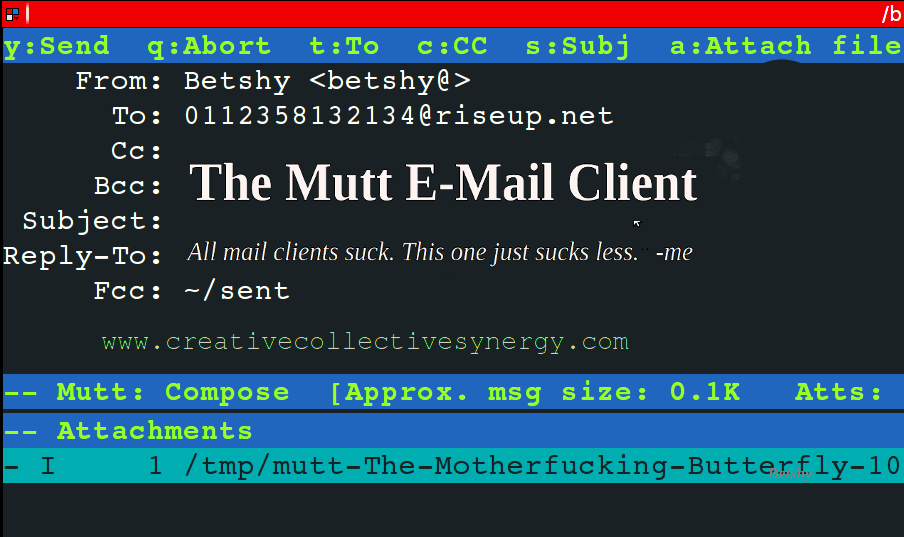
Mutt is an excellent, open-source, messaging client that functions through the Linux terminal. Many security experts are still using this because it has good PGP support, it’s fast, and can be customised to one’s taste. It isn’t recommended for those who only begin learning about command-based interfaces. There are a few things that need to be configured in the /etc/muttrc file, such as IMAP y SMTP. However, once these few things have been dealt with, it is quite easy to use to receive/send e-mail.
This is the step by step, command-line based process:
Download and install mutt.
sudo apt-get install mutt
Open the file with your preferred text-editor. I use Vim.
vim /etc/Muttrc
Create a commentary “e-mail-configuration” so it is easy to understand in the future.
#e-mail-configuration
Next, paste the following information. Make sure to replace “username@email.com”, and “password” with your real details.
# IMAP
set from         = "username@email.com"
set imap_user         = "username@email.com"
set imap_pass = "password"
set folder = "imaps://imap.gmail.com:993"
set imap_check_subscribed
# SMTP
set smtp_url = "smtp://username@smtp.email.com:587/"
set smtp_pass = "password" set spoolfile = "+INBOX"
set postponed = "+[Gmail]/Drafts" set trash = "imaps://imap.gmail.com/[Gmail]/Trash" set header_cache =~/.mutt/cache/headers set message_cachedir =~/.mutt/cache/bodies set certificate_file =~/.mutt/certificates