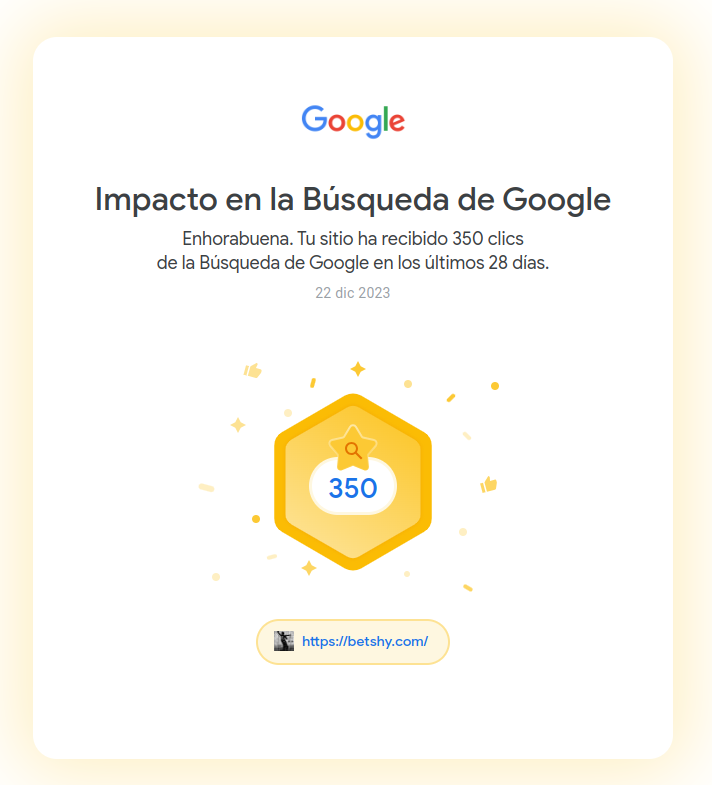
In the last couple of days, I have been spending a lot of my time assessing analytics on Google Search Console. I make a daily visit to this website to monitor how things are indexing for my blog. Recently, on the 22nd December, I achieved the following badge.
What this is saying is that 350 people had clicked my website on the Google search engine in the last 28 days. This is brilliant news and my site has been exponentially growing, which is something that makes me truly happy as I have been working super hard to ensure the search engine optimisation (SEO) is high standards and effective. I am currently attempting to increase traffic even more, and have long-term goals to achieve it.
Now, let’s answer the daily writing prompt question I selected for this journal:
My biggest challenge is to succeed in meeting the users’ needs when they conduct a search on Google, Bing, or other websites. One can only try one’s best. Another challenge is to provide such a high quality content, that other people feel like mentioning my blog in their blogs. These links would be highly appreciated, and that is so the blog can gain more authority on search engines.
Final Thoughts
I will continue to add new journals and updates about SEO as time goes by, and will continue to answer a daily writing prompt per publication. Thank you once again for supporting this blog, and I hope you enjoy reading some of the new material. Take care.
So, I’ve had such a productive week when it comes to all things related to Betshy. I’ve recorded a new podcast episode called The Dark Side of Religion, also created a video for it which is found on Youtube and on this blog.
I also have been flowing with article-writing. I must admit that I rarely include references now, so I can write daily for the sake of writing. But I am currently working on an academic article which will contain references and will be published on Academia.
It’s Betshy here, your Plymouth-based dreamer, forensic psychoanalyst, advocate, and proud autodidact, writing from my little seaside haven where the waves remind me daily that small, steady efforts create lasting change. As someone who …
Trump bombed Venezuela, killing over 40 people (including civilians); and captured President Maduro on the 3rd January, 2026. The entire world instantly had headlines about the event, and the iconic picture of Maduro blindfolded …
Hello, my wonderful community! Here I am typing away from Plymouth, my cosy corner where the sea breeze whispers encouragement. Back when I was just 16, in the distant year of 2007, I crafted …
Hello, my cherished community. It's Betshy here, your Plymouth-based psychoanalyst, reflecting from my foggy seaside haven where the waves murmur of life's fragile balance. At 35, navigating the middle age, I've pondered mortality deeply—dreaming …
I am also enjoying working with artificial intelligence in varied forms. I feel lucky to be interacting with these technological advancements because I understand that the future will be easier for those who adapt to the new mainstream elements.
Now, it’s been a while that I’ve been wanting to participate in WordPress‘ daily writing prompt activities, and I have chosen to do so in this blog post. The question asked is the following:
Yes, I can be a good judge of character, I tend to be accurate about many factors I attribute to individuals; and can often predict behaviours and outcomes. So I believe that because of how much I research psychology, I am always expanding my mental database in order to be able to comprehend much more. It is an ongoing process of knowledge and experience acquisition.
Final Thoughts
I hope you have enjoyed learning a bit about my week. I will try to do these Editor Journals more frequently so I can stay in touch with all of you who read me. Thank you for taking the time to learn from the blog posts of this website. I am glad this is the case. Take care.
I always think: ‘I will find the answers to the puzzle of my mind and life’, and instantly make mental reference to whatever is plaguing my mind or whatever it is that I am trying to achieve. After all, working out outcomes takes some logical calculations and a few decisions. The latter, however, is always the most difficult part when it comes to accuracy of predictions. This blog post will guide the reader towards unblocking the mental process of decision-making about important outcomes.
As a general rule of thumb, whenever I am trying to figure out the relationship between existing elements of reality, I ask myself one question: ‘What is my role in this outcome?’. This entails several more questions such as: ‘Do I have any influence on this outcome? Have I missed an opportunity to control this outcome?’. This is of course considering that there is an outcome which can be positive or negative, but maybe not neutral. It’s at this point that questioning what a positive outcome would be like, and equally visualising what a negative outcome would be like is a good idea. How do these polar opposite outcomes feel?
Things can get biased with mental health problems, though. For instance, post-traumatic stress (PTS) can blur important cognitive processes such as this one. This is why in order to manage the risk of bias, and to minimise the effect of reactive emotions; it is wise to introduce another question at this point: ‘how do past experiences remind me of this outcome?’. This is when a mental process of comparison takes place, with all the repercussions of reliving memories of emotional significance. Yet, if I am lucky, I tend to be able to examine the potential outcome in alignment with my true self.
I begin taking my assertions seriously, and I engage in positive affirmations knowing that in order for my honesty and integrity to survive I have to be in control of how I respond to my own thoughts and situations. I induce pragmatic thinking by considering how healthy the desired outcome is for me, and whether there is any risk of harm or loss in the process of achieving it. I then self-monitor to ensure that I am not disproportionately fixated on an outcome that does not help me align with my true self. Like this, step by step… I get closer to achieving the outcome I need, and the outcome which soothes my self-esteem and self-worth.
When I began this journey in Forensic Psychology, I did not expect to learn as much as I have. The main tenet of this career consists in understanding psychopathy, and psychopathology.
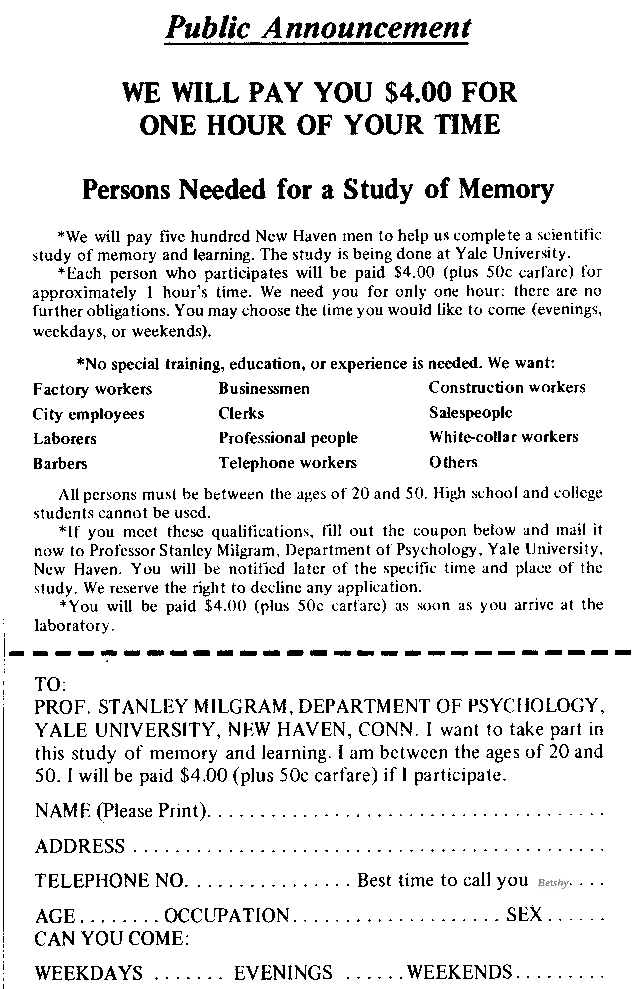
It does make me question authoritarianism and the ways in which it can manifest. For instance, Milgram and Adorno et al. studied the psychology of obedience under pressure, and how following orders led to the holocaust. An aspect that has been questioned little is how scarcity or the fear of scarcity has led to similar phenomena due to how people have been conditioned to see money as an enabler of everyday behaviour. For instance, when Milgram conducted his obedience experiments during the 60s, he monetarily rewarded his participants for taking part in the studies. Modern psychologists have attempted to re-examine the dynamics at Yale’s laboratory and what might have led the participants to show that they were capable of being sadistic under such conditions. An example is Gibson’s (2013) work which meticulously examines the prods given by the experimenter. In a way, Gibson seeked to understand how the orders and requests given by the authority figure contributed to the decision-making processes of the participants. However, I have not come across much research highlighting the role of the monetary incentive in everyday behaviour; or how being given a monetary incentive places a subconscious obligation on individuals to comply with requests, even if such requests at times make them feel uncomfortable.
The c/s/x movement, also known as ‘the psychiatric survivors movement‘ (Wikipedia, n.d.) explores how a large number of individuals report feeling or having felt dehumanised by the mental health system. For the unstigmatised person, it is often more common to assume that all these people expressing dissatisfaction with the system are crazy, than to understand the nature of what it means to respect a person’s dignity and human rights. It is quite a complex situation, because it is unclear what reinforces and keeps some mental health settings from actively listening to their patients’ concerns.
According to Turner (2015), signal detection theory (SDT) “describes processes whereby information that is important to the perceiver (known as the ‘signal’) is distinguished from other information that is unimportant and potentially distracting (known as the ‘noise’). It is my hypothesis that some of the inherently dehumanising behaviours occurring in the mental health system happen as a result of the hyper-normalisation of object-relations with patients. As I mentioned on my post ‘Investigating the neuropsychopathologyof prejudice‘, people can at times perceive those with stereotyped and stigmatised characteristics as non-human objects. This would of course increase the chance of mental health settings staff processing signals coming from clients as background noise, rather than as worth-listening-to human signals. Such established conscious and unconscious behaviours leading to the dehumanisation of many clients are reinforced through monetary incentives, and through an intragroup, mob-like co-validation of such unconscious biases. Like Eichmann, many live their lives constantly affirming to themselves that they were just following procedures and orders, or just doing their job; and therefore they believe it is not their responsibility to reflect on how clients are impacted by this. But the signals coming from mental health patients often stand in stark contrast to the common belief that these dehumanising, and at times non-empathic methods are appropriate, or even de facto acceptable.
I do think everyone deserves to be paid for their labour, and that having access to a basic form of income is an important foundation in any society; and I also think that mental health settings need to be encouraged or trained appropriately to detect clients’ signals as more than just background noise (i.e. as more than non-human objects signals) in order to reduce risk outcomes. The situation is problematic, persistent, and pervasive with these manifestations of authoritarianism in mental health settings. It would indeed be arrogant to assume that all the patients/clients expressing dissatisfaction with the service are wrong, or to culturally pathologise reasonable dissent. It would also be irresponsible and de jure unacceptable to fail to take steps towards alleviating feelings of ‘being dehumanised’ in civil society, especially if such feelings of dehumanisation have the potential to lead to never events, such as suicide.
Turner, J. (2015) ‘Making sense of the world’, in Turner, J. and Barker, M. J. (eds) Living Psychology: From the Everyday to the Extraordinary, Milton Keynes, The Open University, pp. 7-45.
Blogs are a great way to express your voice. Even if your experiences have made you feel silent, oppressed, and unfairly treated at an intergroup relational context; you can still assert your thoughts, feelings and opinions in the online community. This way, blogging can be a method for cognitive-emotional democratic healing at both individual and collective levels.
Why is expressing your voice important?
Actions and reactions happen at inter and intra group levels for many reasons. Sometimes communicating our perspective helps elucidate a particular situation. So for instance, if you feel that some members of your social milieu have displayed hostility towards you as a result of the hostility that they themselves have been subjected to, you might be correct in assuming that such a hostility might have become hypernormalised at the group’s cultural level, and that such members are experiencing reactive-formative symptoms of trauma. For the minority individual, the experience of being let down, or rejected by a group, culture, system, or apparatus can be debilitating (i.e. it can feel like mob behaviour), and when this happens for a prolonged period of time; it can create feelings of marginalised frustration. Blogging is a good way to use your freedom of speech in a way that directly addresses the public audience, whilst simultaneously being an interpersonal method for expression.
The risk is to stay silent.
Setting up a blog
There are different ways in which you can begin your blog. The most common problem I hear when I speak with people about blogging is ‘I do not not what to say. I would not know where to start’. My answer is that such is precisely the way to start a blog. You do not need to know what to write about in order to express that you do not know what to write about. Sometimes it could be sharing your professional work. Other times it could just be about sharing an experience you went through. I tend to shift between these modes. Most of the time, I share some of my thoughts, feelings, and add something interesting that I have been researching about. Regardless of what your needs for expression are, blogging is an effective method for online communication and an interdisciplinary style for socialisation. But, what blog to use?
Choosing a blogging platform
Different people will prefer different types of blogs for their journalism depending on how much time or effort they wish to invest in the endeavour. Here are a few options:
Blogger: A very simple and generic user experience design for expressing thoughts. It has an archive of dates which store your thoughts across time. The interface is easy to learn, and it is free of charge. It is ideal for those only getting started in cybercultural activities.
Google Sites: This platform truly is flexible in terms of allowing the user to experience freedom in how to structure their pages. It is useful for creative projects and for getting started with digital design. It lacks an automatic blogging archive, so if what you are looking for is a place to log your thoughts, Blogger is a better option. All you need is a Google account.
WordPress: This blog (as you can see at the bottom of the page) is powered by WordPress. The reason why I personally prefer this platform is because it gives me a wide margin of flexibility when it comes to design, as well as simultaneously having an archive for blog posts which permits organization.
Medium: For those who do not wish to either hassle neither with the design nor with the other technicalities, Medium allows people to register and write. It is a community project, meaning that people from all walks of life contribute to the discussion.
Lately I have slept better. Taking Zopiclone has helped me sleep through any kind of disturbance. Consequently, my mental health feels more in balance, and I have been able to once again concentrate on my research. I still feel a deep sense of injustice, but the things I research about give me hope for a better future.
As usual, I have been studying a lot. The books I am currently reading are really interesting. One of the chapters I am currently working on (Dixon, 2015) for university speaks about the neuropsychopathology of social cognition, and how prejudice can result from an institutionalised (i.e. culturally conditioned) context, becoming predetermined emotional responses. One of the excerpts that has mostly sounded relevant to my independent research on cultural narcissism is the following:
‘In a series of studies, using similar kinds of photographic stimuli and fMRI technology, Harris and Fiske (e.g. 2006) found that certain social groups do not produce the neurological signature of person perception. Instead, these groups are processed mainly by areas of the brain more associated with the perception of non-human objects; i.e. they are literally treated, neurologically, as though they were not, fully, fellow human beings. This reaction is worrying because the ‘dehumanisation’ of others has been associated with extreme expressions of prejudice (e.g. the willingness to torture, rape or murder other people)’ .
John Dixon (2015, p. 150)
Now, this object-relational evidence of prejudice and how it leads to the neurologically-based, inherent dehumanisation of those who are considered as out-groups (e.g. Here in the UK, those who are protected by the Equality Act 2010) is consistent with the narcissistic approach to relationships. The idea that simply categorising an individual as an outgroup is enough to attribute characteristics to them that are not humane is truly concerning. Now, combining this with the corporate-narcissistic agenda is essential for social change. It links up to the book I am currently reading about corporate psychopathy:
“While individual lapses in judgement may garner attention in many cases, the ability of psychopaths to cover or explain away their individual decisions makes evidence of these lapses difficult to obtain. Rather, it is the long-term impact of their behaviours in a variety of situations and their dealings with a variety of people that shed more light on who they really are”.
Robert Hare and Paul Babiak (2006, p. 248).
Based on the above, I begin wondering just how deep the neuropsychopathology of tyranny is. That is, what are the common excuses the general corporate narcissist uses to justify violations of human rights? Has the corporate narcissist been made through institutionalised behavioural conditioning which is partially reinforced by unconscious dogmatic-authoritarian beliefs? I suppose this is where forensic psychology as a science collaborates with occupational psychology, social psychology, and educational psychology to uncover these answers.
References
Dixon, J. (2015) ‘Why don’t we like one another? The psychology of prejudice and intergroup relations’, in Capdevila, R., Dixon, J., and Briggs, G. (eds) Investigating Psychology 2: From Social to Cognitive, Milton Keynes, The Open University, pp. 133-178.
Hare, D. R. and Babiak, P. (2006) Snakes in Suits: When Psychopaths Go to Work, New York, HarperCollins.
What a day. Today my blog was saved (thank you, Juan!) after it was hacked and taken down following two articles I wrote which now I am nervous to publish after that. I’m currently reading several books at once and sometimes feel so devastated to realise some barbarities about the world around me. But having my blog back is so comforting, and so I have another reason to continue surviving all these difficult situations, yay!
In the meantime, I started a channel on Medium where I might journal now and then. You can read my post Thriving Against Oppression Now there where I speak about what it has felt like lately for me to go through a lot of problems. I will be reviewing and republishing the commentary articles I had published prior to the hack attack within the next few days. I am currently so busy with my studies that I have to spend more time inputting than outputting information. But I will try to retake a more informal and more frequent blogging style, because I feel it is certainly therapeutic to blog.
Also, in response to some commentary as to whether I have conditioned myself into these situational factors, the answer is that there are some unconditional, natural elements when it comes to the good side (writing, blogging, studying); and some conditioned elements that have been institutionalised (e.g. verbiage and time-keeping). It is difficult with psychology, you know. Specially when there are incentives, rewards, and negative reinforcement schemes in many of the contexts of practice. But there are factors of situations which are outside my locus of control, yet I get through, thriving on the roller-coaster life.