
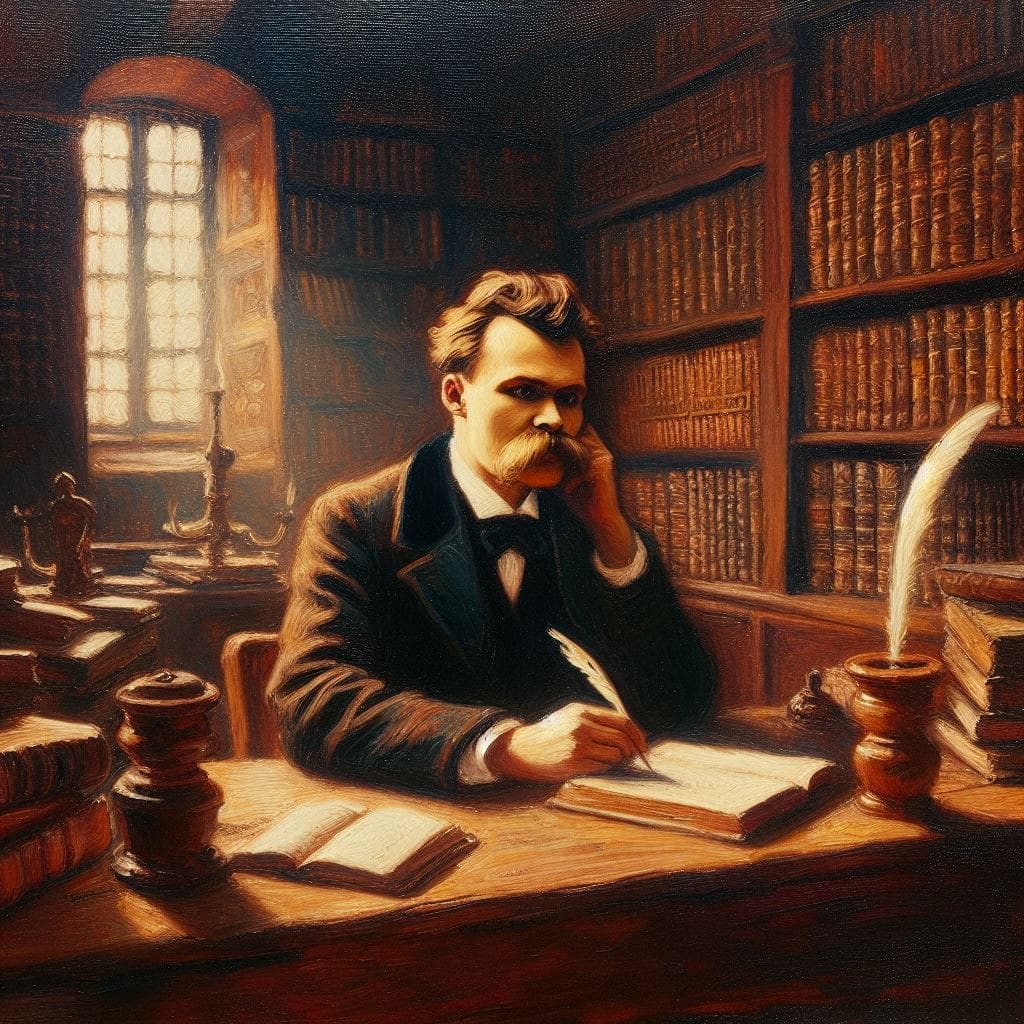
Friedrich Nietzsche is one of the most influential and controversial philosophers in the history of Western thought. His ideas have had a profound impact on a wide range of disciplines, from philosophy and psychology to literature and art. Nietzsche’s work is marked by its critique of traditional morality and religion, its emphasis on individualism and self-overcoming, and its exploration of the nature of power and truth.
One of the key concepts in Nietzsche’s philosophy is the idea of the “will to power.” For Nietzsche, all living beings are driven by a fundamental desire to assert their power and influence over their environment. This drive is not necessarily a conscious one, but rather a basic instinct that motivates all of our actions and decisions. Nietzsche believed that society and culture often suppress this will to power, leading to a sense of alienation and nihilism in individuals.
Nietzsche also famously proclaimed the idea of the “Ubermensch,” or “Overman.” The Ubermensch is a hypothetical individual who has transcended conventional morality and societal norms, and has created his own values based on his own will to power. The Ubermensch is a figure of self-overcoming and self-realisation, who is able to embrace the chaos and uncertainty of existence without succumbing to despair or resentment.
Another central concept in Nietzsche’s work is the idea of “eternal recurrence.” Nietzsche posited the theory that time is infinite and cyclical, and that all events and experiences will repeat themselves endlessly. This concept serves as a challenge to individuals to live their lives in a way that they would be willing to repeat them again and again, embracing both the joys and sorrows of existence.
Nietzsche’s philosophy is often misunderstood and misinterpreted, in part due to his provocative and often ambiguous writing style. However, his ideas continue to resonate with readers and thinkers alike, as they grapple with questions of meaning, morality, and human nature. Nietzsche’s work remains a touchstone for those interested in exploring the complexities of the human condition and seeking to live authentically in a world that often seems chaotic and uncertain.