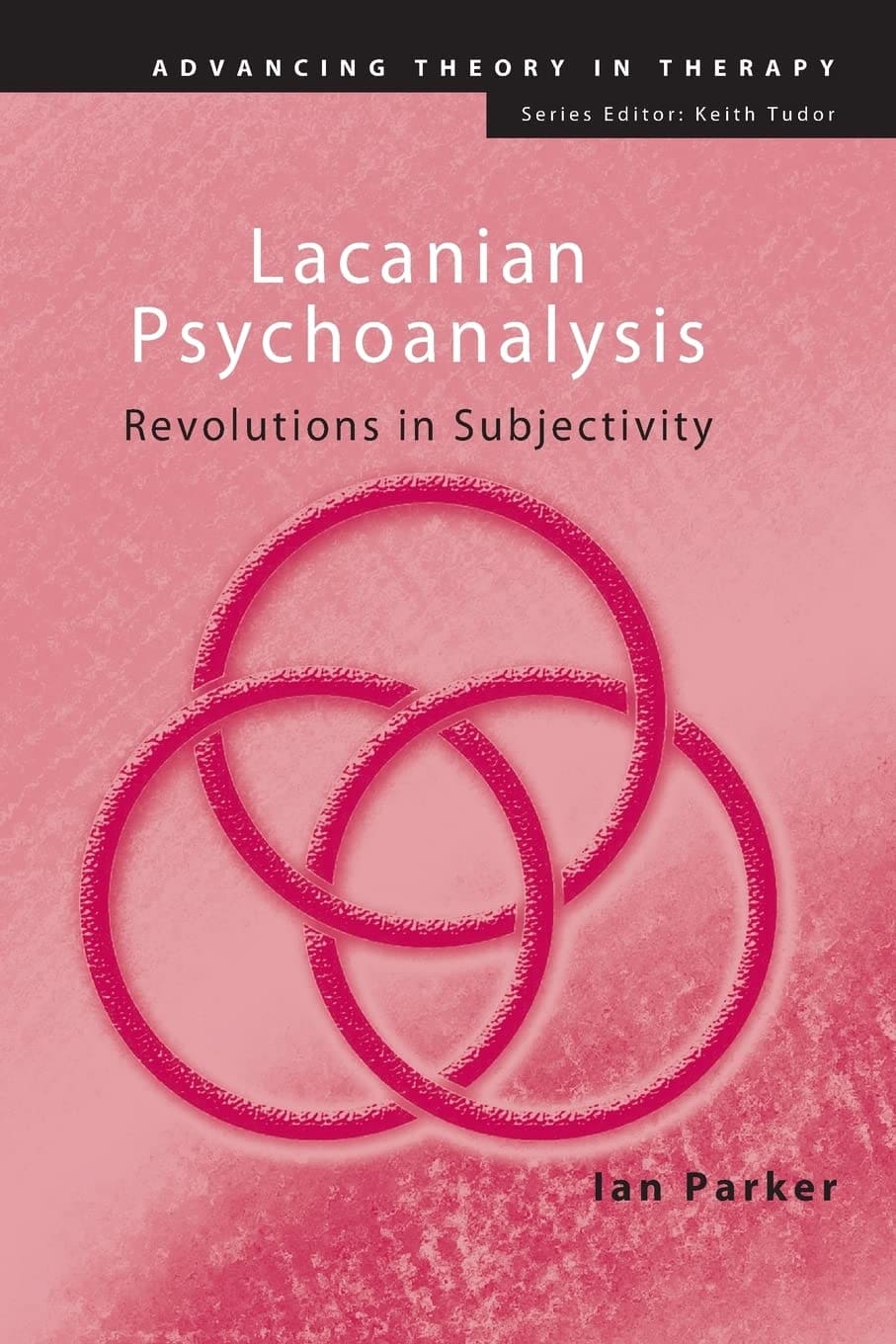

Psychoanalysis as a field has undergone various transformations since its inception with Freud’s groundbreaking work. Among the various schools of thought within psychoanalysis, the Lacanian approach has gained significant attention for its unique interpretation of human psyche. Developed by the French psychoanalyst Jacques Lacan, Lacanian psychoanalysis offers a thought-provoking perspective on the subconscious and its impact on human behaviour. This is why I decided to read the Book by Parker (2011) Lacanian Psychoanalysis: Revolutions in Subjectivity.
Parker (2011) makes Lacanians sound alien in the way he describes them and compares them to other forms of psychoanalysts. He describes them somewhat as mystical standard deviations. Furthermore, Parker (2011) explains how society psychiatrises, psychologises, and psychotherapeutises things in general. He also makes a clear distinction between all of these psych sciences and psychoanalysis; as well as between general psychoanalysis and Lacanian psychoanalysis.
Moreover, he attempted to draw a relationship between psychoanalysis and politics, although that relationship was not made as clear as one would have expected which to some extent reinforces the outdated idea that psychoanalysis does not go well with politics, a perspective also mentioned in the book. It was precisely his obsessive focus on the psychoanalytical relationship that made it most difficult to touch base with politics.
Finally, he also deconstructed the relation between analyst and analysand, the roles of signifiers in psychoanalytical interpretation, and how such signification has an effect on the dynamics of transference. It is my opinion that he could have used simpler language to reach a wider audience, and could have briefly explained some of these concepts which might be new to analysands, for example.
Key Concepts of the Book
The Mirror Stage: Lacan posits that infants, between six and eighteen months, experience a critical stage in their development. During this period, when an infant encounters their reflection in a mirror or any other reflective surface, they construct an ego or self-image that is unified and coherent.
The Unconscious and Language: For Lacan, the unconscious is structured like a language, operating beyond our conscious awareness. Through symbols and signifiers, individual desires and drives emerge, often conflicting with societal norms and expectations.
The Phallus and Lack: The phallus represents not only the male sexual organ but also functions as a broader symbol of desire and lack. In Lacan’s view, the phallus is a symbolic representation of power, authority, and object of desire. All individuals, regardless of gender, experience a sense of lack and desire rooted in the absence of the phallus. Such a lack fuels our ongoing quest for fulfilment and drives the complexities of human relationships.
The Role of Therapy: Therapy in the Lacanian tradition involves a distinct approach, departing from traditional psychoanalysis. Unlike Freudian techniques that emphasise free association and dream analysis, Lacanian therapy focuses on linguistic analysis and attempts to unravel the unconscious desires hidden within language.
Favourite Quotes from The Book
- “While the unconscious is structured by thing presentations – images, impressions, sensations – consciousness combines the two kinds of representation, and so the process of speaking of something brings it into language and into consciousness. There is therefore an intimation of the ‘truth’ of the subject before it is put into words, but it is not nearly fully-formed enough and available for the subject to articulate as such” (Parker, 2011, p. 27)
- “Under capitalism we are necessarily falsely-conscious about the world and our place in it precisely because that consciousness of the world is actually a fairly accurate way of mapping and moving about the symbolic now (Sohn-Rethel 1978; Zizek 1989)” (Parker, 2011, p. 42)
Conclusion
The book by Parker (2011) shows that a Lacanian approach to psychoanalysis offers a unique perspective on the complexities of the human psyche. From the mirror stage to the phallus and the role of language, Lacanian theory sheds light on the power of symbols, language, and unconscious desires in shaping our experiences and relationships. Understanding these concepts can provide individuals with valuable insights into their own psyche and potentially foster personal growth and transformation. Whether one is a psychoanalysis enthusiast or simply curious about the intricacies of the human mind, exploring Lacanian theory can be an intellectually stimulating and thought-provoking journey.
Reference
Parker, I. (2011) Lacanian Psychoanalysis: Revolutions in Subjectivity, New York, Routledge.
Share this:

You Might Also Enjoy Reading